The Influence of People in Your Life

Influence – to affect or change how someone or something develops, behaves, or thinks. (Cambridge Dictionary)

We are in the information era; however, I think we are a bit further along than that. We are in the influence era. Although we have always been influenced by others, whether family, friends, education, marketing, politics, religion … it is now when “influencers” are found everywhere, at every level of society, and even recognized as an occupation, that is, thanks to the development of the internet, and with it, social media venues. However, artificial intelligence is adding another layer to this era of influence, and this is only the beginning. I think that all markets will be changed by this in a significant way. In my opinion, we are entering a new era.

Aside from this, we have always been influenced by something or someone, directly or indirectly. The adage, “Birds of a feather flock (fly) together”, speaks of this influence. Who we allow in our close circle, whether we realize it or not, will influence us in a positive or negative way. Even when we think that we are strong enough to remain neutral in our relationships, there is always a part that is influenced by the other person(s). Sometimes, by the time we realize the type, depth, and degree of such influential forces, some damage has been done. Whom we have listened to, walk with, and entertained in life, those influences, have molded some of our responses/decisions, and views in life. Sometimes, an influential relationship will be beneficial, other times, the opposite, and years of such relationship(s) will affect, change, our development. It is usually after a long period of time that we begin to realize how a particular relationship influenced our outlook and behavior as well, and down the road, many of the results we observe in life due to choices we have made. This is not to blame others for our own choices, but to recognize the power of influences in our daily living. I have heard many times that “you become who you befriend.” You can develop a positive outlook or a “poor and doom” mentality. The other day, I was listening to someone talk, and every other word was can’t, never … words along those lines. I understood what was being said behind the scenes.

We are social beings, we tend to form groups, and we have a basic need for belonging. How that need is filled is up to us, as adults, that is. When I watch the news, and I see so much turmoil, hate, irrational behavior, verbal and physical attacks, and other less than civilized behavior, I see “influence” at play. When there is extreme polarity, taking sides becomes harder for the observer. The least of two evils might not be enough. Values are there for a reason, a sort of compass, but those values are subject to influences throughout our life. White or black might not be enough, and gray seems a forced compromise sometimes.

Blaming others (influencers) for our choices is denying personal responsibility and eventually, hindering our growth as human beings; it diminishes our humanity, and in a way, our ability to recognize influential forces in our lives, including our own. We reject our free-will, our most precious gift and essence.

What Am I Reading Now?

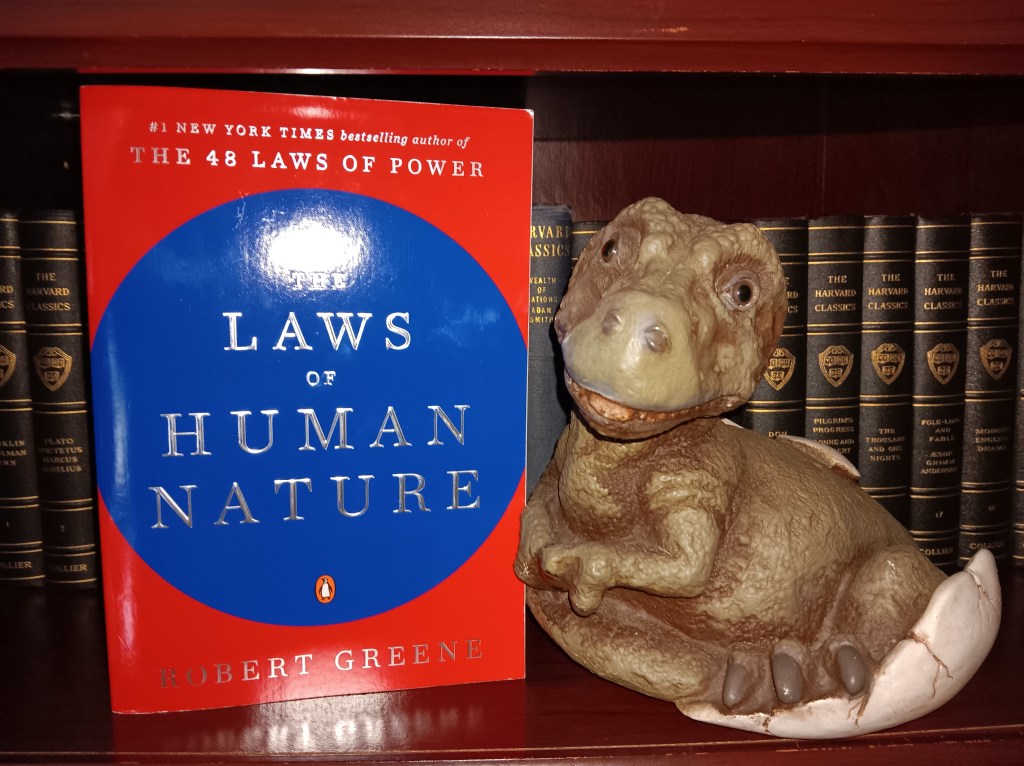
Herbert presents, The Laws of Human Nature by Robert Greene (Photo by M.A.D.)

This was a lovely surprise, a gift from my nephew on my birthday. The Laws of Human Nature by Robert Greene is about the understanding of human behavior but from a historical perspective, with examples throughout history. The bestselling author explains basic human nature behavior through historical examples in order to teach you how to apply decoding the same behavior today, in others and in yourself, and how to better understand and get a hold of your emotions once you understand this behavior, as well as become more understanding of others, thus improving your relationships.

So far, I am enjoying this book immensely; so far, a good read for sure.

Whispering Trees

When I moved to the old farmhouse I had already come up with a name for it; I called it Mill Creek Little Trees. The name came to me after thinking of all the little pine trees that grew freely on the property when I first saw it – abandoned, dilapidated, and covered in wild vines and overgrown trees and bushes. In just a few years, and by the time we moved in, they had grown very large and beautiful. I am glad we let them be. Not long ago I was walking outside, and a gentle breeze made its way through the trees. It caught my attention because it seemed as if the trees were whispering, as if nature was having a soft conversation. I felt at peace. It occurred to me that a better name would have been Whispering Pines. I have loved pine trees since I was a child, any type of pine tree. It is synonym of joy, at least for me.

I am convinced that nature’s purpose is to provide peace, joy, solace, and inspiration when humans need it most. It is balance to our lives, and we naturally gravitate to it. Even in the busiest cities, people find a way to commune with nature, whether it is by visiting a park, placing a few potted plants on a window sill, or enjoying the company of a pet. Nature is a stabilizer to our human chaos. It gives us life, literally. We are part of nature but we tend to feel separate from it, as observers. I’ve asked myself if that is just human perception because when I observe animals they seem to flow with the rest of nature, and at peace with it. Our species must harness, conquer, possess, and subdue, and for some reason, it doesn’t feel as a natural flow as with other species; it seems forceful in some way.

The theme of human redemption appears on my novels and I am considering a novel with a stronger approach to the duality of our human nature. Not so much about good vs evil but more about the ambivalence of our fragile/strong soul. I am not a hundred percent sure yet but it seems more likely the more I think about it. For now it is just an idea, a whispering thought.

The Tree of Life

Sometime ago, my husband and I were sitting on the porch conversing and looking at our new surroundings. He said, “Trees are funny.” I asked, “How come?” He answered, “They go around each other and bend around to continue.”

I looked at the trees he was talking about and I was mesmerized by what I saw. Many branches giving way to other branches of other trees, twisting and bending just right so there was room for every tree to continue to grow and expand. Unlike ivy, climbers, and other plants and bushes that choke one another to overpower and survive. I said to my husband, “We humans should be more like trees.” He smiled.

Simplicity

Simplicity – The quality or condition of being simple.

Simple – Easily understood or done. Plain and basic or uncomplicated in form, nature, or design.  (Oxford English Dictionary)


Over the past few years my quest have been to embrace simplicity. It seems that it may be part of human nature to make things less simple. We take something basic and we build or design other things around it, whether material or non-tangible such as rituals, ceremonies, celebration, protocols, and so on. We are embellishers by nature. We may become obscure, and sometimes obtuse, for the sake of completion, in our search for becoming whole. We attach rituals and a series of steps to spirituality, and even tools and other gadgets to complete the package.

Many times, all the preliminary stuff diminishes the joy and meaning of our intention and makes our target feel farther than it is. Why do we do this to ourselves? Is it in the name of wholeness, greatness, status, or self-preservation? Is it the nature of being, and therefore inescapable? Of having the experience in the material and the spiritual? Our entire civilization, society, speaks of it. We have taken the concept of shelter or the basic need of eating, for example, and built around it. Hence all the gadgets and toys we enjoy, the mansions, the fine cuisine, and all the emotions and meaning that we attach to these things. Even in the search for simplicity we overdo or complicate things – meditation groups and techniques, lists and journals, gadgets, rituals … .

Do we go back to find simplicity because we had enough or because we lost that part of us, the sense of it? Is it because without it we do not feel whole? At any point of our lives we may try to return to it, and the quest begins (sometimes with all the bells and whistles that we may attach to it). Is it the beginning or the end? Or a circle, a cycle of life?

This post is an example on how to take a simple concept and make it complicated.