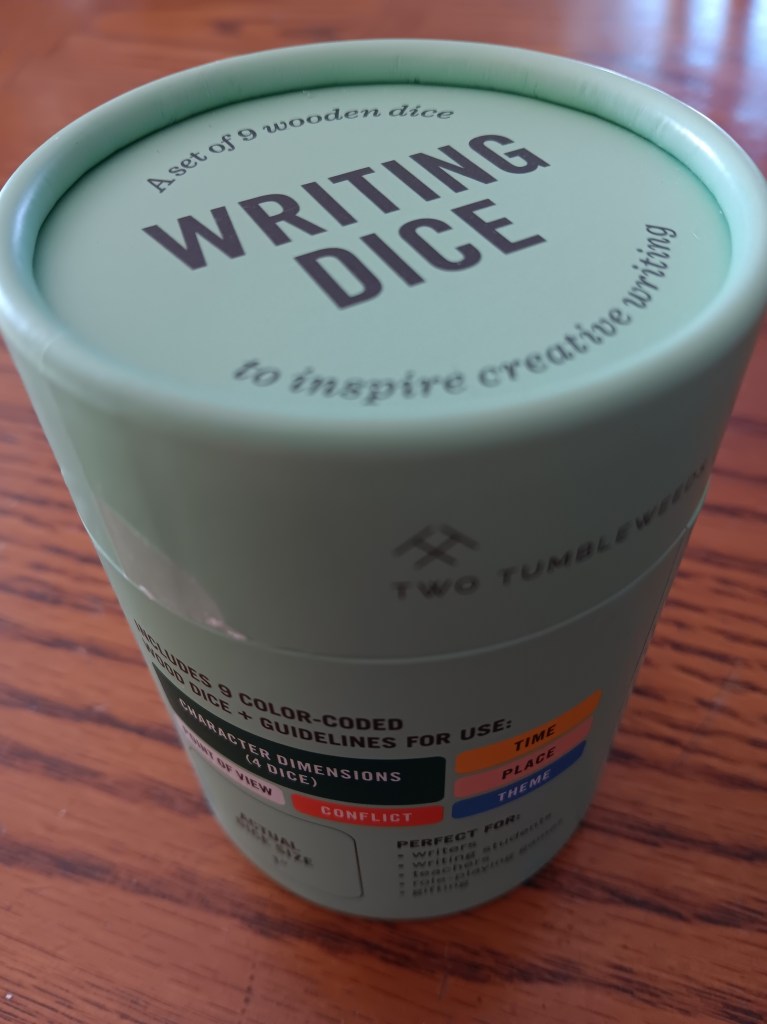
I had never heard of writing dice. One of my lovely nieces gifted me with this interesting writing prop. It looks fun and certainly has the potential to spark creativity. It is a series of color-coded dice with words/categories written on the dice. The way it works is by throwing the dice and creating a story with the words/categories obtained. Each color means something, for example, yellow represents time/place, white is point of view, and so on. Here’s what it looks like.
Photo by M.A.D.Photo by M.A.D.
If I was to apply the example of dice in the picture to my first novel, Moonlit Valley*, it would be like this: written from the protagonist point of view (Rose Carrigan)(white dice), who is very witty (green dice), and taking place in a small rural town (Moonlit Valley)(pink dice); she is presented with an unexpected destiny, that challenges her identity (blue dice), as well as everything she thought she knew about her husband (yellow dice), in a supernatural twist of fate (orange dice). Now the funny thing is those were the dice (in the picture) that came out at my first try. Made me smile for sure. What a fun writing prop.
*You can find Moonlit Valley on Amazon, in eBook and printed format.
The first month of a new year is when many people look for motivation in order to set new goals and have a “fresh start.” Although goal setting is a healthy practice, when we do not feel motivated enough, this practice might seem daunting or even hopeless. What motivates us?
Motivation – To stir to action; provide with a motive. (American Heritage Dictionary)
Enthusiasm for doing something; the need or reason for doing something; willingness to do something, or something that causes such willingness. (Cambridge Dictionary)
Both definitions above point to a need, a reason, a motive, to create the enthusiasm to move into action. In other words, without motive there is no action. What motivates us? What stirs the hope that causes us to set goals and a plan? Sometimes, we confuse our goal with our why, or vice versa, and sometimes we focus so much on the reason or the goal that we miss an important point – that we are a system, and everything is a system that interrelates.
It is no wonder then, that we feel defeated, tired, and guilty when we fail to perform, or we do not achieve our goals. We blame and chastise ourselves and we end up feeling defeated, sad, depressed… When we see and realize the complexity and beauty of our being, it becomes harder for us to be so harsh with ourselves and with others, but also, we learn to view ourselves and others with kindness, but most important, as a part of everything else. It is with this new vision that we can find the motivation to dream again, to desire again, to strive and understand the why that will determine the goals that we want to achieve. Suddenly, the why and the goals are just a small part of a bigger existence.
“I will praise You, for I am fearfully and wonderfully made; marvelous are Your works, and that my soul knows very well.” Psalm 139:14
I have to become before I become. As I wrote a few things that I want to accomplish this year, the thought crossed my mind. I may develop a detail plan, but it truly does not mean anything unless I start modeling behavior, acting as the person I want to become in order to achieve the target goal. I have to become, in my mind and in my doing, the person I want to eventually become. To illustrate, I will use a simple example, a common goal that most people set – to save x amount of money by a certain day. In order to do that, I have to act as a saver. I have to become/model the behavior of a saver, a person who saves money. I have to act/be what I want to become in order to achieve what I want to achieve. That is just a simple example, but depending on how many layers a goal might have, that will determine how many identities I might have to assume in order to make it real.
As a writer, writing characters, identities, personality traits … become second nature. Eventually, by repeating a specific behavior that is required to achieve a specific result/outcome will become second nature as well. Just as a character grows and develops throughout the pages of a story, so do we, when we model what we want to become. With each layer, each modeled behavior, we grow from one initial step to the next, and so on, just as a character grows/evolves from chapter to chapter or a series.
Depending on the complexity of a goal, that is how many identities one might have to assume. Going back to the example of saving money, I will evolve it to a few more layers, let’s say, saving x amount (first layer) to pay debt (second layer) in order to build wealth (third layer) for a safer future (fourth layer). There are a few layers on this financial goal.
Goal layers – Identity/behavior
Saving money = Saver
Debt free = Frugal person/conscientious of spending
Build wealth = Spend less than you earn/Financially literate
Safer future = Wealth manager/manage money wisely
In each level of progress, a new identity emerges that the previous identity will support; it all interrelates and works together, but without “acting out the part,” without becoming or modeling the appropriate behavior, nothing will happen. Many times, we become overwhelmed by looking at the outcome first, but in reality, it is much manageable and real when we just look at the first step/ the first behavior, and let it evolve from there.
“And do not be conformed to this world, but be transformed by the renewing of your mind, that you may prove what is that good and acceptable and perfect will of God.” Romans 12:2 (NKJV)
“And have put on the new man who is renewed in knowledge according to the image of Him who created him.” Colossians 3:10 (NKJV)
A new year represents a fresh start for many of us. We evaluate the previous year, check a few boxes, and set new goals. Sometimes, we are disappointed because we did not accomplish as much as we wanted to in the previous year; other times, we are satisfied with our performance. For others, it represents a challenge because they can already identify the areas of struggle ahead.
Whether dread or inspiration, when we look at the new year, one thing that we can always count on is hope. Hope for a better year. Each day represents a blank canvas. We might have to deal with a few smudges here and there, but as long as we keep hope we can paint a new picture or add some color to the one we are painting.
When we feel hopeless it is as if we are covered in darkness. One cannot see the light; one cannot see the colors. Setting goals and planning is good; however, there are times when despite careful planning and hard work, things don’t go our way, or at first glance they don’t seem to go as expected. Add to that a few years of hard work, determination and no results, and it can break your spirit, and burn you out. If you have experienced it, you know well what I mean.
At one point or another, we all will experience setbacks, disappointments, heartache, hopelessness, and brokenness, to various degrees. It is how we view/react during those times that will determine our comeback and the length of time we stay in the shadows.
“I sought the Lord and He answered me; He delivered me from all my fears.” Psalm 34:4
It is good to set goals and to plan. To get somewhere there must be a destination and a map.
“Commit your works to the Lord, and your plans will be established.” Proverbs 16:3


 Inkspeare