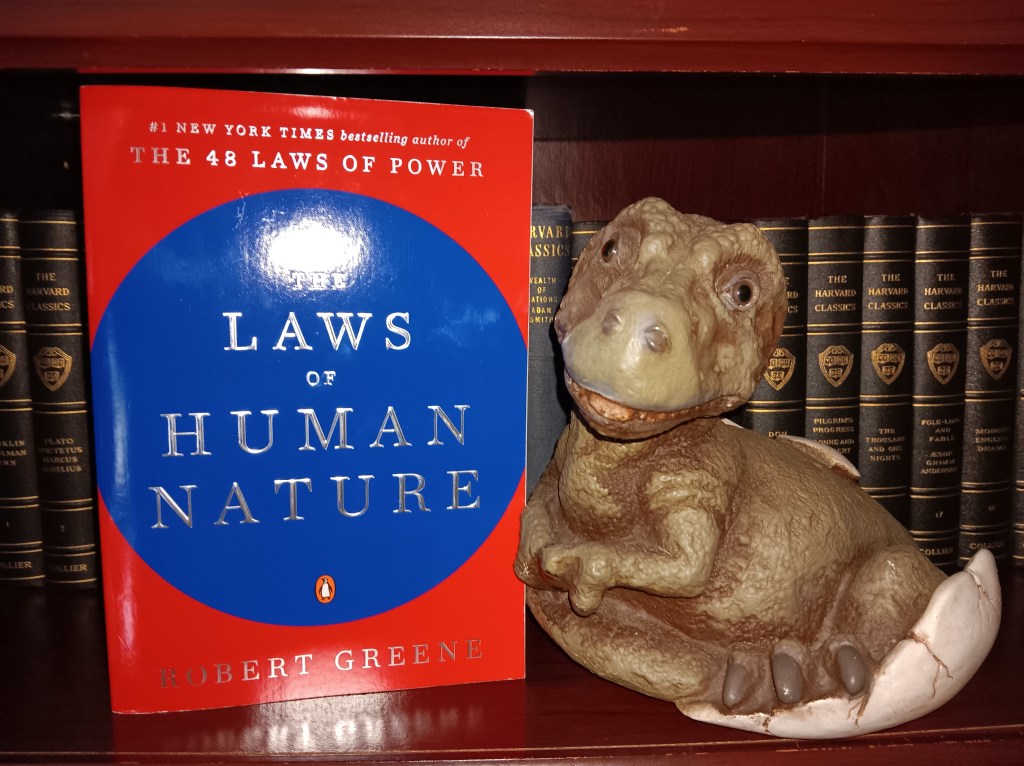
Herbert presents, The Laws of Human Nature by Robert Greene (Photo by M.A.D.)
This was a lovely surprise, a gift from my nephew on my birthday. The Laws of Human Nature by Robert Greene is about the understanding of human behavior but from a historical perspective, with examples throughout history. The bestselling author explains basic human nature behavior through historical examples in order to teach you how to apply decoding the same behavior today, in others and in yourself, and how to better understand and get a hold of your emotions once you understand this behavior, as well as become more understanding of others, thus improving your relationships.
So far, I am enjoying this book immensely; so far, a good read for sure.
While I was rereading The Royal Path of Life by T.L. Haines A.M./L.W. YaggyM.S., it occurred to me that there were many words that we don’t see much in books today. Many of them I understood by just rereading the sentence and focusing on the context, but other words I had to look up. This aroused my curiosity, and I thought it would be a good idea to share some of these words and the meaning in a series of posts.
The Royal Path of Life was written in 1876; I own a revised edition (1884). What I love about this book besides the engraved leather binding, gilded title, and gorgeous woodcuts illustrations is the common sense and wisdom found throughout its pages which bleed of the way of living of the times. Here are six words I found interesting. Many words today are derivatives, and many of these old words are obsolete.
From Merriam-Webster and OED
Macademize – To construct or finish (a road) by compacting into a solid mass a layer of small broken stone on a convex well-drained roadbed and using a binder. First known use 1823. Used after John Louden McAdam (1756-1836), civil engineer, pioneer of this method.
Bespattered (bespatter) – Spatter. Synonyms – dash, spatter, splatter, plash, splash. First known use in 1602. I could not find the etymology of this word.
Bedimmed (bedim) – To make less bright. To make indistinct. First known use 1565. From dim, Germanic, Old English.
Trifles (trifle) – Something of little value, substance, or importance. First known use 14th century. Middle English period. From Anglo French.
Irksome – Tedious. First known use 15th century. Formed within English by derivation.
Timorous – Of a timid disposition. Fearful. First known use 15th century. Middle English. From Medieval Latin (timorous), from Latin (timor).
Some of these words, one can make up the meaning, especially when they are close to Latin or Spanish (if you speak the language), for example, timorous. I hope you enjoyed these interesting words.
I love to collect antique books (and writing instruments). There is some magic about these tomes. Although none of mine have great monetary value, these tomes are valuable to me. Whether for its old-fashion wisdom, their depiction of a long-gone era, rich in the culture of the time, or the way these look (material, colors, patterns used in their making …), these books are a delight for me, a gift to my senses.
While I was rereading The Royal Path of Life by T.L. Haines A.M./L.W. YaggyM.S., it occurred to me that there were many words that we don’t see much in books today. Many of them I understood by just rereading the sentence and focusing on the context, but other words I had to look up. This aroused my curiosity, and I thought it would be a good idea to share some of these words and the meaning in a series of posts.
The Royal Path of Life was written in 1876; I own a revised edition (1884). What I love about this book besides the engraved leather binding, gilded title, and gorgeous woodcuts illustrations is the common sense and wisdom found throughout its pages which bleed of the way of living of the times. Here are five words I found interesting. Many words today are derivatives, and many of these old words are obsolete.
Sundered – to break apart or in two: separate by or as if by violence or by intervening time or space. (Merriam-Webster). Earliest known use: old English period, pre-1150. (from OED)
Cynosure – One that serves to direct or guide. A center of attraction or attention. (Merriam-Webster). Its origins are Greek, and it passed into Latin, later French, then to English. Earliest known use was in the late 1500s (OED).
Sire – Father, male ancestor, a man of rank and authority. (Merriam- Webster). From the old English pre-1150. Inherited from Germanic. Last recorded in the 1500. It is obsolete. (OED)
Sinews – I only found the word sinew, what seems to be a derivative. It means solid resilient strength, power. (Merriam-Webster). The earliest known use, early 1500. From the old English, pre-1150.
Boon – A timely benefit: blessing. Benefit favor. Favorable (archaic meaning). (Merriam-Webster). From the earliest Middle English period (1150-1500), A borrowing from the Scandinavian. (OED).
Even if we never use these words again, it is a good mental exercise, and entertaining as well. Hope you enjoy reading about these old words. Does anybody say commode anymore?
Finding my way back to my book in progress, The Girl Who Could Not Love, hasn’t been easy. I stopped. I tried. I stopped once more. I had to put it aside for some time despite wanting to continue writing it. Something was not right. It lay dormant, and eventually, I knew I had to come back to it. It has been on my mind all this time, morning, night, and in between; however, distant, but calling me. It is the book that begs to be written to a hesitant writer that has finally surrender to it. Whether to answer the call or not, is not important anymore; it is why. Why is this story haunting me? Why the fight between pen and heart? Why do I want to write this story? Why won’t the story quit? Why won’t I quit?
While reading Never Too Late (or was it Shine On? I read them back-to-back) by Claire Cook, I thought about something she mentioned. It is to ask yourself in the reinvention journey, but in her case while writing a book, what stands in the way of my protagonist? I asked that question about my novel, and my protagonist. The answer, me. I was standing in the way. So, I had to ask myself the question, and I got my deep-rooted answer. I am working on it.
In the meantime, I have been reading up a storm, some of which are these. I am currently reading It’s Rising Time by Kim Kiyosaki. I am enjoying this book very much. I like the writing style of Kim Kiyosaki; it is straight and to the point. So far, I think that this is a book that every woman should read. Next on the agenda is Life Glows On by Claire Cook. Her non-fiction books are straight from the heart and fueled by her experience, as a woman who reinvented herself.
Photo by M.A.D.
Photo by M.A.D.
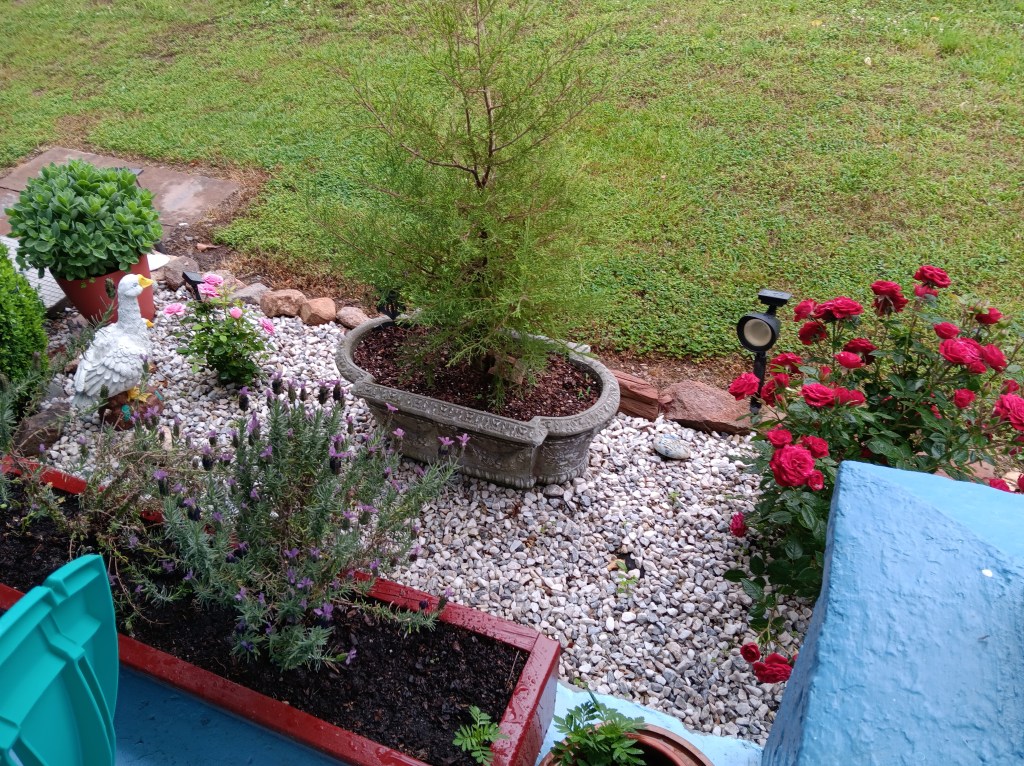
The garden always calls this time of the year. About two years ago, I planted two tiny rose bushes. One of them, the red rose bush, has grown considerably when compared to the other, a pink rose bush. I planted these at the same time, and they have grown under similar conditions. Both were labeled miniature rose bushes. Just as people, they continue to grow at a different pace. Just like writer’s stories, they bloom and develop at different stages.
To the left, near the duck, the pink rose bush, and on the right, the red rose bush. Photo by M.A.D.
Red rose bush. Miniature? Not so much, but spectacular. Photo by M.A.D.
Miniature or not, both rose bushes have their own enchantment.
I always keep an eye for new additions to my library, especially, if I am at an antique shop or a similar place where books are not a merchandise priority. I found a few old books at a Habitat for Humanity Re-store. It is a place that mesmerizes me because it is never the same, and there is not telling what you might find. If you are into giving materials a second chance, especially construction and home materials, you might like this place. The proceeds help in the construction of affordable homes for people via volunteers.
I am at the point where I don’t add too many books, just one here and there that will get my attention and cannot be resisted by many reasons: price, subject matter, or just appeal. At the Habitat for Humanity Re-store, I found three books that I could not let go even when I said that I am trying to make a dent on what’s on my shelves already. Besides, at fifty cents each I could not resist.
A Writer’s Reference by Diana Hacker/Nancy Sommers. Instructor edition, 7th edition.
Herbert presents, A Writer’s Reference 7th edition by Diana Hacker/Nancy Sommers (Photo by M.A.D.)
This one, I purchased for practical reasons. It is an instructor edition. It is divided by subject tabs: composing and revising, sentence style, word choice, and much more. It seems to be a free copy for instructors. As a writer, I will benefit from its content.
Of Mice and Men by John Steinbeck
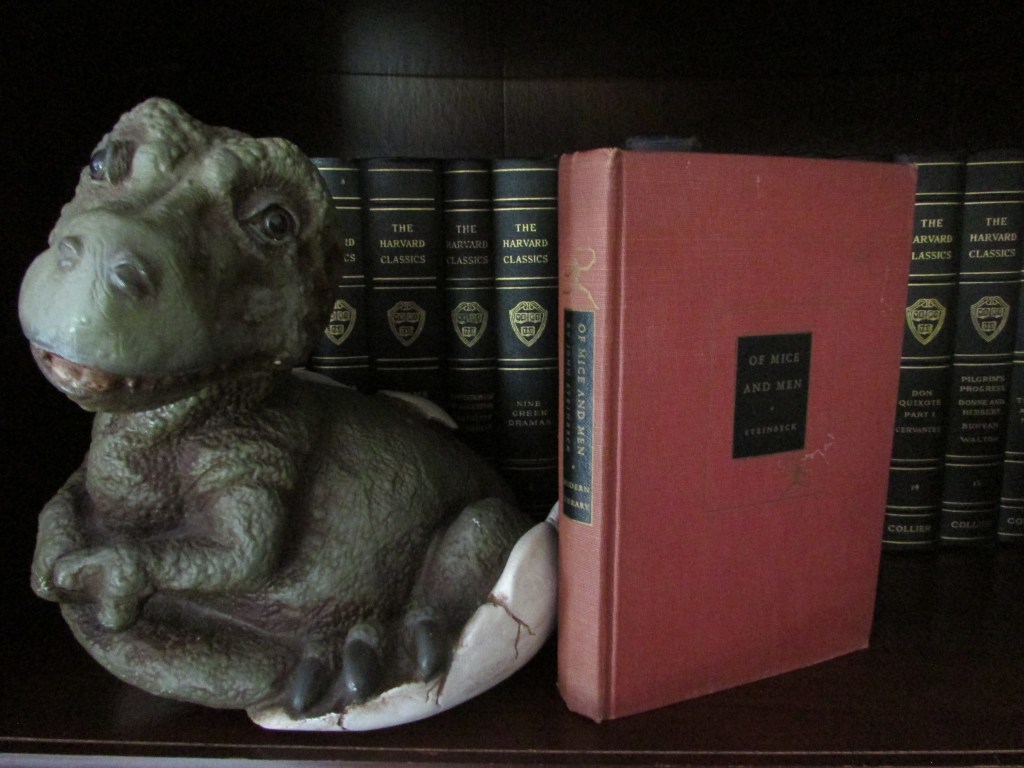
Herbert presents, Of Mice and Men by John Steinbeck. 1937
The second book I found is a 1937 copy published by Random House, Of Mice and Men by John Steinbeck. It is a first printing by this publisher. This book was banned at some point, still banned today in some school districts due to many reasons such as misrepresentation of ethnic groups, language … It is in very good condition with yellowing of the pages, might be missing a dust jacket, but otherwise intact. How could I resist?
Better Than Gold, edited by Clinton T. Howell, third printing 1972
Better Than Gold, edited by Clinton T. Howell, third edition 1972. (Photo by M.A.D.)
Better Than Gold, edited by Clinton T. Howell, third edition 1972. (Photo by M.A.D.)
Better Than Gold, edited by Clinton T. Howell, third edition 1972. (Photo by M.A.D.)
The third selection is unusual, and what attracted me to it was its cover and title – Better Than Gold, edited by Clinton T. Howell, third edition 1972. It is bound in leather with a golden ribbon, and gilded lettering; overall, just gorgeous. Its pages and overall presentation are just divine. It contains a collection of poems and writings on various topics such as advice, age, death, faith, friendship, happiness, and much more. It is an inspirational book. Its pages were made to look aged and can only get better with the passing of time. The typography and design of the pages, including images of old English woodcuts, is breathtaking for sure. I am truly going to enjoy reading this one and turning its pages. Perfect read for the coming autumn.
When I collect a book, I don’t focus so much on monetary or future resale value from a collector’s point of view. Instead, its subject or title has to ring a bell, and be visually attractive as well. In the case of A Writer’s Reference, it was purely practical for me because writing is what I do, and that is one reference area that keeps growing and expanding in my library. The rest is purely a passion and a delight.
Sometimes, there is a wall between the reader and a classic novel, and it results on the abandonment of it. On occasion, I have felt disconnected with the story. I have found that it is not the story per se, but a combination of elements: the time when it was written, the culture, and the (old) language that was used during the time. Many times, I have come across a word that I don’t recognize, and I have paused reading to look it up. In a way, it interrupts the flow of the story when reading and becomes a distraction. One can get the gist of it and continue reading, but for some reason something feels missing.
In order to do justice to that classic novel one has to become an archeologist of words. It must be treated as an adventure, a special read, unearthing a world that one does not know well or at all. Viewing it from the point of view of the writer’s times, the period in which it was written, the social/political conditions of the time, the writer’s life, and other considerations of that period, is something that helps the reader appreciate the story more, and understand it as well, finding common ground with it, and giving it a chance to reveal itself, and reconnect with it.
I find that doing light research about the author and the times prior to reading, helps and enhances the reading experience. Before tossing that classic novel aside, try this; maybe it will help in viewing it with different eyes.






 Inkspeare