Developing a Brand Statement

I should have written about this topic sometime ago, but it is something that you do not think about unless you are making a conscious effort to create, evaluate, or develop/expand your brand. Whether you are an author, artist, entrepreneur … or are starting to create a brand, eventually, you will have to develop a statement. In this case, I will refer to your statement as a branded author.

What is a brand statement? To make it easy, compare it to your novel’s elevator pitch. I have read in several sources about many variations of expressing it, but it can be easily explained as the sum of what you/your product is, plus the type of customer/reader that is your target, plus what you/your product offers/does for them (your intention). Once you put that into words, in a short sentence, you have developed your brand statement. For example, my brand statement is: “Inspirational fiction author Maria Antonia Diaz delights readers of fiction and non-fiction by offering works that combine adventure with the supernatural and the divine.”

If you look at that statement it tells who I am/my product as an author, it mentions my target market, and what the product (books) offers the readers. The reason that I include the non-fiction sector, is because my novels have an inspirational tone to them, which might be of interest to that sector. If you think about it in those simple terms, you can develop a simple brand statement that you can sum up in a sentence.  It is an easy way to keep the focus of your brand in front of you, and make it clear to others. Think about who you are as an author and who your readers are, and what you want to do for them through your work. That should lead you to express your brand statement.

What Makes a Bestseller?

What makes a bestseller?

I am as clueless as you are. I don’t know that anyone knows for sure. These days, it is a hit or miss. If you write whatever happens to be selling well, you might have a slight chance of being discovered; however, there is no guarantee, as these times seem to be characterized by fast and furious writing, of aiming a target market and pleasing the publishers. Indies might not try to please the publishers but the readers who crave the craze at the time. Pleasing readers is good; however, not if you are writing something hoping that it sells but your heart is on another place. In that case, you lost your writer.

The other day, I picked up a small paperback, a fantasy/paranormal romance that promised a bit of adventure, just for fun reading; I was in the mood for it. It was from a bestselling author on that genre, who had written many novels, and had won awards. I was truly surprised when (just my opinion) I discovered poor content, weak, poor dialog, and honestly, it needed a decent amount of editing. I continue reading (stunned) but had to skip pages, and eventually, had to put it down. I was puzzled – a best seller, but how? Your guess is my guess.

What makes a bestseller these days? Lots of luck, maybe? Good writing doesn’t seem to cut it anymore. I am an eclectic reader; I enjoy many genres. I have read very good books that are not best sellers. I understand the fever and craze that a genre might cause at a particular moment, but I don’t understand how a poor written story becomes a bestseller. Maybe it is all about sales and hoopla. Your guess is my guess. I would love to hear your experiences (as a reader) on this topic.

What’s in a Name?

Spanish Language Wikipedia logo

Spanish Language Wikipedia logo (Photo credit: Wikipedia)

Short answer – Nothing and everything.

Why? Naming something, whether a character, selecting your author name, or naming a website … unfortunately gives an impression to the person who happens to read it – positive or negative, maybe even neutral. Some authors opt for using a pen name because their names are not “suitable” for the genre they are writing, or because they prefer not to use the real name.  As an example, I will use my own. When you read my author name (Maria Antonia Diaz), you may (or not) assume that I write in Spanish, when I don’t; so far inspiration has come in English, but that doesn’t mean anything because one day, I may sit down and write a novel in Spanish (translations do not count here). Perception of a name depends on many factors – personal, cultural, social … you get the idea. Fame adds another layer. As an example, I will mention J.K. Rowling (famous) and her recent pen name of Robert Galbraith (not famous, at least until he became J.K. Rowling and the book started selling hot, hot, hot).

Recently, I was reading about the importance of obtaining the .com for your author name if available, and how to forgo another domain (.net, .org …) if it was already taken. The reason given is that people are conditioned to search for a .com first, and the mind makes an association with that first name (the .com owner). In addition, people will land on the .com first, and it may not be to your best interest if the association with the already taken domain is not a positive one, especially after so much work and dedication crafting your path. The author’s opinion was that it was better to obtain a .com by tweaking your name, or by choosing some important point/feature from one of your novels to drive attention to your work. This was when panic hit. I realized that I had never bother to see if a .com was available for my author name. After so many years of research and work, how this simple point escaped my attention? If I was so serious about my path as a writer, how something so basic eluded me? The answer to that had to do with how I viewed my two work-related domains, as an intricate part of me, the author. That was the wrong answer. Why? Because readers don’t make that connection, I do.  You can guess what happened next.

I found out that the .com was available, and I grabbed it. In addition, I decided to build a separate website as an author. It is in the making. I could have done that from the beginning, but Inkspeare was the name for this blog, and it is how it developed. Changing the name of it at this point, would be a mistake. This takes me once more, to the importance of thinking your author name and its developement, not only well, but separate from your other online personas/entities. You might view yourself as one and only one, but this is only your perception, and not necessarily translates into the reader’s perception. As far as readers concern, they don’t care about your other jobs, sites, or online entities; they just don’t make that connection that you have internalized.

If you are contemplating a career as a writer, a long and serious one, think about separating the author from your other online personas that do not relate to you as an author, and which readers will not make a connection with, because in reality, it does not pertain to your name as an author.  In the long run, it will be easier for you, and less confusing for the readers. It doesn’t matter if you don’t have many readers now because you are setting the foundation for your future as an author.

So what’s in a name? Nothing and everything.

Great Book for Indies

When I think about all the hours, years of research and learning that I spent as an aspiring author, I have to say that I wished that some of the information I was craving would come in a more cohesive format. Unsure of the path I wanted to take in relation to publishing, after learning as much as I could about not only the craft, but about the different publishing venues, I found that a great part of the information was scattered, biased, and sometimes, not clear enough. Eventually, after separating this information, I finally decided that the indie path was the best choice I could make, and I did.

Recently, I came across an excellent book for indie authors or aspiring authors – The Indie Author Guide by April L. Hamilton. It was first published in 2010, and I wish that I have found it then, because it is a great resource for aspiring authors or indie authors. So I am passing you this bit of information that I am sure you will appreciate. If you are serious about writing and becoming an independent author, or even if you don’t know about it much but want to know more so you can make the best decision when it comes down to publishing your work, this guide is for you. I got my copy from Amazon. It is a treasure, especially if you are starting out; it will save you much time and wasted effort.

So if you are serious about writing, go get your copy; it will be very useful and enlightening. By the way, this is my opinion and I am not endorsing or affiliated in any way; just passing along a great source.

Why Self-published Authors Succumb to Contracts

Français : FICHE GÉNÉRIQUE Modus operandi, ins...

Français : FICHE GÉNÉRIQUE Modus operandi, installation vidéo-interactive, 2003 Conception et réalisation : Jean-Louis Boissier. Production : laboratoire Esthétique de l’interactivité, Université Paris 8, Association Transports. (Photo credit: Wikipedia)

It is a new world and a new game at the publishing industry. It has opened doors to independent and self-published authors who are enjoying the best time to make their works known without the demands and constraints of the traditional publishing industry model. However, what makes a successful independent or self-published author succumb to a traditional contract? It would be a good idea to differentiate between the terms indie and self-published (this assessment is my view, in general).

I view independent authors (indie) as entrepreneurs who enjoy the freedom and flexibility of maintaining their status as indies, and who have established for themselves  a “modus operandi” that they love and prefer. I view self-published authors as writers who love the craft and have embraced the opportunity with the changes in the industry but whose goal is to one day, become published the traditional way. They might have received rejection notes or not, but their main goal is to obtain publication via the traditional model of publishing, and at the same time, making a name for themselves.

Despite the rules of the traditional publishing model, publishers are turning to Amazon to discover future contracts by following who sells the most/ranking. This works well for self-publishers, who have not been able to reach the system via an agent. For a successful self-publishing author this might eliminate one layer of the traditional method – finding an agent, but agents might be looking for these self-published successes as well, knowing that the sales have been proven, and most likely, will turn into profitable contracts.

Successful Indie authors are smart about all this, and although they love their freedom and flexibility, they would consider the right contract, as long as it proves to be more profitable than what they are already experiencing by their own efforts. For other indie authors, the issue is more about flexibility and the need to control the creative process, and their working style. Indies might or might not want to obtain a contract, depending on their goals.

Successful indie authors who value an entrepreneur model of publishing seem to retain more control over what they want than self-publishers whose goal is to get a contract to validate their status as authors or to make a name in the industry. It seems that it comes down to “what’s in it for me,” and how it falls under “my goals as an author.” Both sides have genuine interests, and there is no right or wrong way to do things, as long as it follows the author’s true values/goals.

The Closet

Linen Closet

Linen Closet (Photo credit: Wikipedia)

A bit different from what I usually write, maybe dark and creepy, but inspiration comes in all colors, and sometimes, unexpected 🙂


The Closet


Hanging by a thread,

Pinky lets go of the rope,

Fighting to grab thin air,

I began to fall, deep dark hole.


Nails screeching the atmosphere,

Long way down the depth of soul,

The slow fall, miles of hope,

Pretending the bottom never touch.


The closet calls, inviting

A safe haven of obscurity

Knowing truth, I avoid the call

For if I go in, I will never be back.


Not lost of body,

Not lost of soul,

But of the mind,

Long lost, lone gone.


A Writer’s Path – Twists and Turns Along the Way

Photo by M.A.D.

Photo by M.A.D.

A writer’s path is a long and quiet (I don’t like the word lonely or solitary) journey. There are long hours of creativity, learning, research, and more learning (especially new technology and tricks of the trade for indie authors). As if all of this is not challenging enough, there is the other part – the part when you are figuring out your writing-self, style, and if you are really cut out for all this. Passion is great, as is love for the craft; however, in these fast times, it might not come as a surprise that you will question your path, from time to time. You may have answered the why, the what, are figuring the how, and might have no clue about the when or where, depending on your goals and planning. Sometimes, the path less traveled seems to be the one that has all the thorns, the most challenging, and the less fast-rewarding. It may take you through twist and turns, up, down, and around, and leave you breathless. However breathless, more knowledgeable for walking the path, stronger for stepping on thorns, and satisfied, bled out but satisfied, even when there are no miraculous clues or tangible gratification for your efforts. What you do next, makes all the difference, and I will leave the next sentence to you -____________________________________fill the blank. It is your journey, and you decide.

I leave you with a small excerpt from Moonlit Valley.

“Loss changes your perception of things. It sweeps the hallways of your mind and dusts off your most precious memories. It forces you to open the doors of rooms closed for a long time and peer into your soul, looking for the last ray of hope, of faith. The hope you desperately need now, knowing that at one point, you had put it somewhere and forgotten about it. When you find it, you grab a hold of it, tight, fearing that when you wake up tomorrow, it could be gone. Tomorrow arrives and you realize that although in a faint state, it is still there, and you hold on to it again.” 

Watercolors Friday – The Story Within

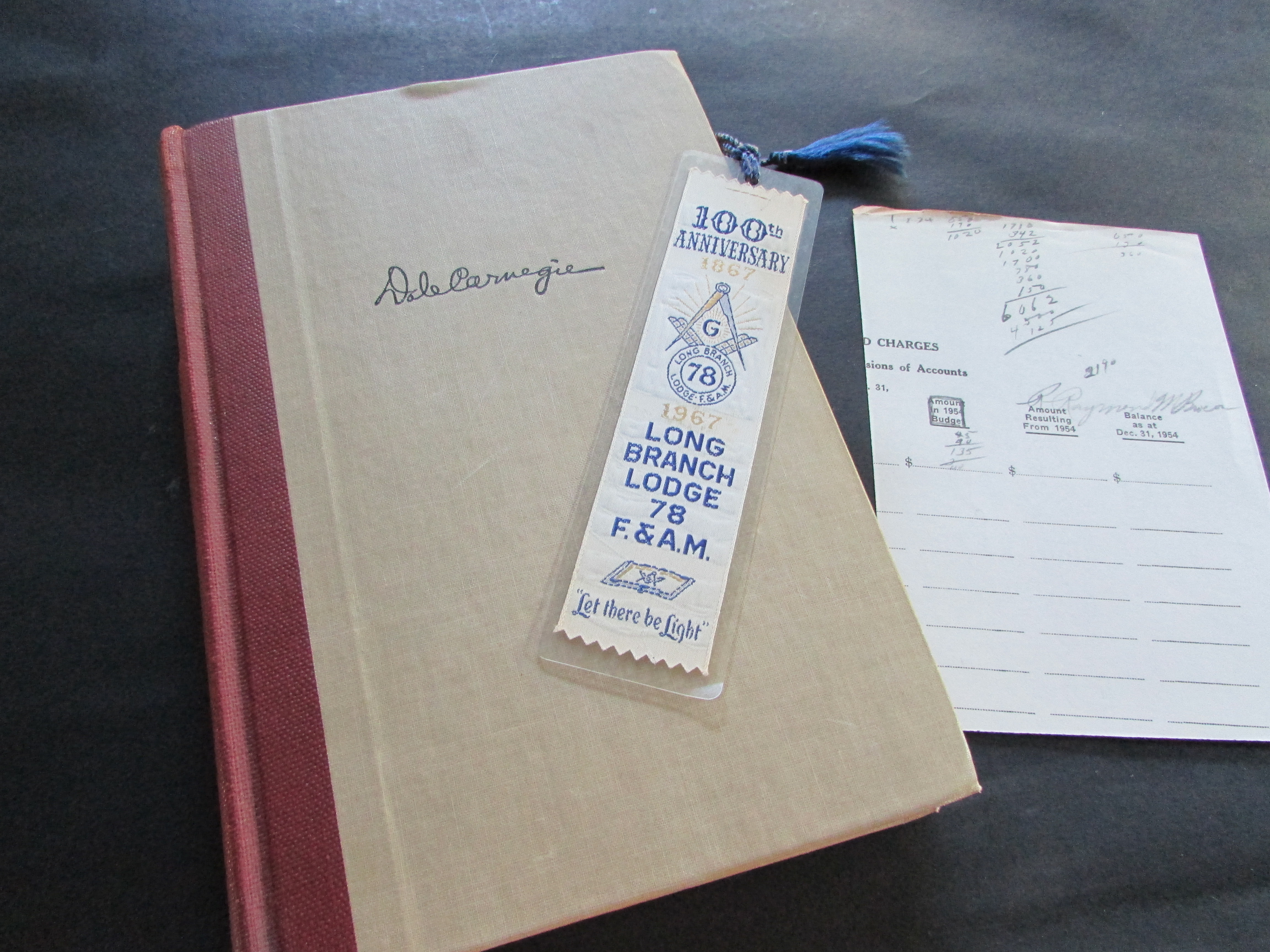
Not long ago I was rummaging through some antique books, and a few caught my eye. Among these was an old copy of Dale Carnegie – How to Stop Worrying and Start Living. I have read other books from this author, but not this one. I took it home, and as many of his books, what a treat it was.  It has a copyright date of 1948, and that old pages scent that goes so well with the right amount of yellowing. No pages are missing and overall, it is in great shape. Besides these features, what else do I love about these old tomes?

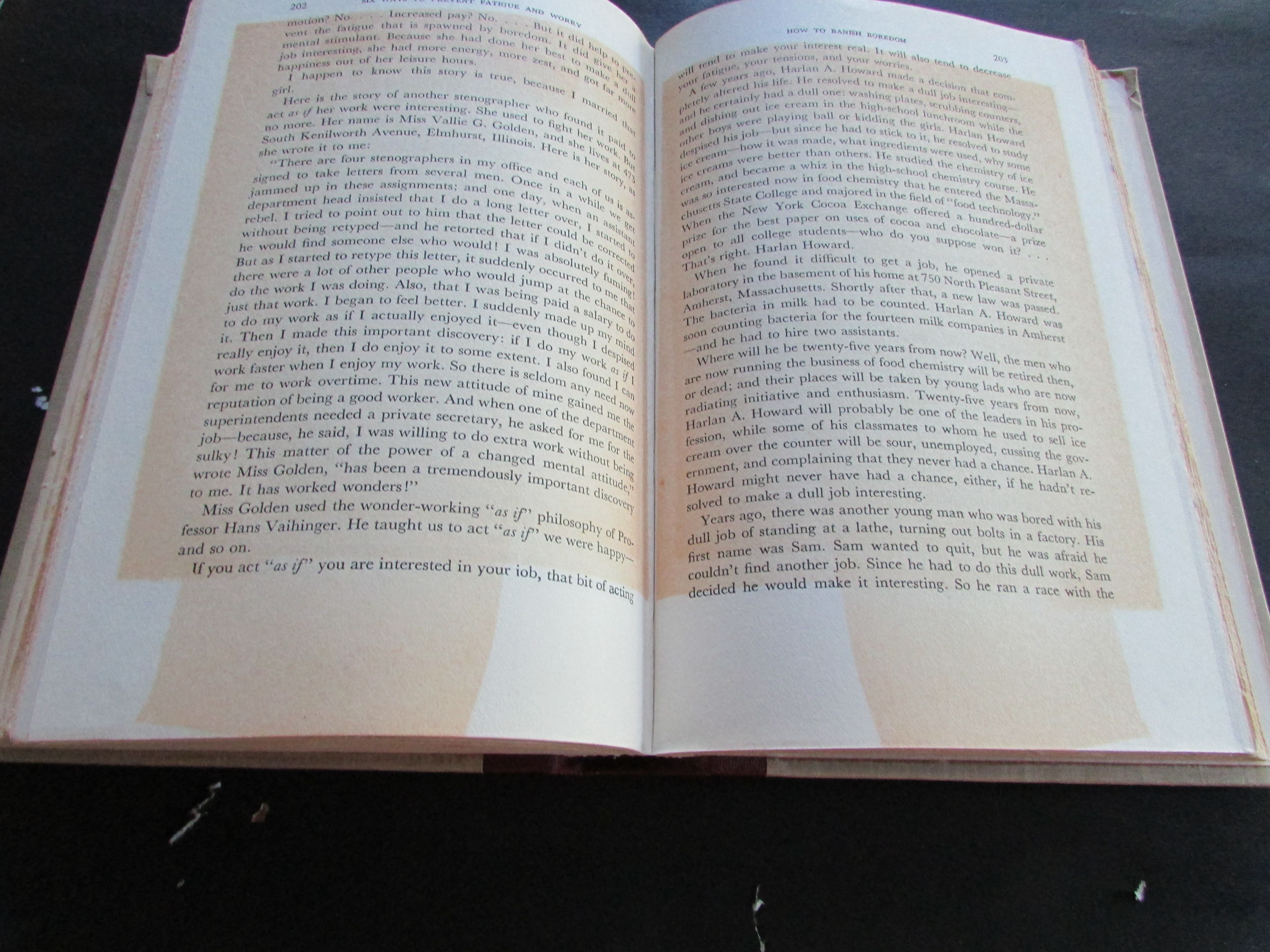
Well, one thing that I love about an old book is that it usually contains a story within its main story. It is the story of the previous owner(s), and one that is written throughout the entire book. I love to have a glimpse of who was this person, and to imagine a bit about his/her life. Sometimes, I find their name handwritten, a year, a dedication signed by the person who gifted it, and other times, even the occasion for such gift. Other times, I may find a marker, a cut out from an old newspaper, or even a dry little flower. What made them buy this book? Many times, you can see the reason by the passages underlined, or the notations carefully made throughout the pages.  Other times, you will find a business card or a written piece of paper that may be revealing. It is always a treat.

On this particular tome, I found an old piece of scrap paper taken from a budget sheet from 1954. It had some numbers in it, written not in the proper space, but added, what seemed as in a rush.  The column Amount in 1954 budget was encased in a square made with pencil markings, and a name was written atop the other two columns. In addition, there was a bookmark from a masonic lodge celebrating 100 year anniversary. The inside had no underlining. What was the story here? Well, the owner was probably a Mason, a business person, maybe an accountant? and he must have scribbled numbers while talking on the phone with the person who’s name was carefully written, and while he was on the phone, he must have doodled the square in pencil, as it seemed to have more than one line, as if this person, went over the square with his pencil several times. Inside the book, there is a large yellow mark made by a paper that must have been placed there for some time. It marked the shape of a large piece of paper and a small one, probably on top of it or attached to it – maybe a receipt (hence why I chose the profession of accountant). This is the story that these clues inspired, but it could be far from the truth; however, I had fun imagining all this. As usual, here are a few pictures.
Photo by M.A.D.
Photo by M.A.D.

007


That day, I found a small collection of small prayer books/bible from the USA army. Back then, the Army, Navy … gave these books to soldiers, and many were presented at service by their chaplain . One of them had the soldier’s name, the chaplain’s name, date, time, and where it was presented. What caught my eye was the heavy underlining on this one, especially passages that talk about war, peace, and righteousness, as well as other passages that made reference to water, which led me to think that the soldier might have been in the navy. There was one underlined passage that referred to a man being healed, one who couldn’t walk. The story I imagine here made me sad.

Next time you happen to come across an old book, examine it, and hear the story it whispers within. Today, we celebrate old authors, as well as book lovers of the past – HAPPY WATERCOLORS FRIDAY!

A Symphony of Human Comfort – The Magic of One in Many

The Antennae Galaxies are undergoing a collisi...

The Antennae Galaxies are undergoing a collision that will result in their eventual merger. (Photo credit: Wikipedia)

Have you ever gotten the right words of comfort when you needed them? Has the right book suddenly came into your hands when you were looking for answers or pondering an issue, deeply looking for some comfort? Somehow, it seems that we experience these occurrences when we seem to have lost our hope, or when our mind/heart is experiencing turmoil, and need to find a little ray of hope or “something” that will point us in the right direction, as our life compass has undergone a little interference. When we happen to find that ray of light, we feel comforted, as well as grateful. Grateful for the ones who have written the words that seem to make so much sense today, as sometime ago. It is like a symphony of human comfort that is as old as we are, that transcends time, space, culture, race … the right words at the right time. “In the beginning was the Word, and the Word was with God, and the Word was God.” – John 1:1

We are part of everything, and everything in us, a concept that for some is difficult to grasp, and that is understandable. Many times, I see a connection in everything that surrounds me. It is in those little moments of serendipity that I feel that connection stronger. It is when the works of someone who lived many years or centuries ago, happen to touch my soul today, and offer insight – whether spiritual insight, or one of those “aha” moments, when my questions seem to have been answered. It is then that I understand that we are one in many. As if our collective knowledge comforts our collective souls. We are part of a greater process, each one contributing in perfect time and harmony, each one influencing one another.

I leave you with a poem that I wrote sometime ago – “One in Many”

One in Many

On this day I shall wish

many blessings, harmony

When the night gives in to day

and the day nestles the night,

we will be as one in many.

Shine your light for it will be

as the beacon one will see

Always seek your love to give

without measure, plenty and free.

As you give you will receive,

one in many it has been.

Me, You, It, one and the same,

Love, One Source, is One in many.

As you wish it will be done,

may you wish, joy, peace, and love

For it returns the wish to wisher,

two ten fold, as one in many.