In The Dinorah Chronicles trilogy, evil is personified via an organized well-funded group named The Damsels of Cain. The Damsels of Cain is a female-run organization spread all over the world, and its male disciples are under female leadership. Males wear a mark in the left wrist, while woman wear it in the right wrist – a black tulip inside a pentacle. Their main leader is Dana Ringold. The Damsels of Cain are led by evil. Their purpose is to recruit young females to establish as many chapters throughout the planet. They congregate in secret temples all over the world, where they initiate new members, baiting them with the allure of riches and power. Their main objective is to target influential men in various organizations (science, politics, technology …) to eventually obtain unified political power on the planet. Once they have achieve this, evil can reign on Earth.
The Blue Lily Society is the counterpart to this group. It is a society established centuries ago with the sole purpose of serving good and protect key individuals. They pose as ladies social clubs to maintain anonymity. They raised Dinorah Sandbeck, the main character, and the one who leads the decoding of a new Earth and the awakening of the Sunrise Souls. Together, and along with divine intervention, they must prevent the rise of evil.
For behold, I create new heavens and a new earth; and the former shall not be remembered, nor come into mind. Isaiah 65:17
If interested, you can find The Dinorah Chronicles trilogy on Amazon in eBook and paperback formats.
The ground around this property seems to change constantly. One day there is a small dip on the ground, and a few weeks later is either larger or it disappears; I don’t know why this is. The only thing I could think of is moles; there seem to be plenty around here. We are always finding things that come up from the ground, especially after heavy rain. The latest is so timely and fun that it made us laugh.
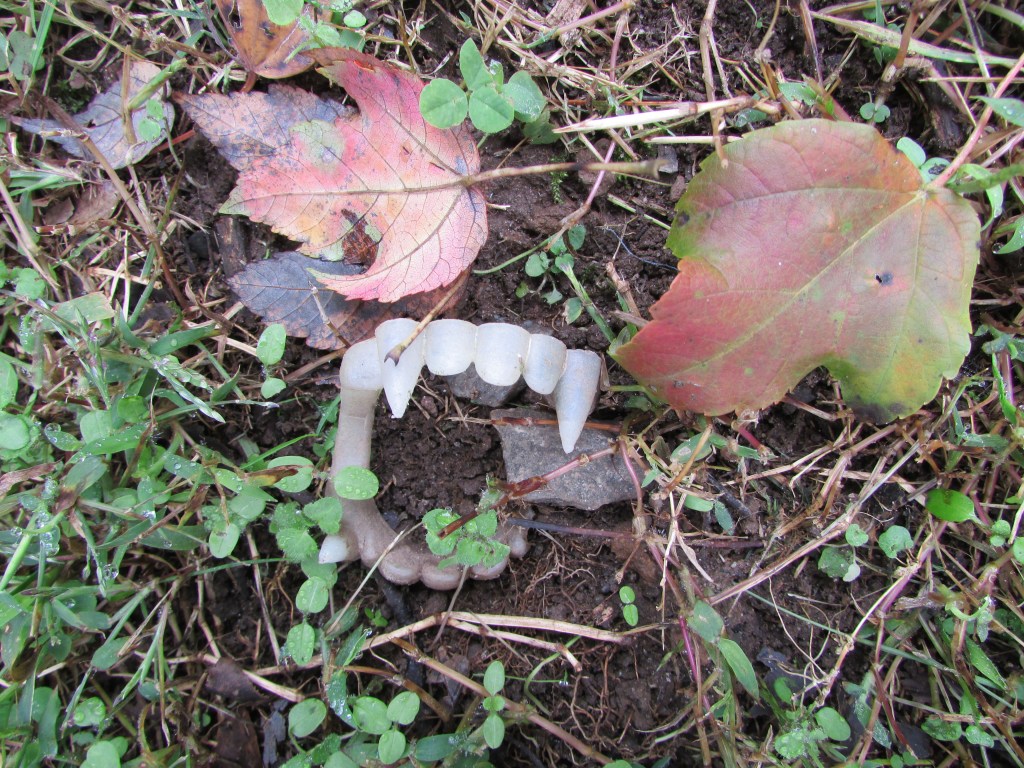
Over the weekend, my husband was blowing out the leaves and cleaning up around the house when he came across something unexpected near the well. Unexpected because this is an area we walk around all the time. He called me so I could see it. He said, “What are the odds?” I laughed so hard that I cried. Here is what came out of the ground, and mind you, soon it will be Halloween. Perfect timing. And of course, it was the perfect opportunity for a picture.
I can tell that these are the vintage type because they look better made and of better quality than the ones you find today at the stores. The type of plastic is also different.
Another view.
We are puzzled because we mow that area all the time and we never saw it. It also lets me know that I am not crazy when I see a slope or dip on the ground that wasn’t there before, because that must have been buried completely at one point and it just surfaced. So what are the odds?
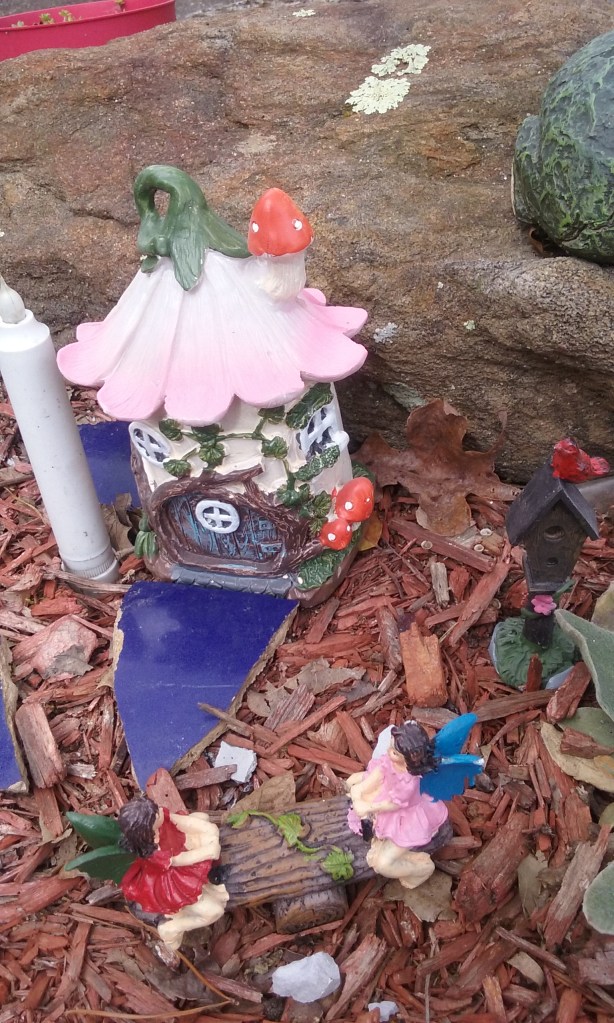
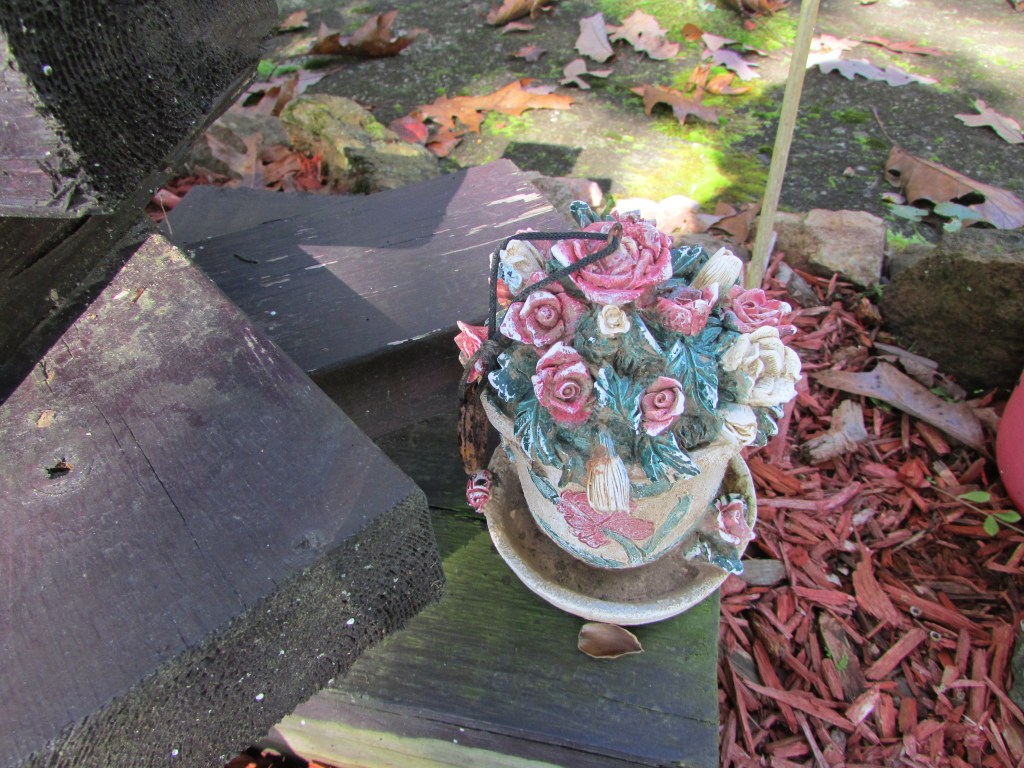
This gave me an idea; to start collecting every little oddity that comes out of the ground and save the items in a box, and share it here from time to time. I have found plastic soldiers, broken china, vintage bottles, odd metal things, marbles, a tiny birdhouse figurine, Tiny colorful beads, and other things. Some of them we placed in the garbage and some ended up in the faerie garden. Other items ended up as part of my décor. Here are a few examples.
Vintage bottle. This is one of over 100 bottles we found.
Pieces of broken china. Love that blue.
Marbles, beads, tiny cup?
My husband found this half-buried where the pumpkin patch will be located. I placed it in the faerie garden.
Mysterious spikes that look like arrows and odd hardware. These came out of the ground in a row and almost damaged the lawn tractor. My husband dug out four of them. He was going to trash them, and I told him I wanted them. He questioned my use of these, but now he likes the way they look together. The other one ended up in the garden. We still don’t know what they are. Maybe some old fencing parts?
Every time I find an old piece of hardware, I display it on top of the mysterious arrows. My husband laughs because I like this stuff.
These I found at different times on my way to the mailbox. They just popped out of the ground one day, and I spotted them.
Some call it junk, some call it treasures, I call it history. Hope you enjoy this post. Happy Autumn!
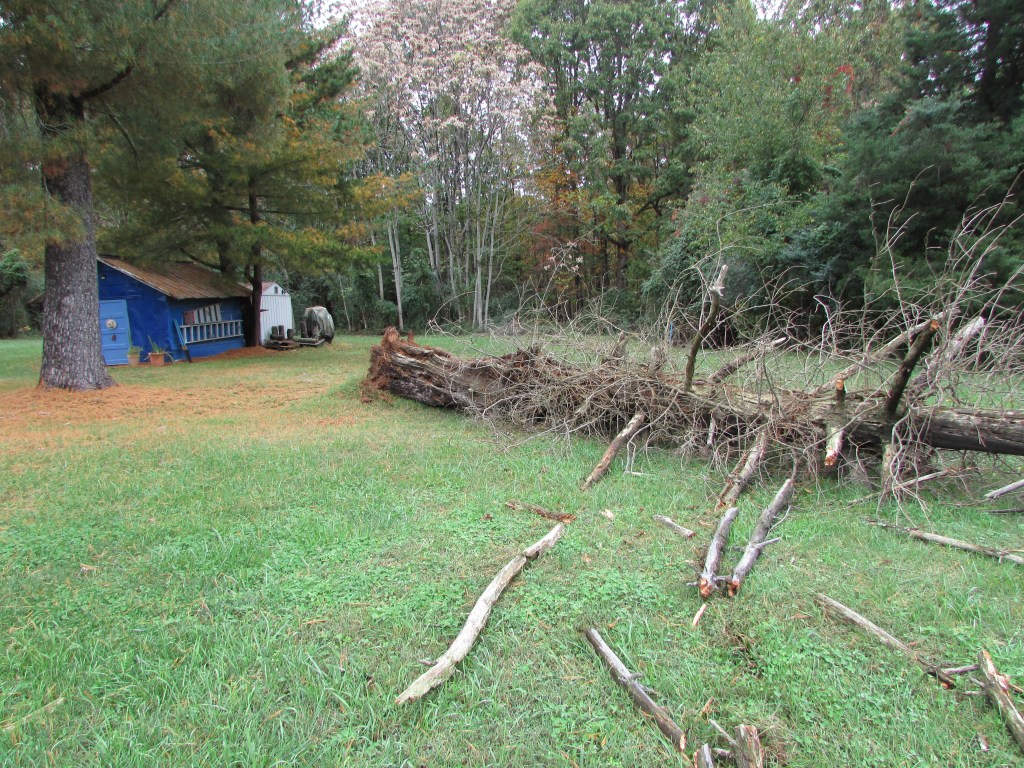
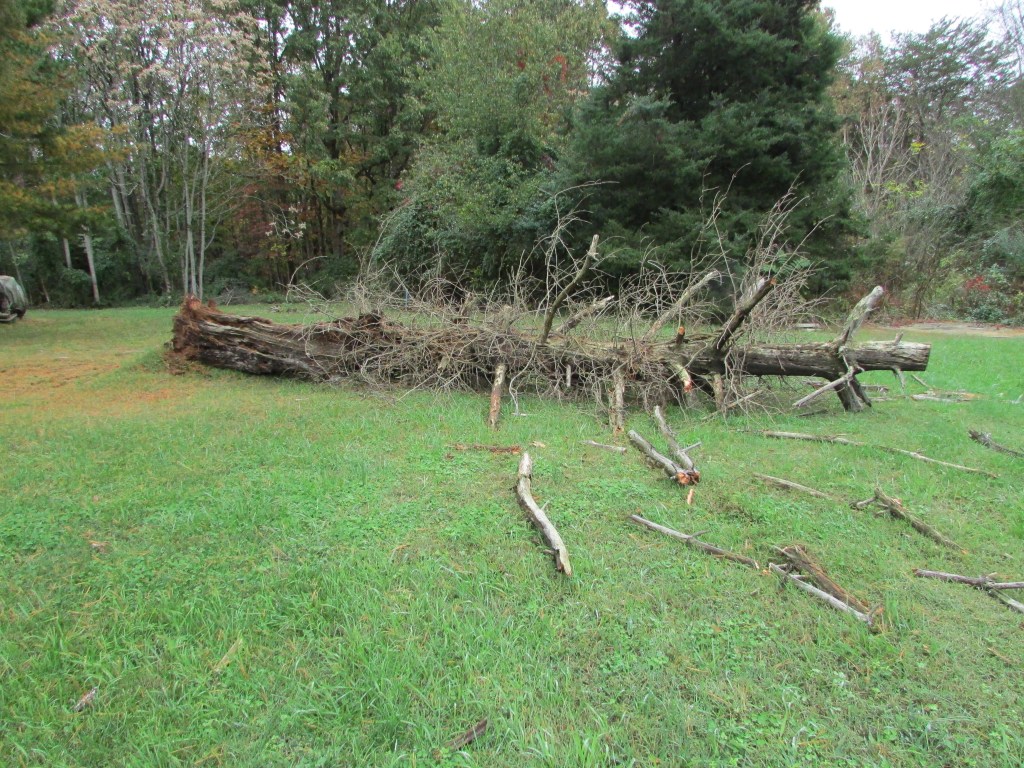
Following up on my latest blog post about future farmhouse projects, we have taken one off the list, or should I say, it took itself off the list yesterday. The large dead tree fell, and that left us with one less tree to take down, however, with a large mess to clean up. Because I started the Twelve Farmhouse Projects series of posts, I thought it would be natural to share the update. Here are a few pictures.
A few pieces scattered around as it fell. The crows will not like this; they used to perch on that tree.
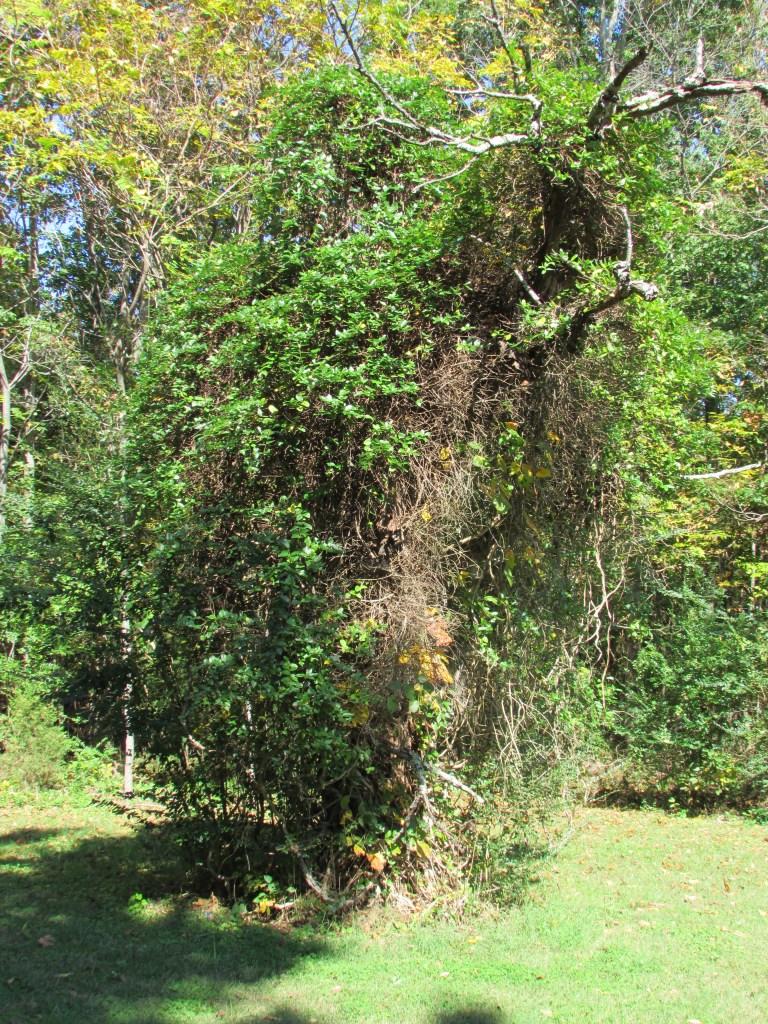
Not sure how easy it would be to cut into pieces. There was a dried up poison ivy plant on that tree.
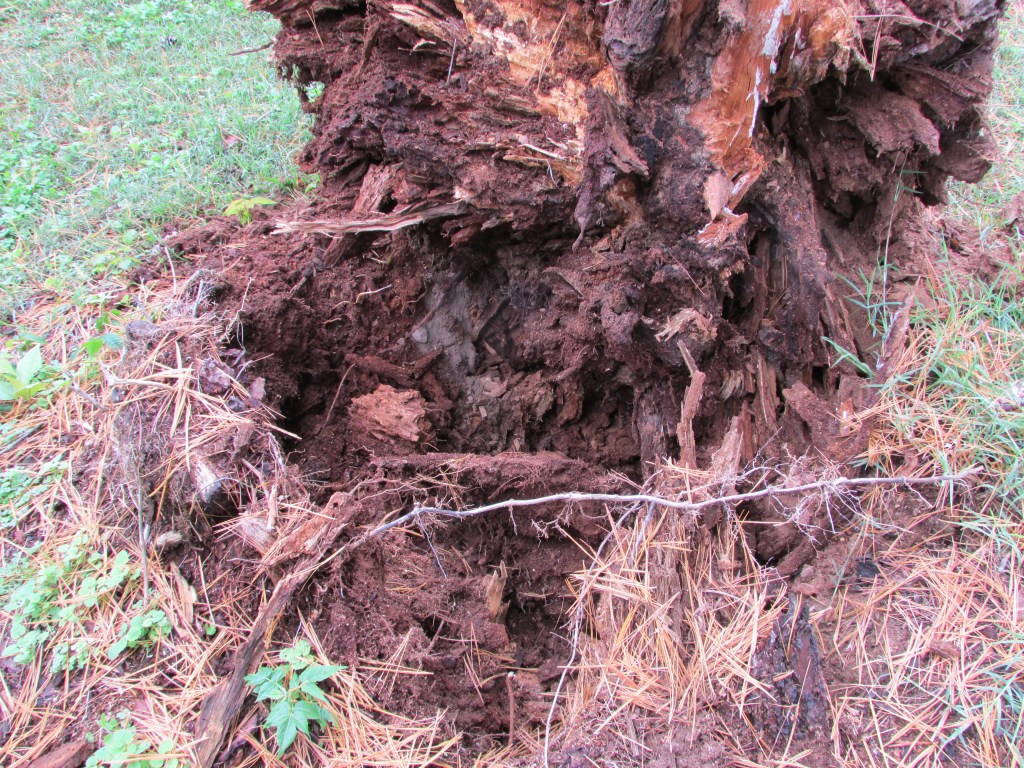
View of the base. The rot is evident.
At least there won’t be any stumps to take out of the ground.
That takes care of one tree, two to go. The most important one is the one near the home. Slowly but surely.
For every house is built by someone, but God is the builder of everything.
Hebrews 3:4
The previous posts on “Fixing an Old Farmhouse” series gave an idea of where we are as far as how much work we have done on this 1910 farmhouse. We started by clearing and cleaning up the outdoor spaces, followed by fixing up the interior of the home, and now we find ourselves going back to focus on the outdoors, as there are many things we have to handle. This post is about those future projects, which will be tackled little by little, as this has been and continues to be a cash-only renovation, hence why it takes longer. Patience is a virtue.
The Roof
The most expensive project will be the installation of a new metal roof. This is a task for roofing professionals, and we wouldn’t take a chance with it. Any slight mistakes would eventually become expensive issues. For now, the roof is coated and will last a few years.
The roof as it was when we saw the place for the first time.
The same 110 year old roof after coating.
Dangerous Trees
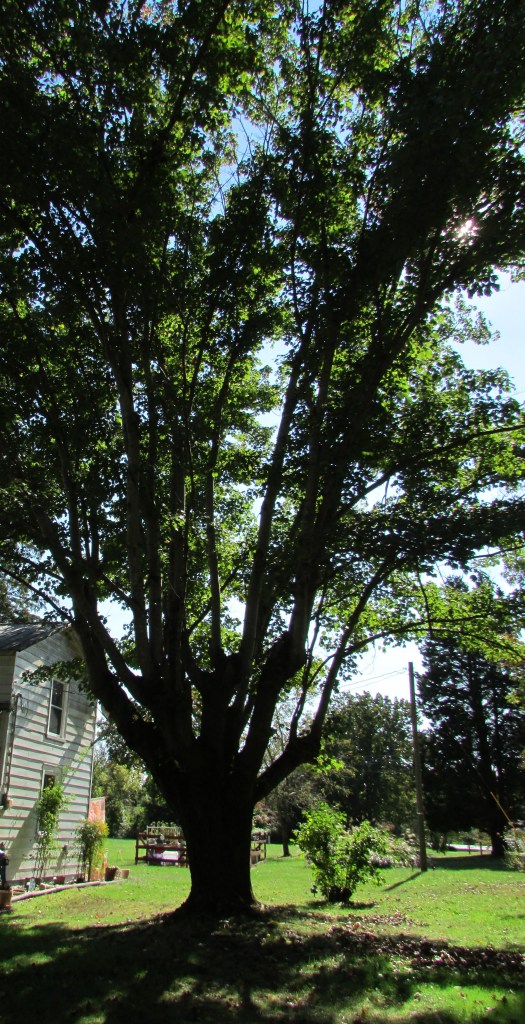
Another important project is the removal of an enormous tree that is not looking too healthy, and is in proximity to the house. We have two other dead trees to remove, large but those are far away from the house. This is another project that is a bit expensive and must be done by tree experts.
Large tree next to the side entrance.
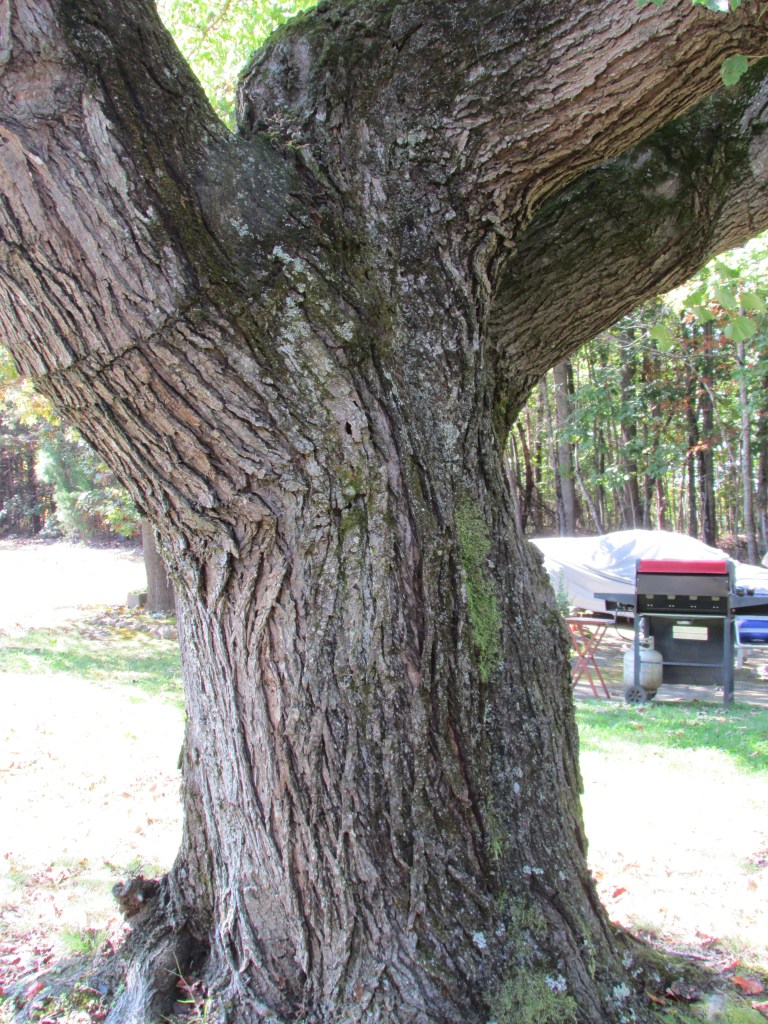
As you can see, it is massive. It is covered in moss, which is not a good sign.
The tree has many areas like this one.
This is another tree that is dead and must be removed. It is big.
Unfortunately, the third tree is my beloved monster tree. After a much dreaded discussion, we agreed that it would be best to remove it. Poison Ivy is growing wild inside and around it, and it is very difficult to remove.
The Driveway
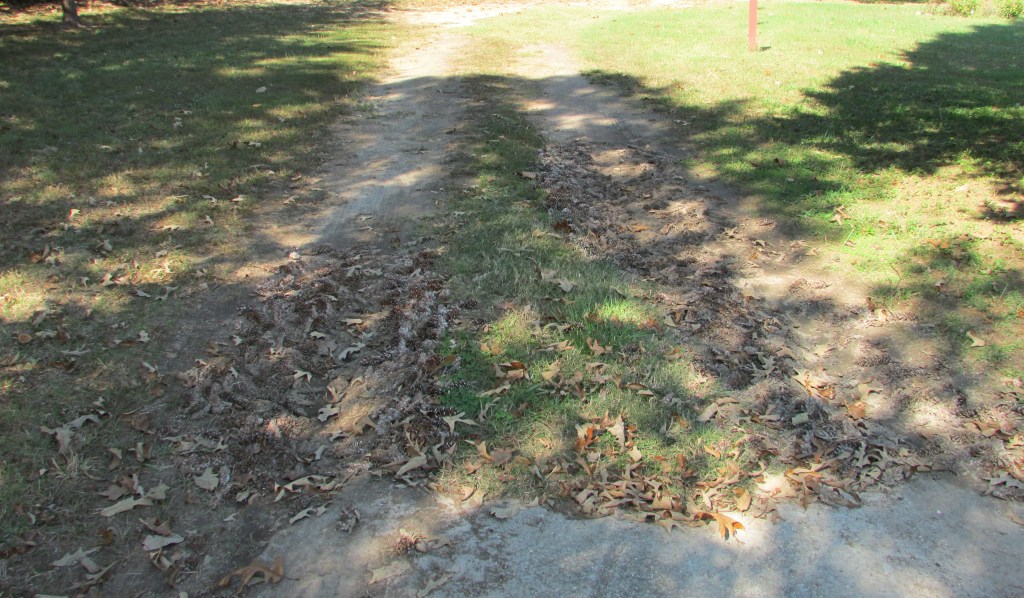
Another item on our list of outdoor “must handle” issues is the driveway. Over time, the soil changes. When it rains the driveway becomes very muddy with two large areas that retain water. A couple loads of gravel should take care of the issue. For now, we have been collecting pinecones and pine needles from the property and placing them in the problem area. It works temporarily. In addition, we have to patch the old cement part that was uncovered.
Not a pretty sight now, but worse when it rains.
The Porch
The porch ceiling needs to be repainted eventually. The cement floor needs to be tiled to prevent further deterioration. Right now, it is cement that we fixed, patched, and painted. Ideally, I would like to place slate tile or brick on top.
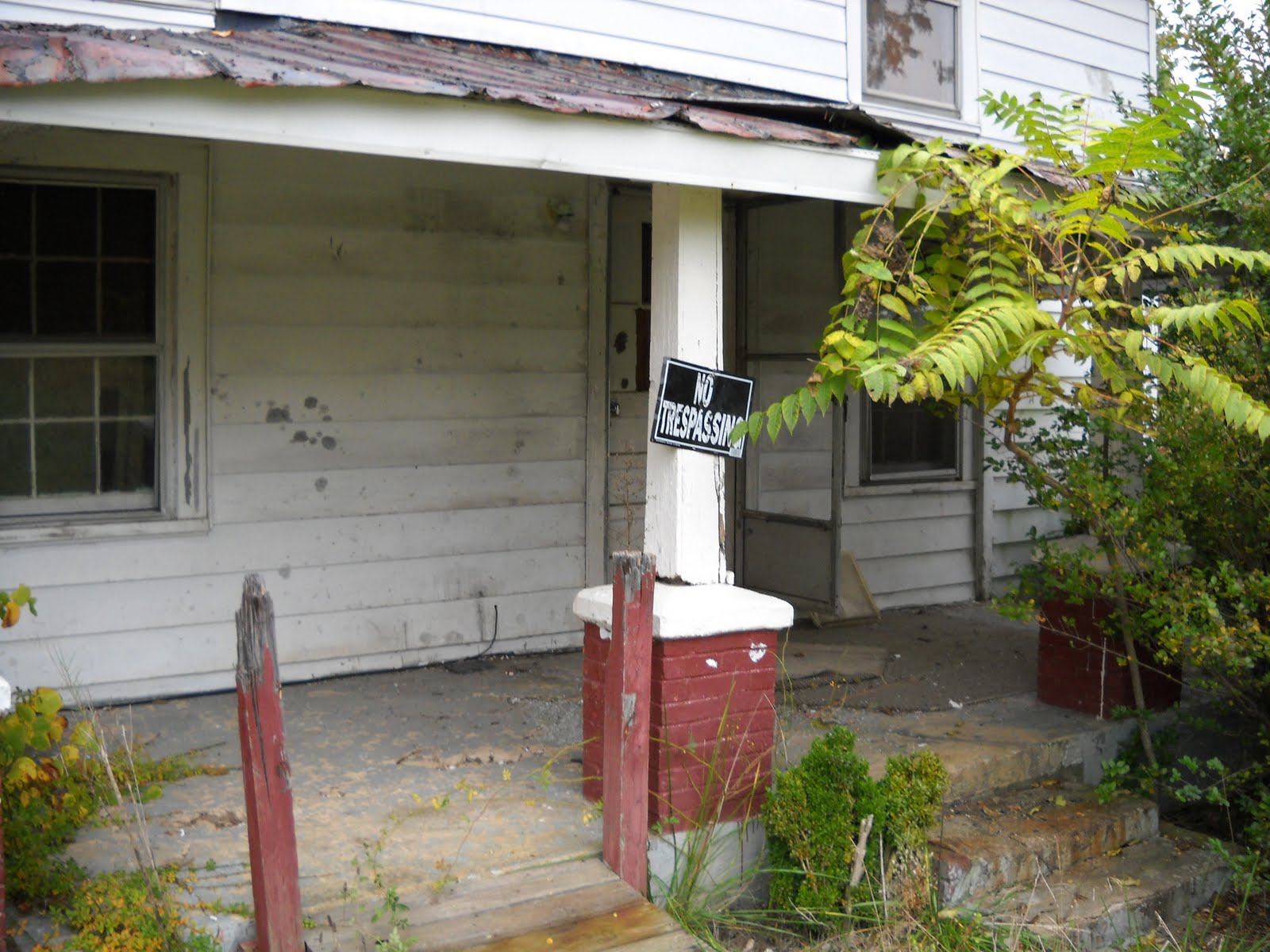
What it used to be when we bought the place.
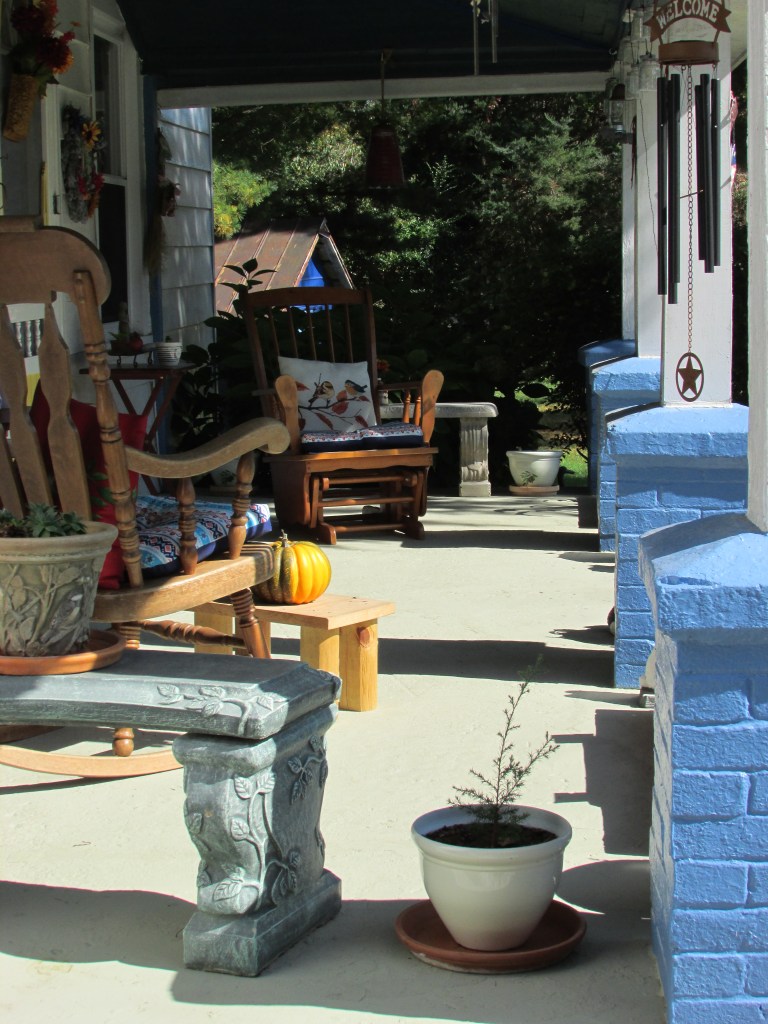
For now, we maintain it until we can take care of it properly.
The Well
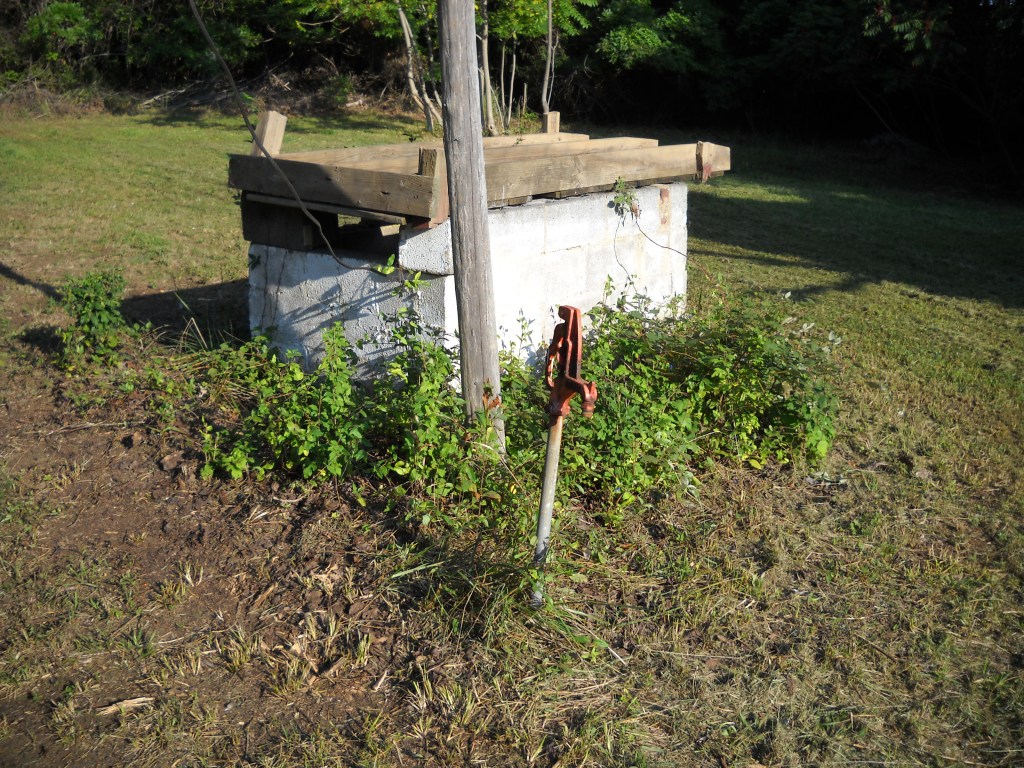
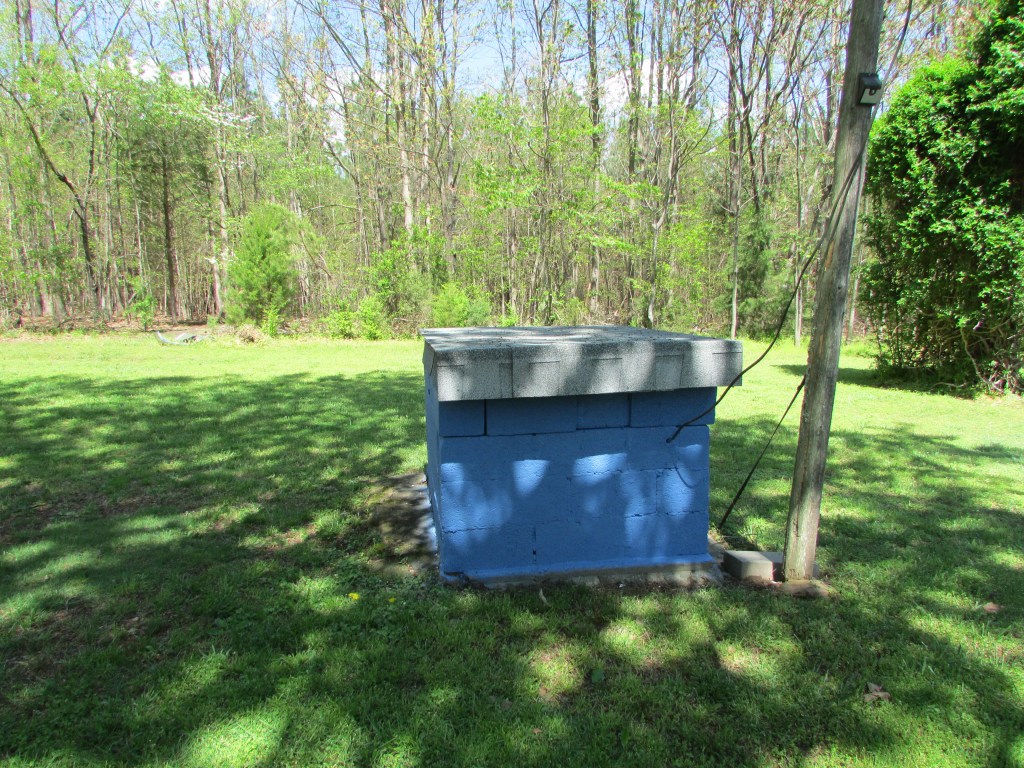
The well has come a long way from what it used to be. We would like to enclose the well with a small shed-like structure. It will provide more insulation from the cold weather. So far, we fixed and painted it, but it needs that extra step.
It used to look like this.
Now it looks like this, an improvement.
Large Shed/building
Although we have two small storage sheds on the property, one of them an existing original old log building, those are being used to store garden tools, heat pellets, and other outdoor items. We need a larger building where my husband can work on his wood projects. This will be its future site.
It will be located at the far end, and we will probably build it ourselves, depending on wood pricing – ready made kit vs. building it from scratch.
Pumpkin Area
We need to prepare an area at the back (right side) of the property where we can grow larger things such as corn or pumpkins. We tested an area this year, where we grew pumpkins and cantaloupe, and it seems a good area for that purpose. Although we will not enclose it, we will have to clear some stumps and grass before planting.
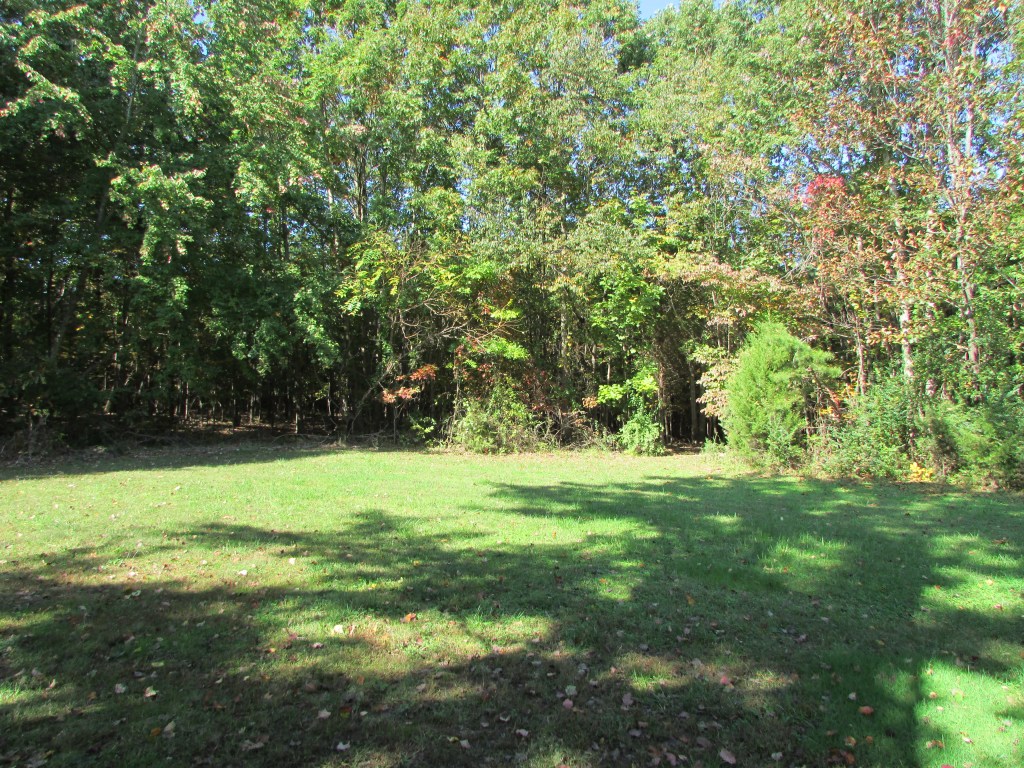
Future site of the pumpkin area. Those stumps were trees that we cut down, and will be removed.
The Christmas Tree
Last year, we cleared and cleaned up the area at the entrance of the driveway. It was full of overgrown shrubs and weeds. During the process, my husband discovered a medium size pine tree that he liked, and he decided to leave alone. This tree has been growing healthy and free of weeds and is looking very nice. My husband wants to dress it up in white solar lights that can be left on year round. His obsession with this tree puzzles me, but I am going along with it, and he doesn’t know it yet, but I already ordered the lights. This will probably become the first project on our list.
This tree has become my husband’s pet.
The Rain Garden
As much as the Christmas tree is my husband’s obsession, the rain garden is mine. There is an area at the front of the house, near the veggie garden, where there seems to be a dip or slope on the terrain. When it rains, it seems to retain water. This area would be perfect for a rain garden. However, since it is at the center, I would like it to become a focal point. I am envisioning a water feature (solar, of course) a small bench, a few pavers, one or two spot lights, a few larger stones, and of course the plants. Maybe one or two stone critters as well. This is the future site of the rain garden.
In this picture, you can see the puddle of water; that is the spot for the rain garden.
Side Steps Entrance Concrete Area
Although there is grass on this area, when it rains it becomes very muddy. My husband wants to place pavers or pour concrete to minimize the muddy mess.
The area where we will pour cement or place pavers next to the side entrance steps.
The Arbor
This is a project that I am excited about, however, I am not sure if it is practical because sometimes, we bring material through the area where it would be placed. My husband doesn’t like when someone comes down the driveway, bypasses the parking area, and ends up parking very close to the house. He says that if a vehicle were to disengage the parking gear or someone miss applying the brakes on time, they would land in the living room. I can see his point. The arbor would signal the end of the driveway, and would serve as a pretty stop sign. In the past, (not around here) I have seen this happen to two people. Their cars were not in parked gear. My husband, being a mechanic, has seen this scenario many times, hence his insistence. If the arbor idea were to be implemented, wisteria would be a good choice and it would have to include an area for the name of our place – Black Crow Cottage.
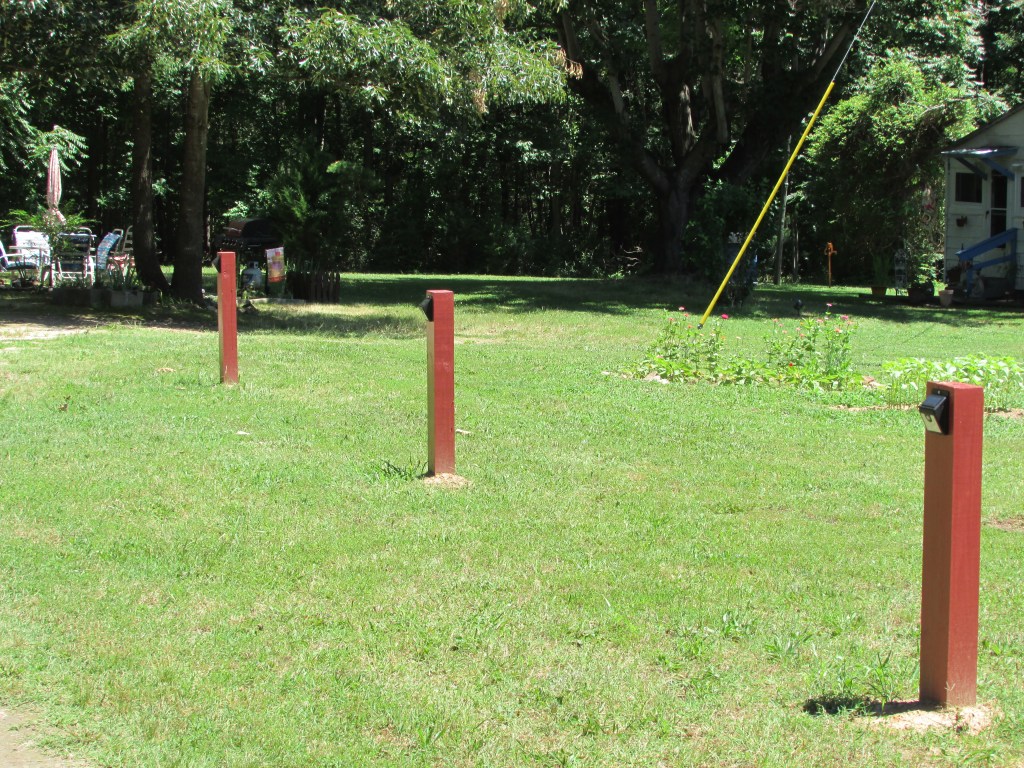
The arbor would be located after the last light post signaling the end of the driveway.
The Woods Trails
I am not sure, but I think this will be the last project to be tackled. It is something that my husband wants to do in the future. He wants to create pathways around the wooded area. He wants the pathway to end where the “Christmas tree” is. He already started the three entrances, and placed a few logs from fallen trees. It will take time and effort, and he knows it, but it is something he envisions and would love to do. I like the idea, although not so much the type of work involved.
One of the three entrances that will connect to a main pathway. Here you can see that this one will lead left or right.
A section of the woods.
These are twelve future projects that I will share here when we are able to complete them, one by one, little by little. We have come a long way from where we started, and there is more to do. I hope you enjoyed this post.
The experience of fixing this old farmhouse has been everything we thought it would be and much more. We do not regret it. The last room to share on the “Fixing an Old Farmhouse” series of posts is the bedroom. Technically, this house was listed as a three-bedroom house, but currently, we use one of the bedrooms as the living room because we set up the living room as a dining room, and the other room is set as the office. You can view these rooms on my previous posts.
The bedroom was the first room we fixed. Like the rest of the house, it was in very bad shape and required work. The walls had significant damage as well as the ceiling. The floor had some minor issues but we decided to install laminate flooring due to the uneven space between boards, some discoloration, and other minor issues, something quite normal. The room is 15 x 15 feet and it has two floor to ceiling windows due to the low ceiling (seven feet or so). The house does not have any closets, except for the one in the living room, something common for this type of construction. The room had a makeshift shell of a closet that was falling to the side, kind of hanging there with no support. We thought about using vintage his and her armoires but settled on the idea of building a walk-in closet around the chimney space, which worked out great. The chimney was in rough shape and had to be covered anyway so the space was ideal for it. I thought that building the closet would rob the room of space but it worked out well; we don’t miss the space and it was a much needed use of it. Because this was the room at the far end, we knew that it would be the coldest room. The pellet stove does a great job at heating the house, however, we decided that adding an electric fireplace on a corner would be a good idea, just in case we needed extra heat on a cold winter. This arrangement has worked fine.
Here are a few pictures of the before, during, and after process.
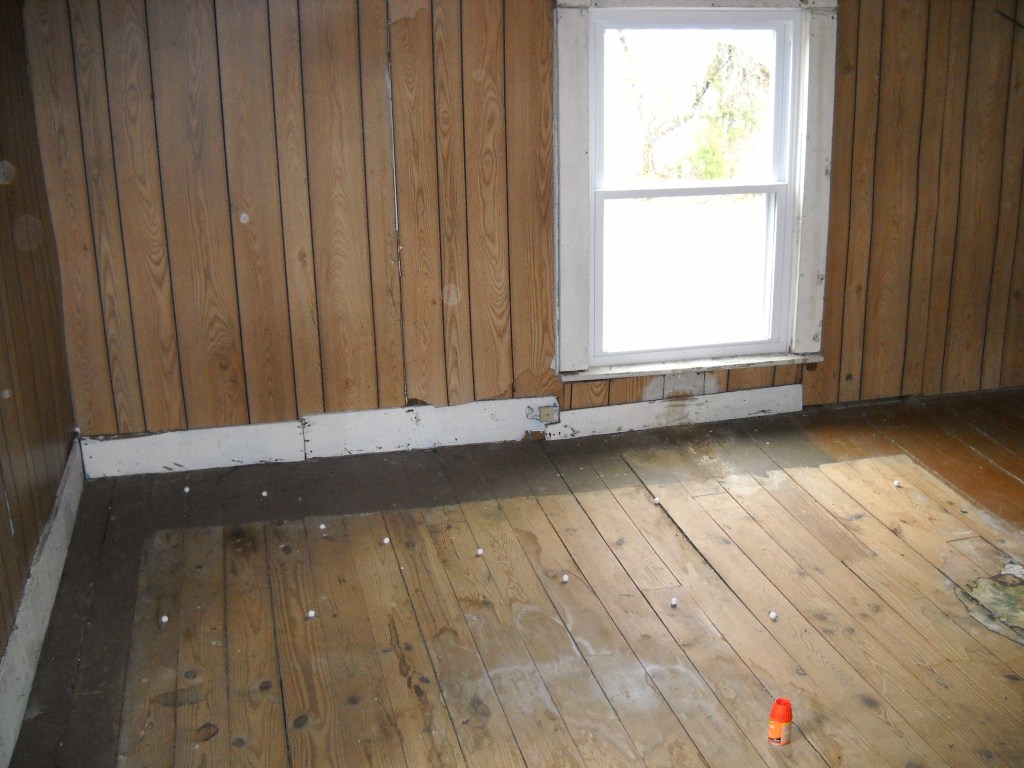
Here you can see the condition of the floor as well as the unfinished molding that might have been left like that by a former renter.
There was a mattress on the floor but no frame, ripped-off linoleum, and tons of garbage that we had to clean out before starting any work. We figured out that the reason for no bed frame was that it was impossible to bring anything upstairs due to the narrow stairway and low ceilings. We had to fold the mattresses using heavy load straps to be able to get them down. We could not throw them outside through the windows. It was a challenge.
The opposite side facing the other room (now the office). Here you can see the many layers of wallpaper, paint, and several materials used by former owner/renters.
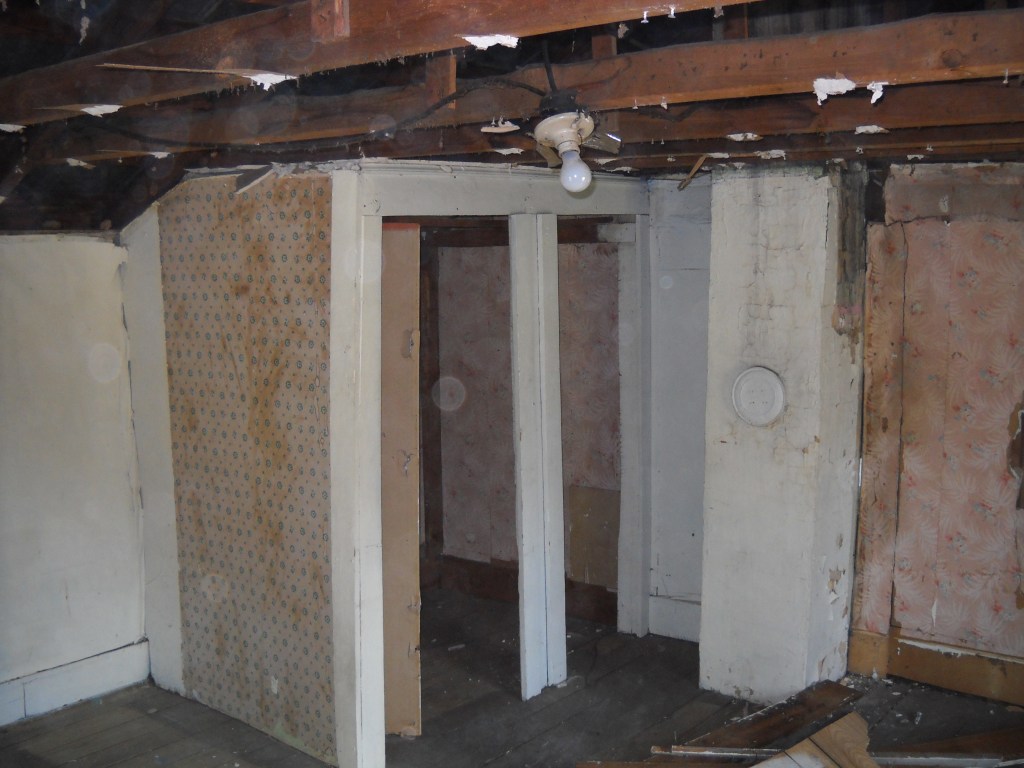
The closet wall was loose; nothing was holding it secure. You can also see the old chimney.
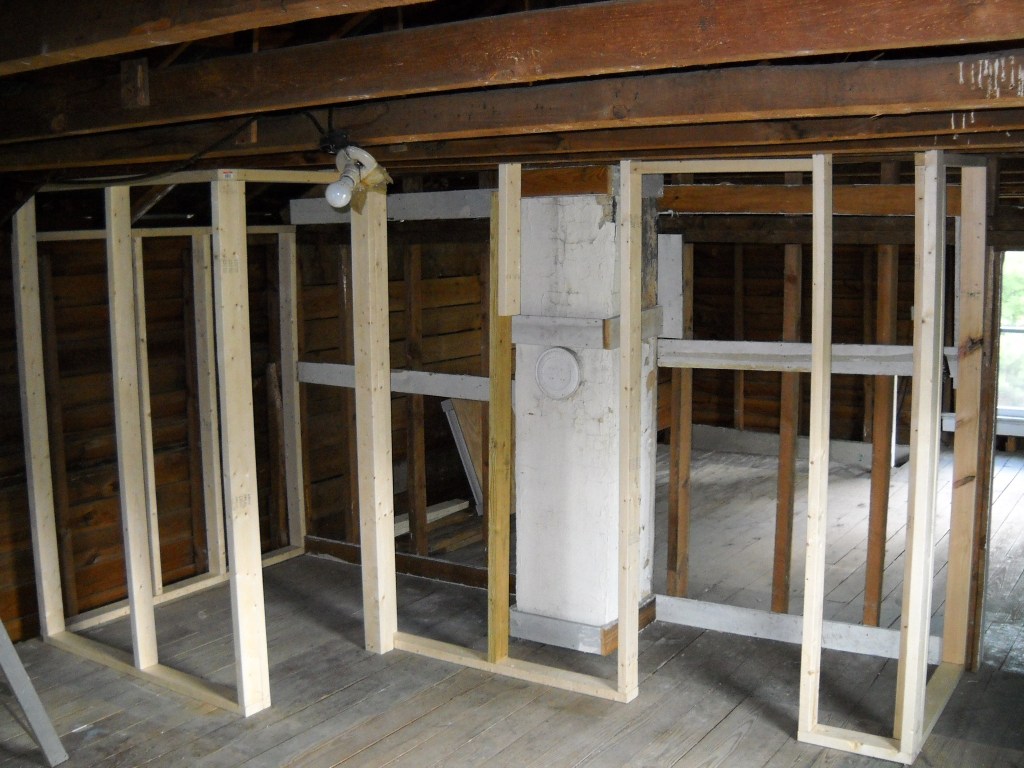
Building the closet. You can see the other room behind (the office).
The other side of the room, where the bed would be located. There were areas on the floor that were painted brown and other square areas were left in the natural wood. I could not figure out why.
Although the closet connects, we decided having two doors and separate spaces was the best option.
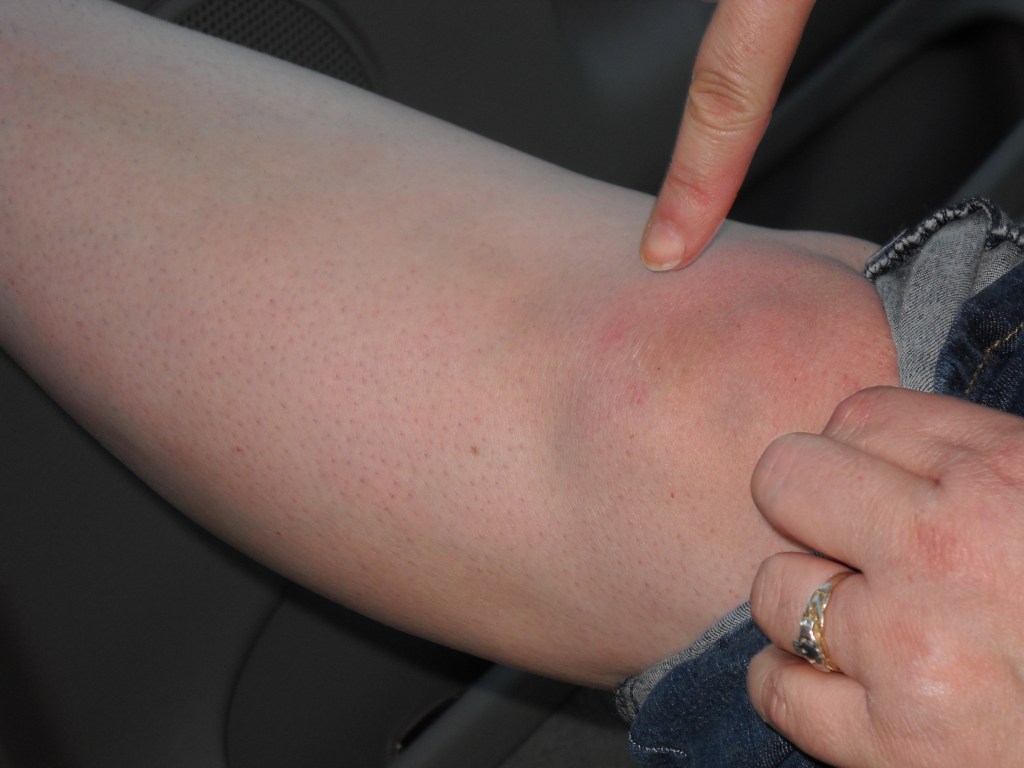
First wasp bite. I was a bit nervous because I didn’t know if I was allergic or not.
Eventually, one gets used to it.
AFTER
The finished side near the entrance that connects the office.
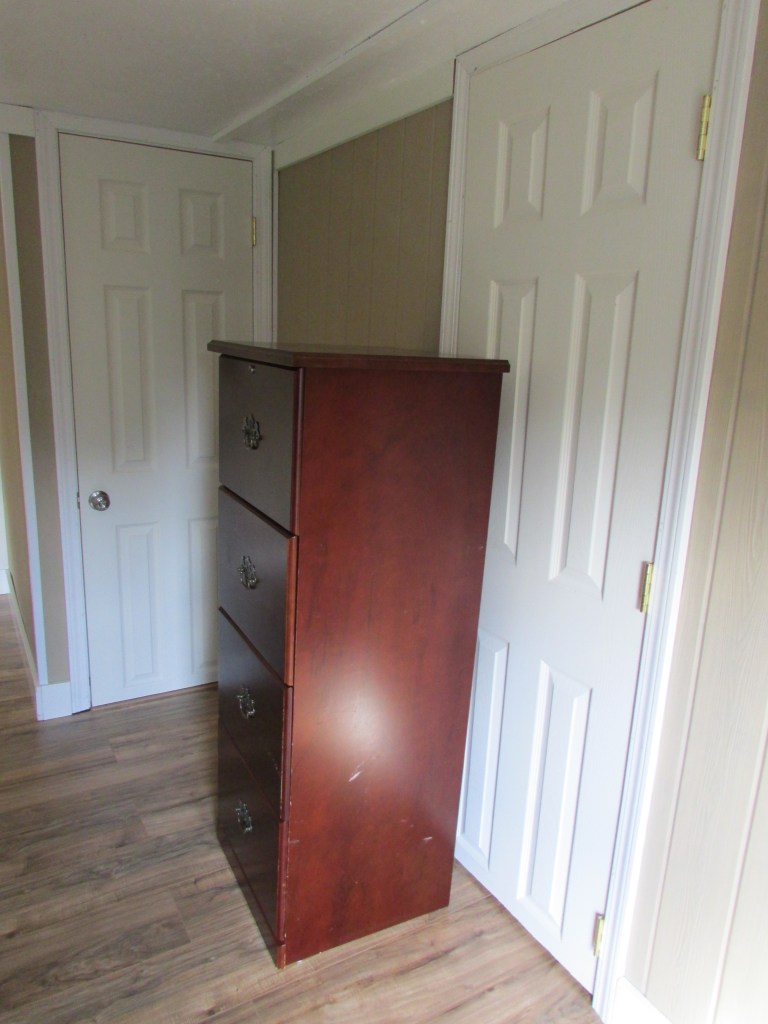
Closet doors have been installed (don’t mind the cabinet that does not belong there). We painted the doors nutmeg.
“Ahh, it feels good to finish one room.”
From the office to the bedroom, at that same spot. Room as it is now.
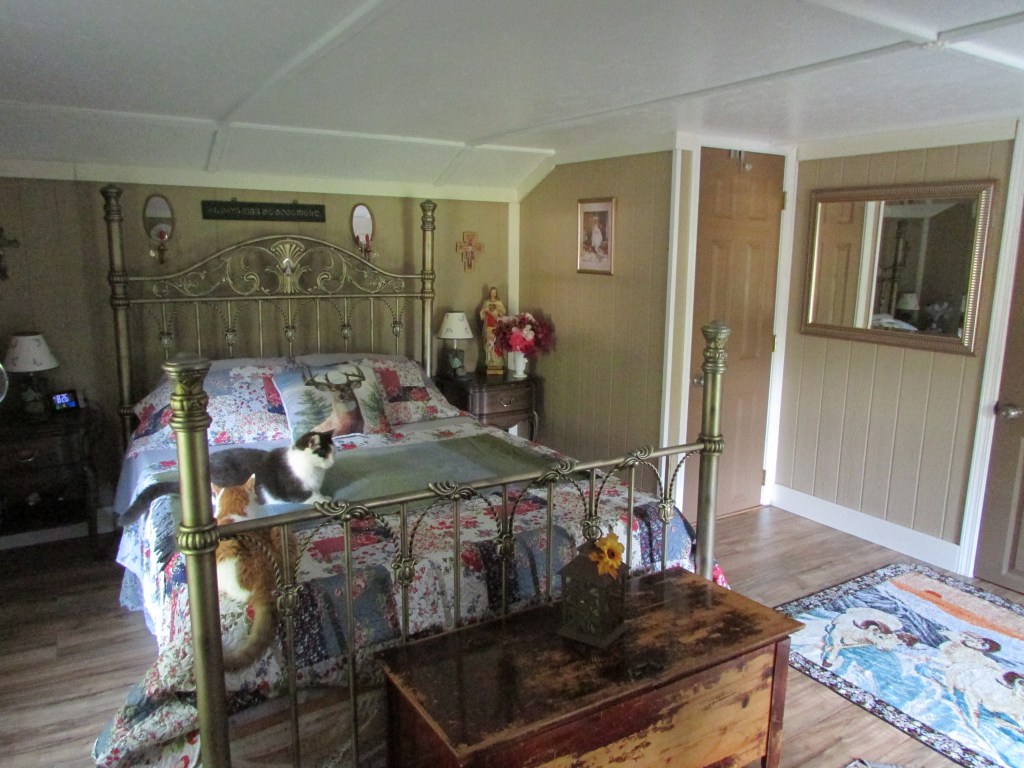
Here you can see the closet doors painted nutmeg, and a few cats.
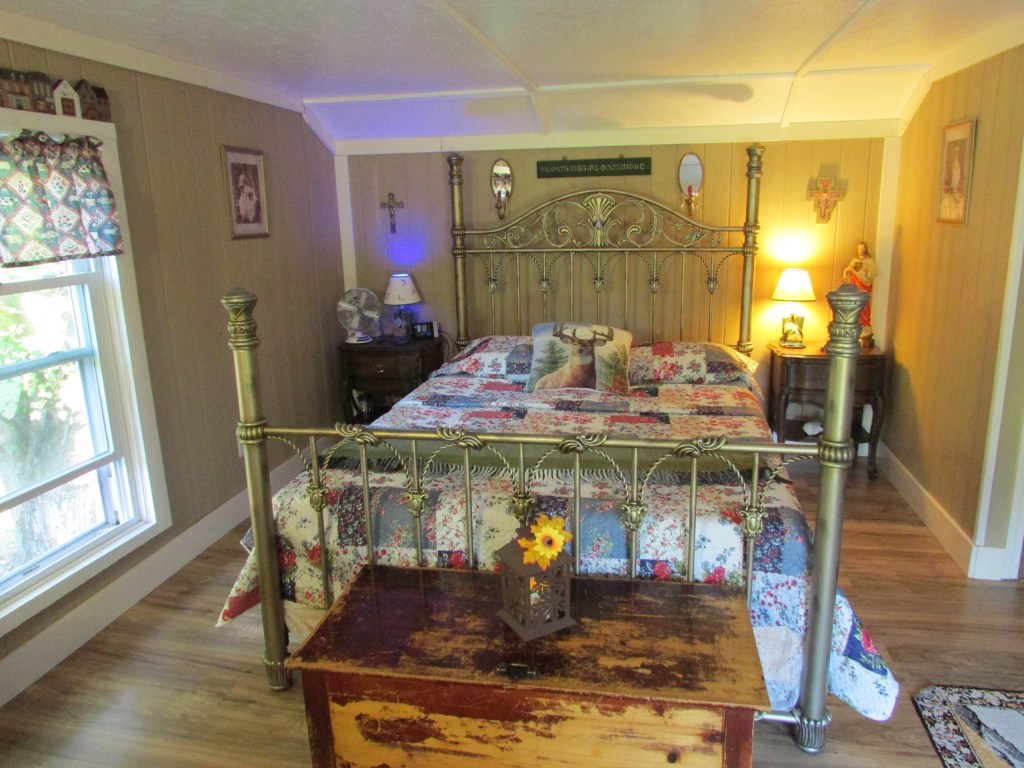
After building the closet there was enough room for a queen size bed and two night tables. The use of the space worked out.
Opposite side.
The cat that came with the house. She was living under the house, and now she has no desire for the outdoors.
This concludes the Fixing an Old Farmhouse series, for now. There is still some work that needs to be done, mostly the porch flooring (slate) and the future installation of a new roof (biggest ticket item). There are a few things to build outdoors, and a garden to develop slowly. I will share more on future posts as we complete each project. It has been a labor of love, exhausting at times but rewarding in many ways, fun too. I hope you have enjoyed the before and after of the process, and hope that in some way, these posts have been inspirational to someone.
The garden is ready to go to sleep, and it seems that the planting/harvest season went so fast this year. I am very happy with what the garden offered, and this year was better than last year. There were a few green tomatoes left in the vine, and the rest is done. I picked what was left on Saturday. It has been a bit cold, a bit early. Last year we lost tons of green tomatoes due to an early frost. Until next year.
Grape tomatoes were a plenty this year.
Yellow tomatoes did very well too this year.
I grew these potatoes in pots; it worked.
This year I learned that potato pants are gorgeous when they flower and more beautiful when they produce this green fruit (poisonous) that looks like a green grape tomato. The seeds inside can be planted ahead of time to grow the plant, but it takes much longer for a potato plant to produce from seed than if planted from the tuber/eye. Who knew?
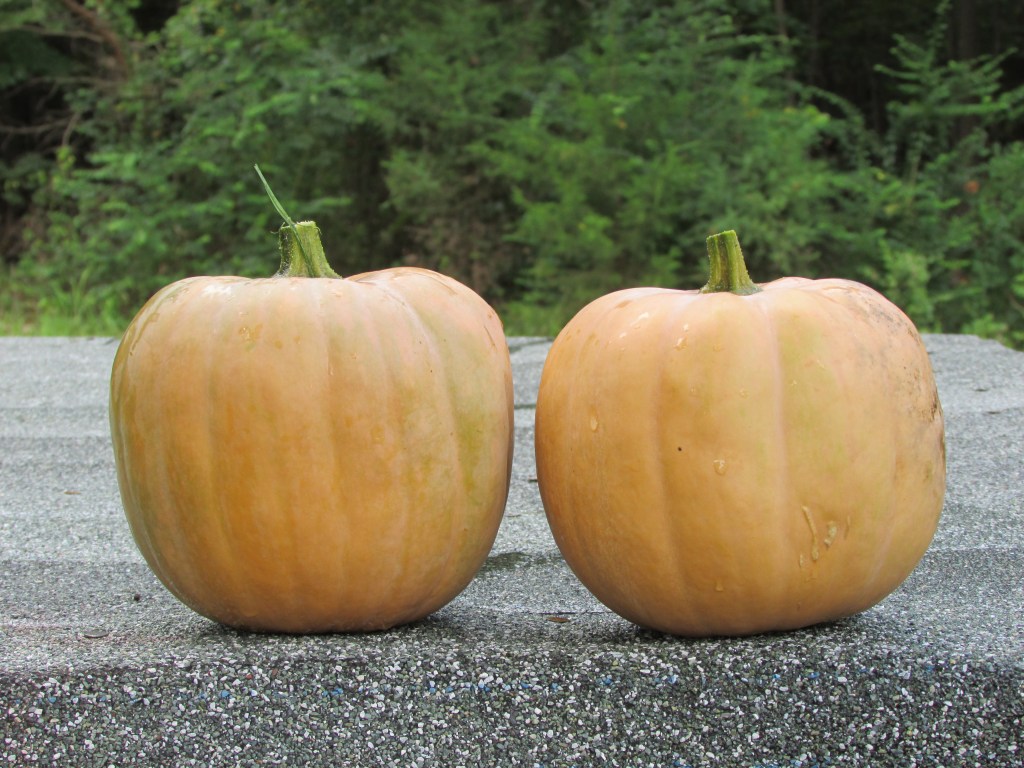
The last two pumpkins.
The first two pumpkins.
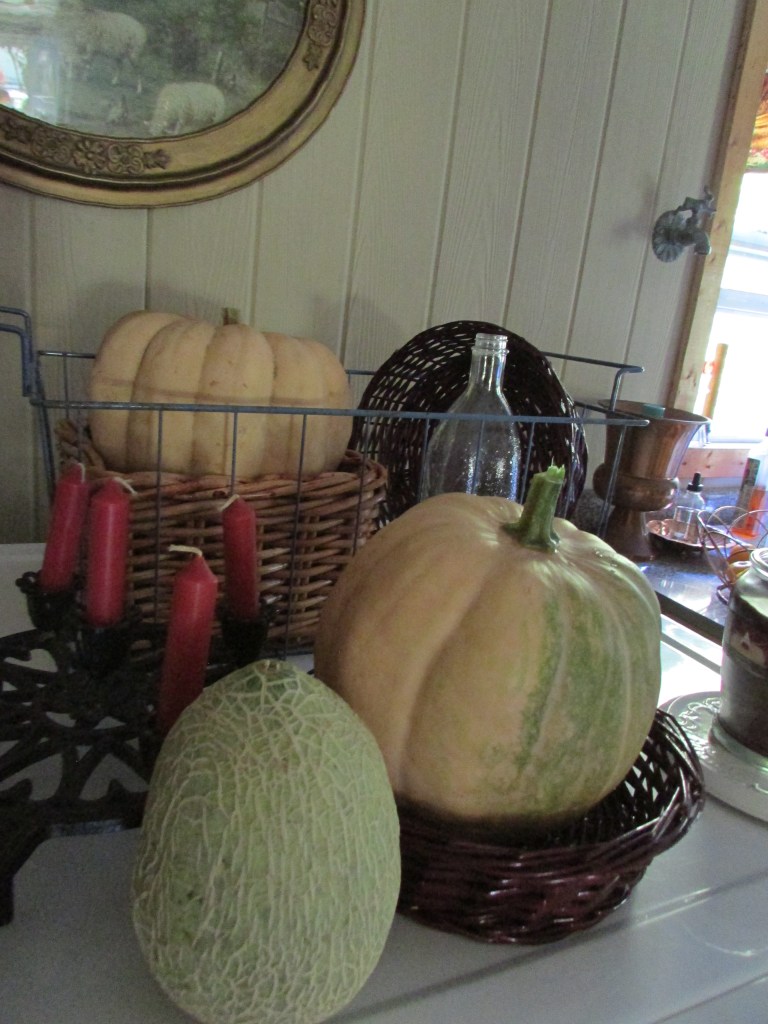
The largest pumpkin we picked sits in the back. I think is the nicest one. We only got two cantaloupe, which we picked a few days early but turn out delicious. First timers.
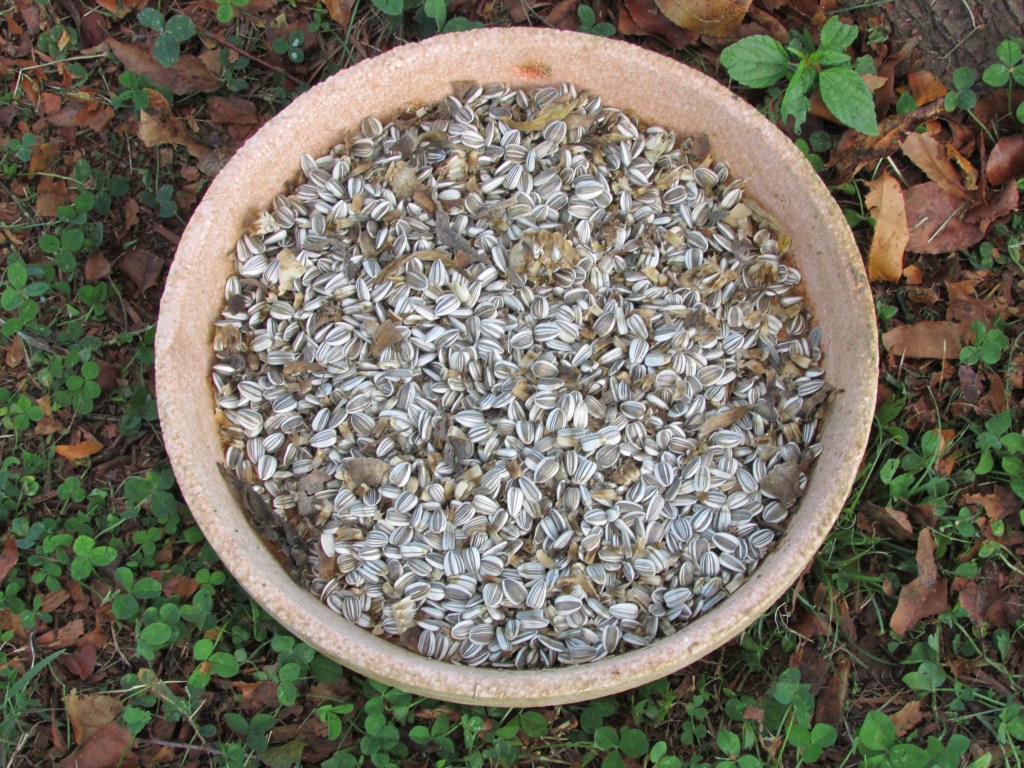
The birds were lucky this year. They enjoyed the sunflowers, and I collected tons of seeds for them. I saved a bag for planting next year.
A round patch of a different type of grass seems prominent this year. I like it.
These colorful beauties are still in bloom and the butterflies are loving them. These get many winged visitors.
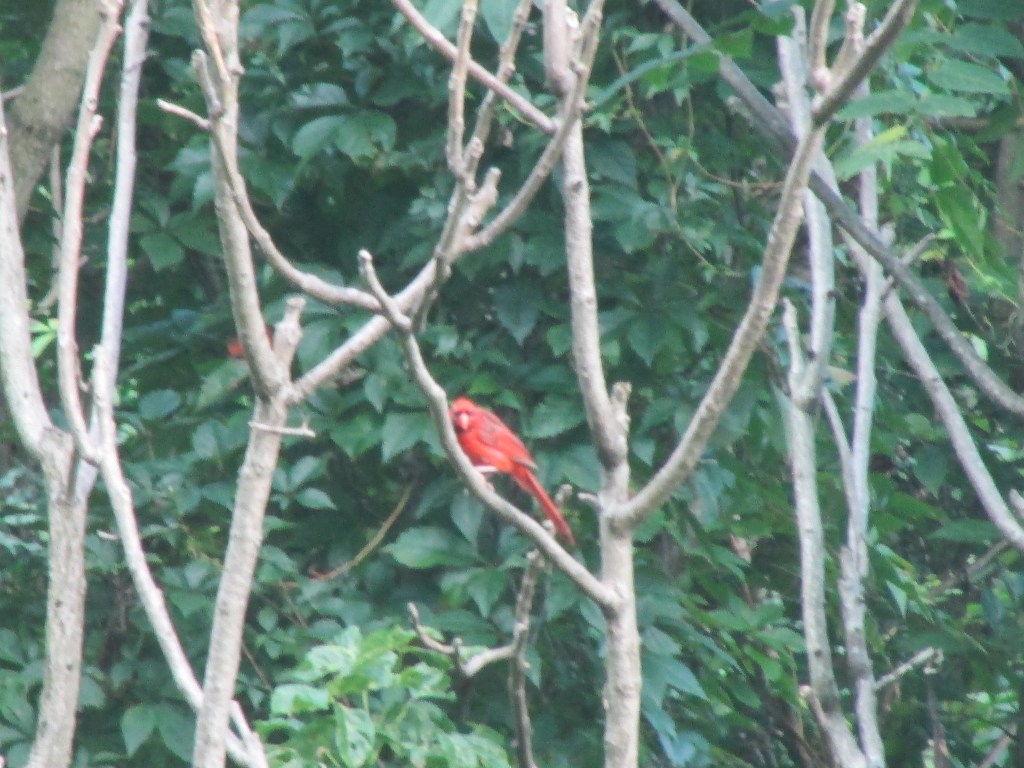
Finally, a better picture of a cardinal. These were hard to photograph. They don’t stay put for long.
A happy visitor who sometimes makes his rounds around the garden. I think he belongs to a neighbor, as I always see him coming from the direction to her house.
A little bird makes friends with a scarecrow. I was lucky to take this photo.
As the garden gets ready to rest, I will be ready for cleanup and ready up for next year plantings. We have enjoyed many blessings from it, and I could not ask for more. Happy Harvest!
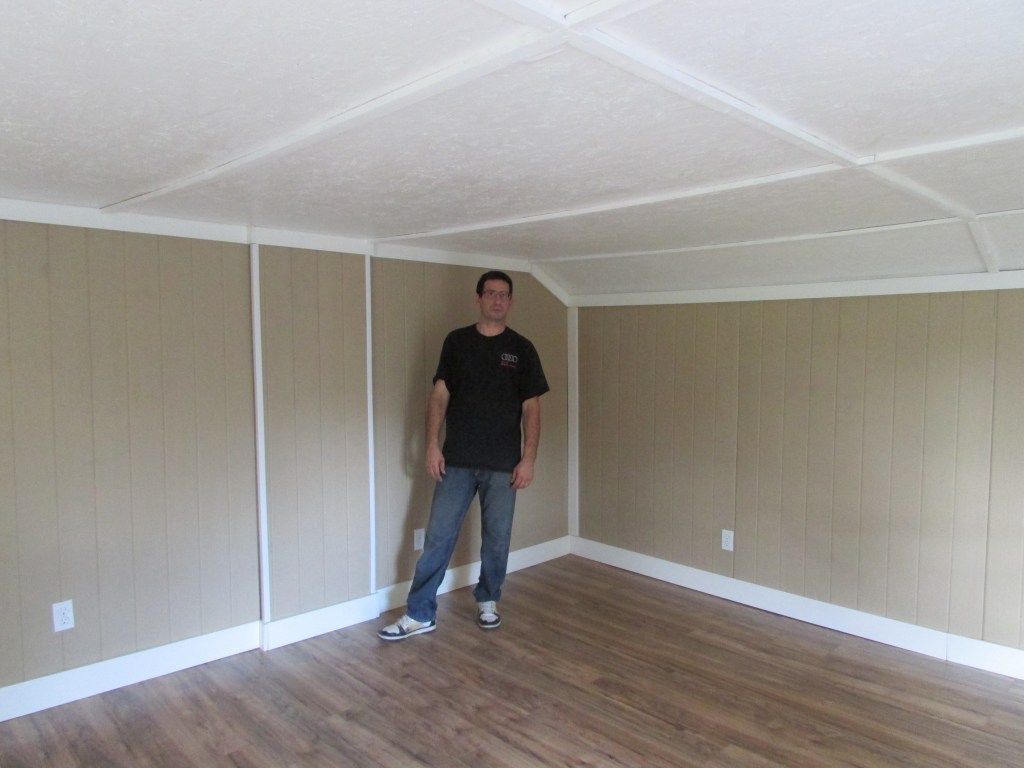
The second floor of this 1910 farmhouse is typical of this type of construction. Immediately after going up the stairway, one lands on the first bedroom. There are no doors, neither a landing. There are two rooms and one connects to the other. The entire space upstairs measures 30×15 feet resulting in two 15×15 feet rooms. These are supposed to be bedrooms. They lack the privacy found in modern construction. We set up the first bedroom as an office. This was a necessary room. Before buying the house, I asked the realtor if there was internet available in the area, if not, that would be the deal breaker. Although broadband was not available, other types of connections were. This room was the second to be finished. The floor was in good condition, however, some boards were loose. The walls and ceilings were in bad shape – holes, dirty, mismatched materials … The chimney in the center of both rooms had to be covered, and some wood beams had to be reinforced. There were birds nests, wasps nests, garbage, debris, and even vines growing inside. As any other room in this old house, it required much work.
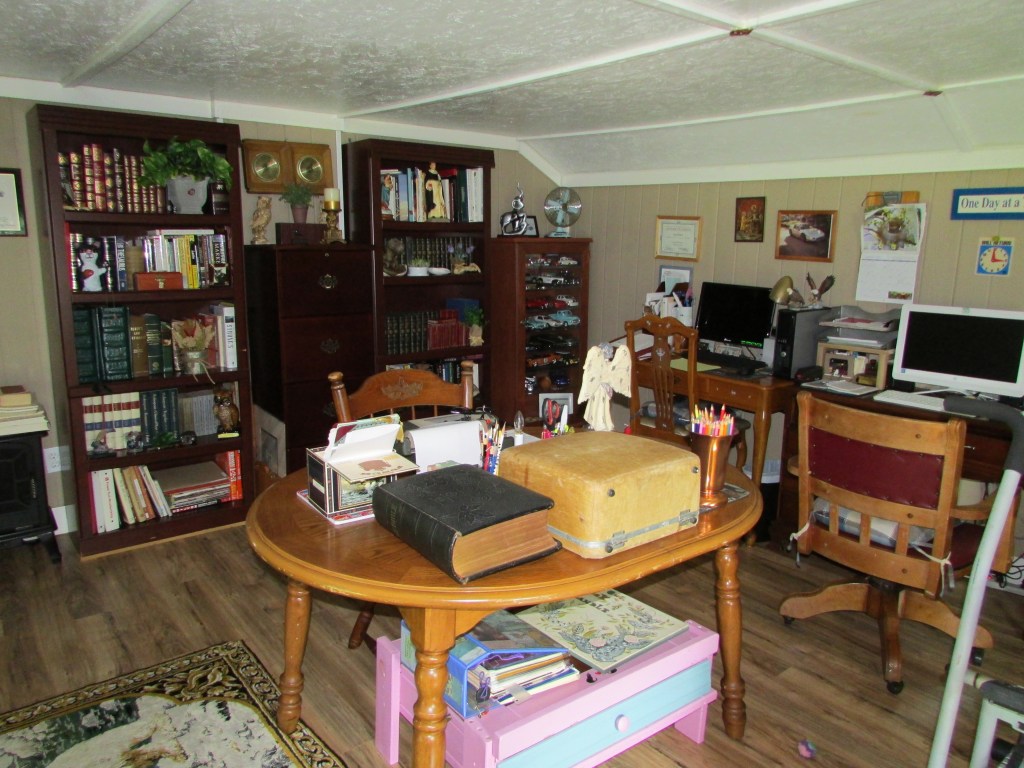
The ceiling in this room is lower than the ceiling downstairs, something that made installation a bit easier for us. I found this room challenging in the sense of the difficulty of bringing material upstairs. In fact, we had to make an opening through the kitchen wall to be able to bring panels, wood, flooring, and long pieces of wood because the stairway was difficult to navigate at its angle, and many things would not go through. The steep incline and the narrow steps presented a challenge as well. By making this opening in the kitchen we were able to go straight up. Later on, when we were done, we closed the wall opening. Another challenge with this room is that I don’t feel it quite ready/finished yet. I call it the messy room. It is were we work/study and it serves as an art/craft room as well. It is a room in progress as far as setting it up. It needs better storage. Due to the low ceilings, it is very hot during the summer. Autumn and Spring are the seasons when this room feels more comfortable as far as temperature.
Before starting work upstairs we had to clean and get rid of a few pieces of very dirty broken furniture that were left, and other scattered items, clothes, garbage and broken pieces … One feature in this room that I liked and we kept was the original banister/handrail that prevented someone to fall through the stairway opening. It was loose, so we reinforced it, replaced the base wood, and painted it. I also like the fact that the windows are floor to ceiling due to the low ceilings in both rooms. The cats love this feature too. They love to look outside, and they don’t have to climb on the window sill. Although the floors were in good shape (if sanded and polished), the openings between some of the wood boards were uneven or a bit wider than we wanted, so we installed new flooring, as we did on the first floor.
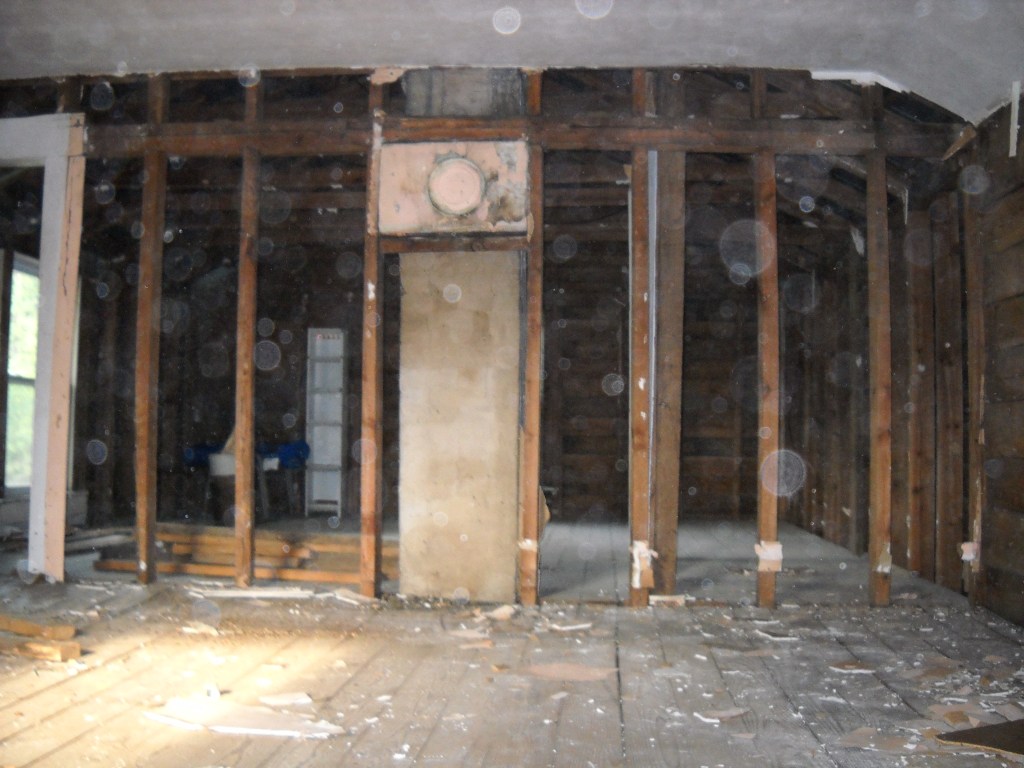
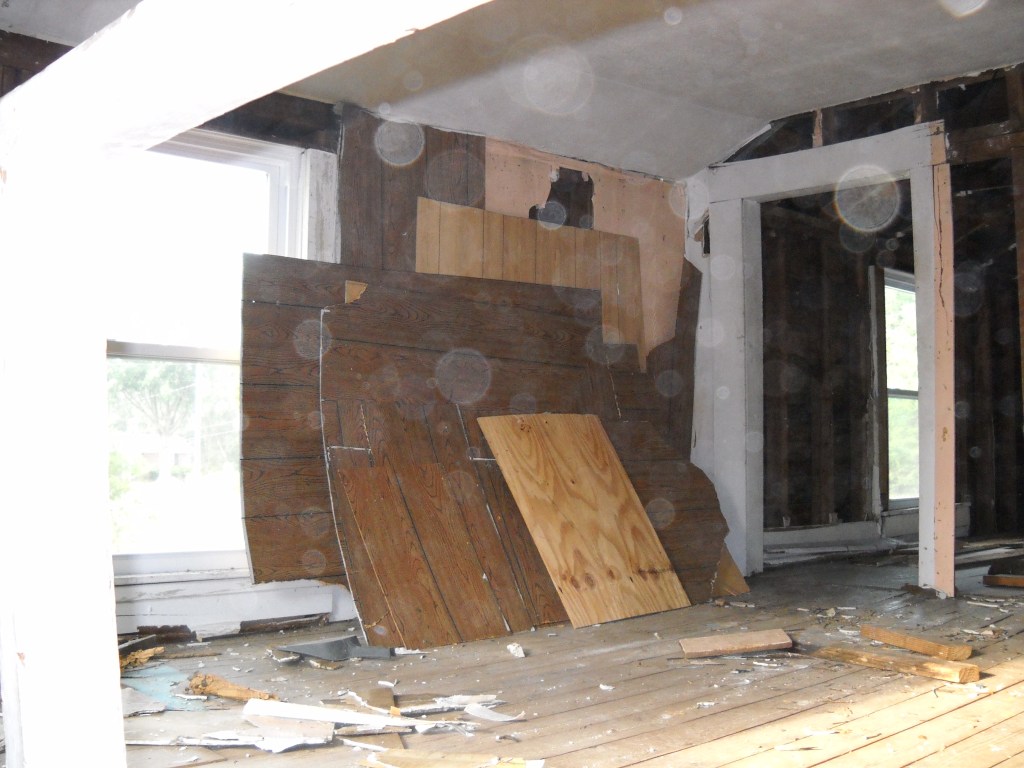
Here are a few pictures of the before, during, and after process. Please excuse the dust orbs on the camera lens due to flying dust.
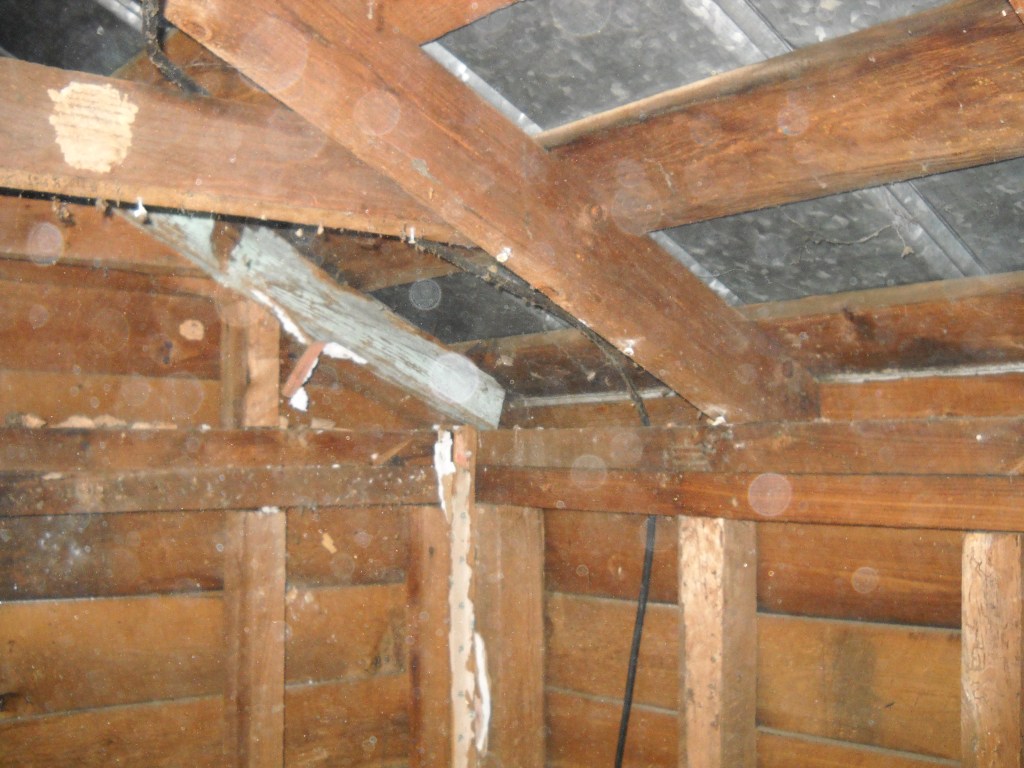
Here you can see the mismatched materials, various layers of wall paper paint, and condition of the walls as well as the floor.
Here you can see the type of construction typical of that time with the boards going across. You can also see the two low windows.
View to the other room. The chimney is in the center of both rooms.
Abandoned bird nest.
During the mess. The entrance to the other room.
The opposite side of the room right where the stairway opening is. You can see the lower level (kitchen) through the opening below.
Here you can see the metal roof. The inside of it is well preserved and amazingly, the upstairs did not have any leaks, only the kitchen part. That is one of the reasons we were able to coat the roof until we can install a new one.
AFTER
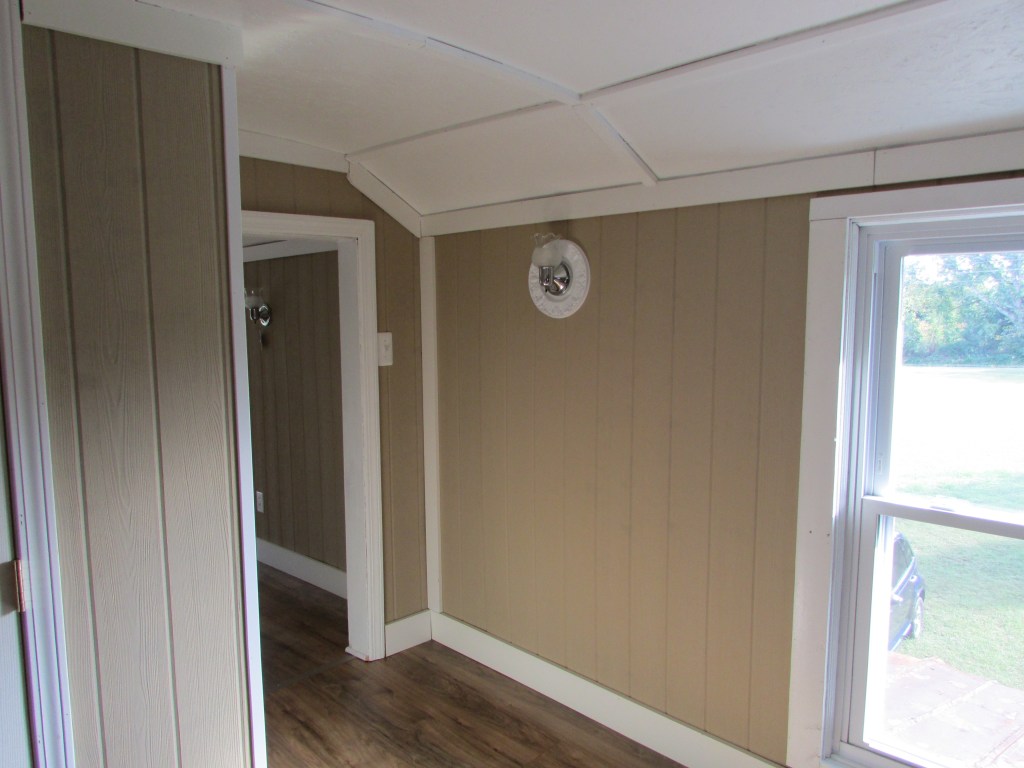
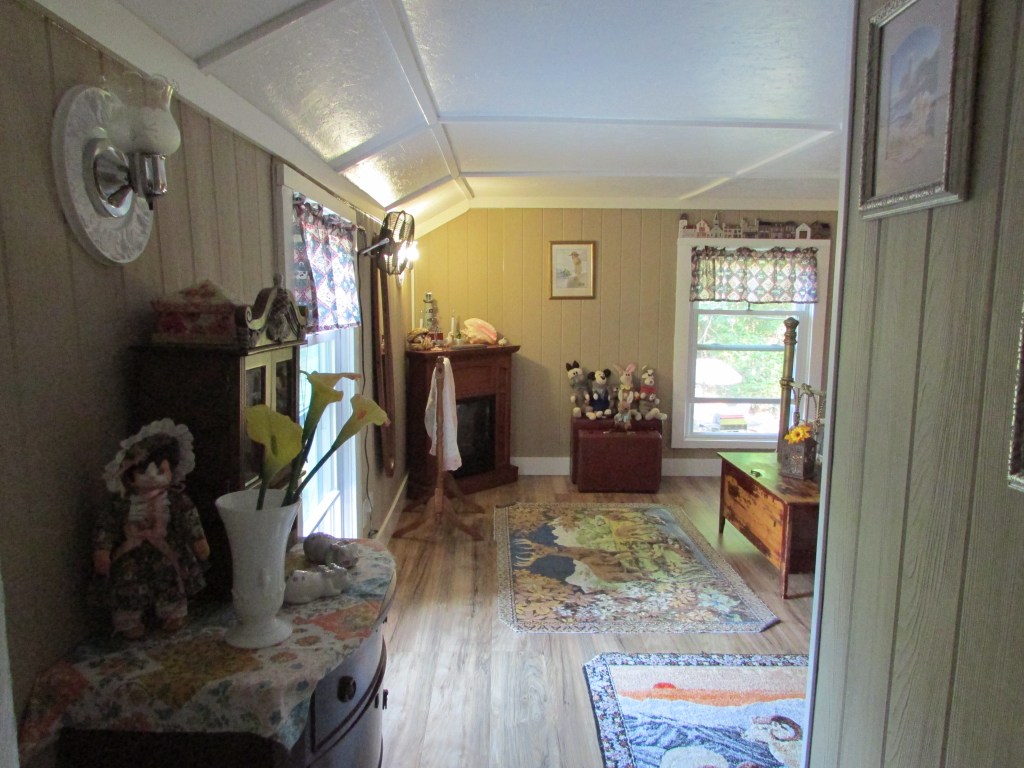
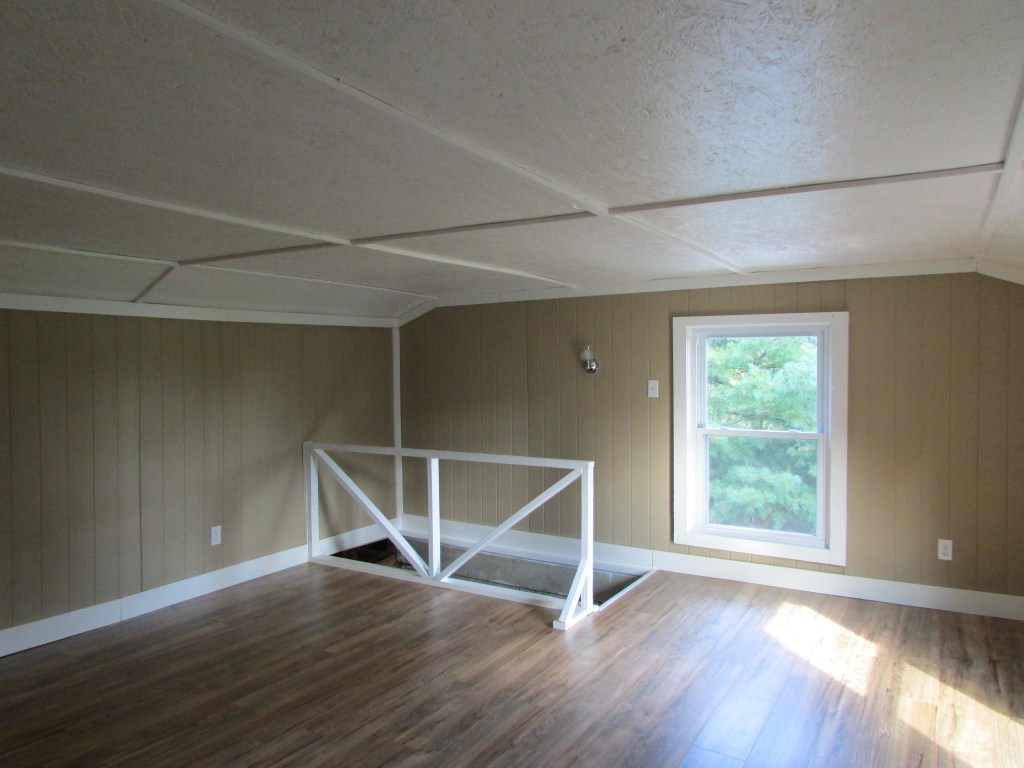
The room finished. Here you can see the original farm style banister that we kept as well as the floor to ceiling windows. I love the barn-like shape of the room.
Another view.
Here you can see where the chimney is covered.
Opposite wall. Here you can see the entrance to the other room. Because the ceiling is so low, we had to install the lighting on the walls. And for the same reason, we could not install ceiling fans.
Here you can see the type of lighting we chose.
Room as it is now.
A view of the room now from the same angle.
It is a room in progress.
Another view near the stairway and first window.
Update – Some minor changes (2021)
Fixing this old farmhouse has not been easy. By sharing these posts, I don’t want to give the wrong impression that it was a breeze to do the work. It was not. My husband and I did all the work and it took a lot of effort, patience, dedication, stamina, hope, courage, and faith. We operated in a cash only small budget, hence why we did mostly everything ourselves, and hired the experts where it counted. There were days when we doubted, we were extremely tired physically, mentally, and spiritually. There were days when we were grouchy and days when we were very happy, days when we felt we could vaporize each other if we could, and days we enjoyed working together and had fun. We had good times, bad times, horrible times, and great times. It was not easy but it was worth it. If you ever decide to take on a similar task take all factors into consideration – finances, health (physical, mental, and spiritual), disposition, and what you can do and cannot do as far as skills. It is not a job for one person; it takes two at the minimum. It does require a lot of physical work, and you might have to forgo your fear or disgust of bugs (big and small), dirt, the gross and disgusting, and any other surprise that might show up. On the other hand, if you are up to it, it is very rewarding and it feels good once you are done. These posts are meant to inspire the reader, as well as give an idea of potential, and encourage you to see things from another perspective, one of hope, vision, and possibility. I hope you enjoy this post.
Sunrise Souls is the last book in The Dinorah Chronicles trilogy. This post is about a happy coincidence that happened one day at an antiques market. Serendipity?
Sunrise Souls is set in Rignano Garganico, Italy. Rignano Garganico is a southern little town in the Province of Foggia, Italy. It is a jewel, a little secret that sits atop a mountain, and rich in history, as it dates back to medieval times. When I imagined the setting of this book, I had in mind a picture of where I wanted Dinorah Sandbeck to be located for her last adventure. I knew it had to be in Italy, but preferably not near the Vatican, as this location plays a part in the story. I had a strong mental image, but had no idea where to find this place; so I armed myself with Google Earth, and asked, “If I was Dinorah Sandbeck, where would I go?” Immediately, I felt a pull to the area, and started my search nearby, and soon enough, I found myself navigating the streets of Rignano Garganico. It was a magical and serendipitous moment; it was the image I had in mind, and more. So I dedicated time to research as much as I could, although I didn’t find much information, but what I found was enough to give me a background on this enchanting place. Here is a small excerpt from Sunrise Souls.
The southern little town in the province of Foggia sat atop a mountain, as if it was the entrance to heaven. The crisp white clouds were reminiscent of watching angels, only to be forgotten by the observer when the valleys bellow revealed a majestic panorama. At first, I was intrigued by it, but now, I was enchanted. Rignano Garganico was growing in my heart. (The Dinorah Chronicles – Sunrise Souls)
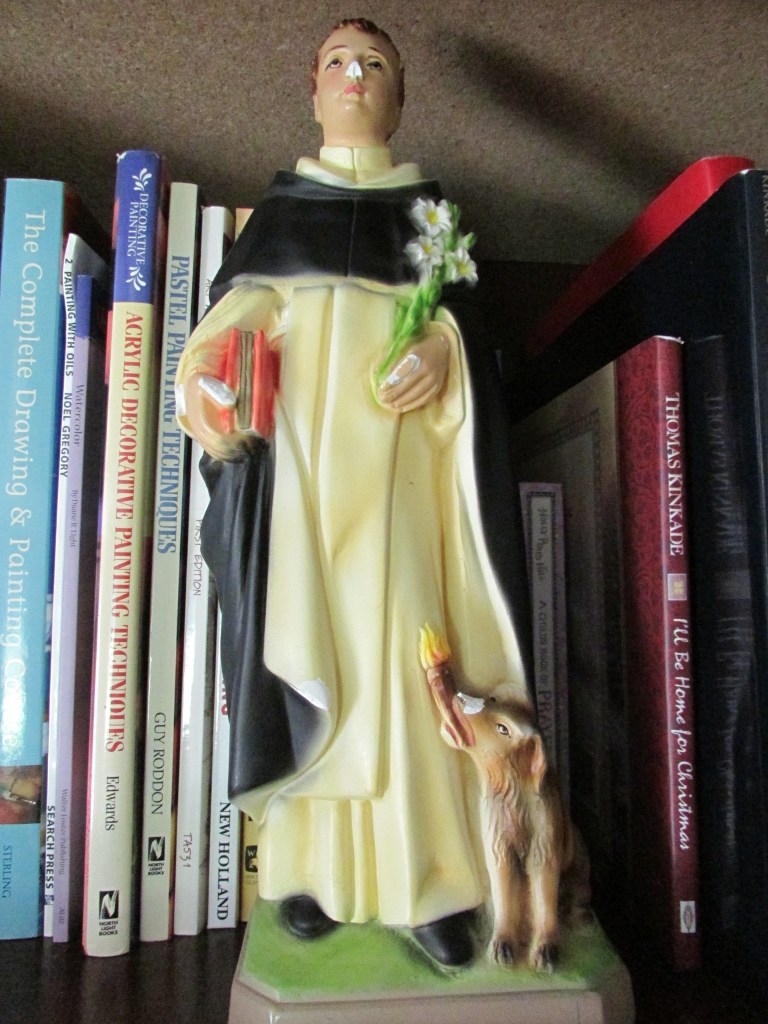
I love old things. I also like religious art; I find it intriguing as well as beautiful, whether it is a painting or a statue, or even a piece of old jewelry. The detail is gorgeous in many of these pieces. When I lived in New Jersey, I used to visit antique markets/shops from time to time. One day, I was browsing the items one seller had to offer, an older Hungarian man I had bought from before. He was a pleasant man, calm, very polite, and always with a smile on his face. As I kept browsing, I noticed he went to look for something. He came back with a beautiful statue and smiling he said, “This one is for you, a gift.” I said thank you and offered to pay for it but he insisted it was a gift. So I thanked him again, and conversed with him a bit before paying for other items, and then I left. Later on, I realized I had forgotten to ask him about the religious statue, so I researched as much as I could about it. One of the searches took me to Rignano Garganico. I became excited; “What are the odds?” I thought. I was writing a novel that was taking place in that same place, a place not widely known. I found out that it is a statue of Saint Roche (San Rocco), patron of Rignano Garganico, Italy (Saint day is August 16). I did not know what to think; it was a beautiful coincidence. Perplexity, awe, amazement, these words describe best what I felt when I came across the information. It was the last time I saw the old man. I did not get the chance to visit him once more, and I moved to Virginia. One question hovers in my mind until this day – how did he know, or did he?
Here is a picture of this beautiful gift. Even with its chipped parts, there is beauty on this piece, and I love the detail and the colors, which the picture does not show well.
Saint Roche vintage statue.
The beautiful old statue sits in my office, on a bookshelf, a pleasant reminder of the mysteries of life, and it serves as inspiration when the inkwell seems a bit dry.
“By wisdom a house is built and by understanding it is established; by knowledge the rooms are filled with rare and beautiful treasures.” Proverbs 24:3-4
I think that the stairway of this home deserves its own blog post in the Fixing an Old Farmhouse series. After all, it was my favorite feature inside the home. When we saw the interior of this old farmhouse for the first time, we did not think that we would be able to save the stairway. A few steps were broken, other steps were loose, however, the structure felt very solid. It felt stronger than the brand new stairway we had in our Jersey home. We knew that the steps could be fixed, and the wall it was attached to could remain as long as we patched it and painted it, so we decided to keep it, along with the unusual rounded post at its end.
I had selected a vintage green for the walls that I kept in storage for a little over a year. There must have been something wrong with the paint because when I opened the can it was as hard as a rock. I was disappointed. A little voice inside me whispered, “mix all those leftover paints.” Those were almost-empty cans of paint that we decided to keep from our former house. I opened them, and to my surprise, those were still looking good. The cans were over nine years old – sage green, blue, gray, and white. Because I had nothing to lose, I decided to try it, and I mixed the paints. Something magical happened. I was staring at the original color of the wall, the first layer of color that was ever applied. You can see it here.
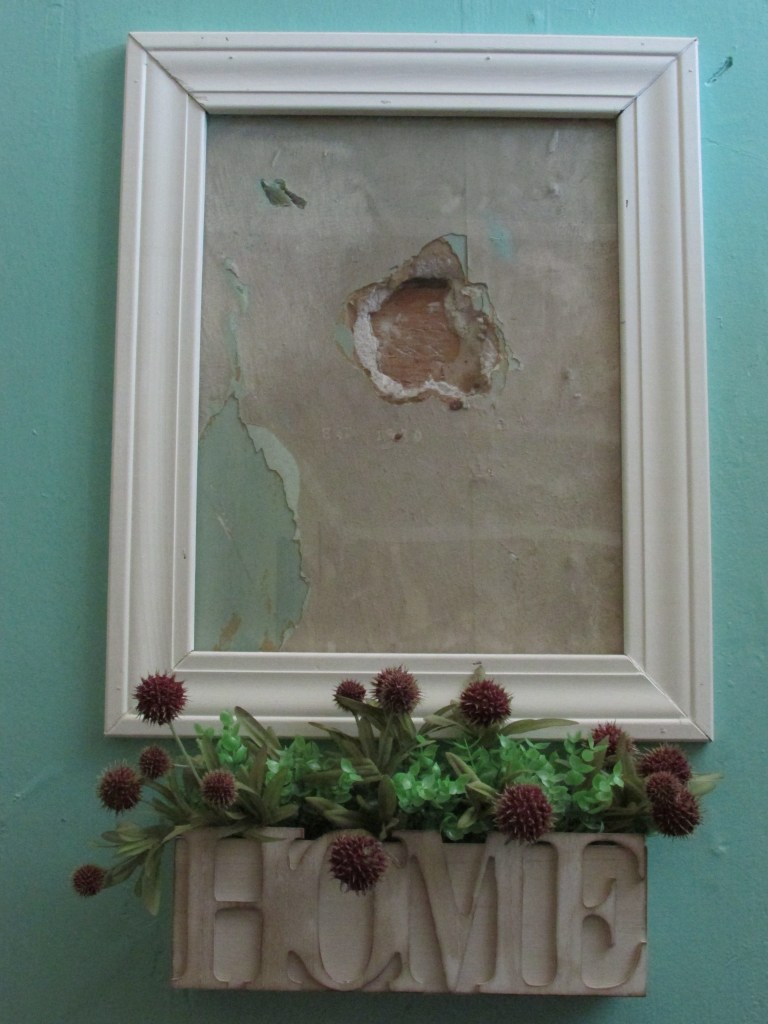
We kept a section of the old wall as a reminder of where we had been, and all the work we put into it.
I ended up painting the wall that color. There was enough paint left to do the closet in the living room. Sometimes, a house knows what it wants; listen to it. We replaced some steps, patched the wall a bit, and reinforced what needed to be. We painted the steps Leather Brown, and put moldings where there were none originally. If you look at the wood above the wall, you can see the way it was cut originally. It is a rough cut, as opposed to the factory cut and finish we see today. I love that character. The stairway is one of my favorite features of this house. The handrail is made from a tree that hurricane Sandy knocked over in the back of our home in Jersey. We sanded and glazed it. It serves a purpose and it is a memento as well. Here are some pictures of the process.
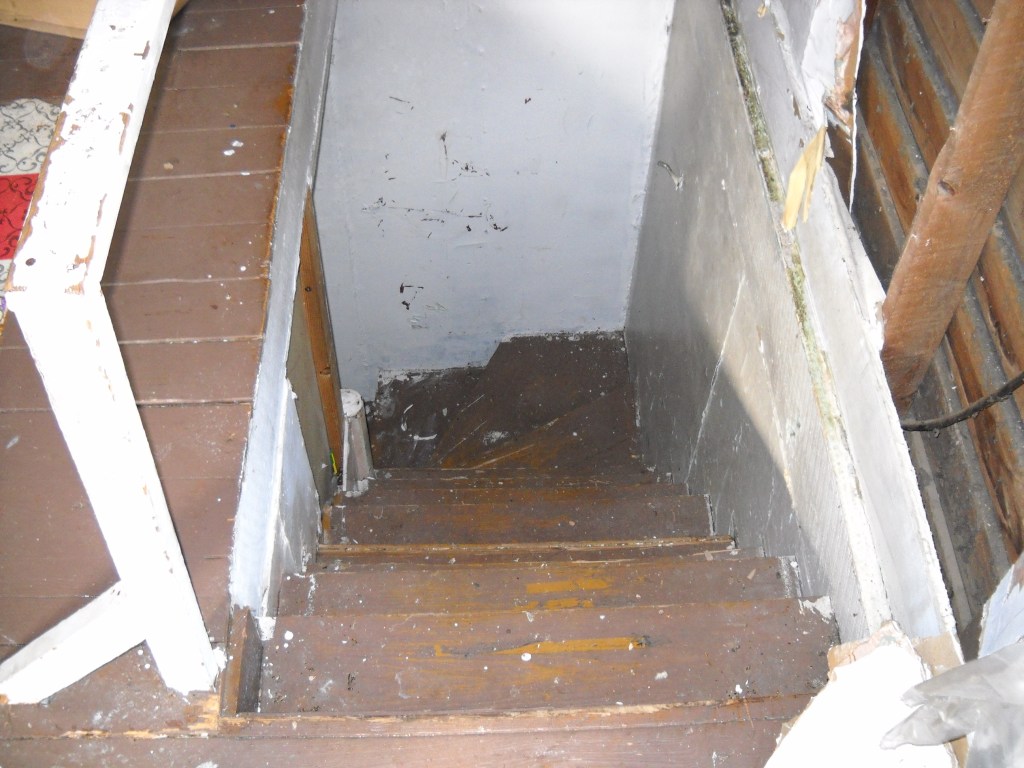
Before.
View from the second floor after rough patching some parts.
We had to open up the wall to be able to bring materials upstairs. Here you can also see some of the steps we replaced, the idea of framing the hole on the wall, as well as the odd round pole.
Before opening up the wall. We opened up the stairway wall as well.
View of the steps and the ones we replaced.
After
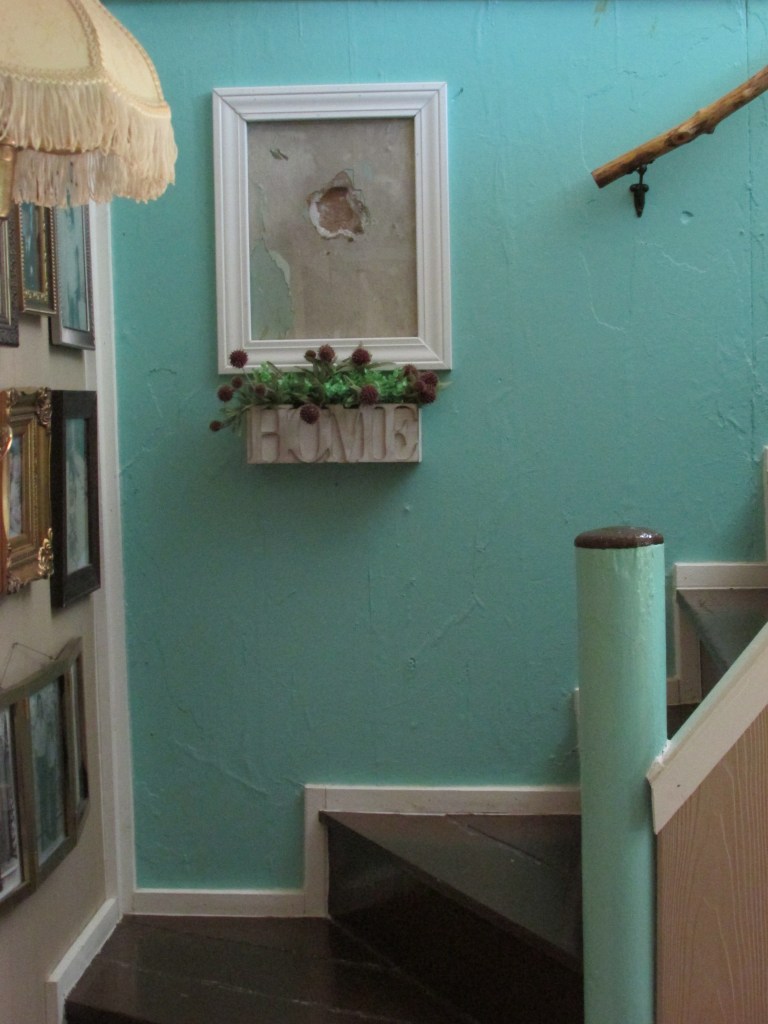
Steps had been fixed, wall fixed and painted, and moldings applied. When we patched the wall, we left some of its character, sort of a rough finish.
Here you can see some of its rough character a bit better, and the rustic handrail.
I hope you enjoyed this post about fixing these old steps. I am glad we worked with their character and did not take them down. It would have been a mistake.