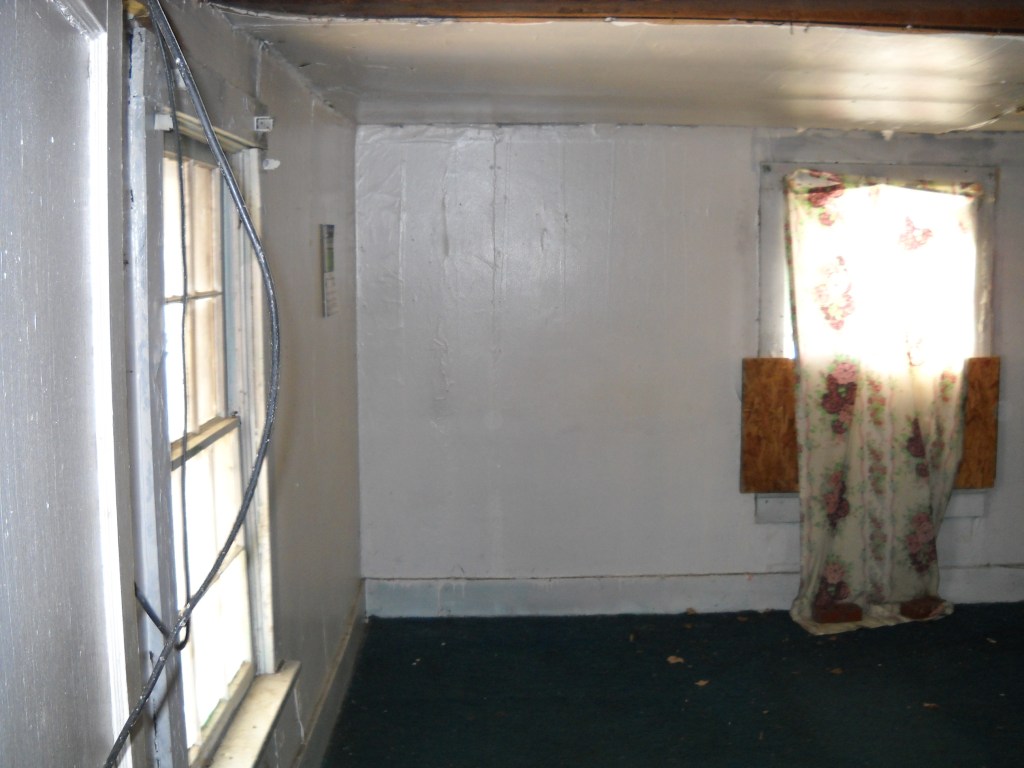
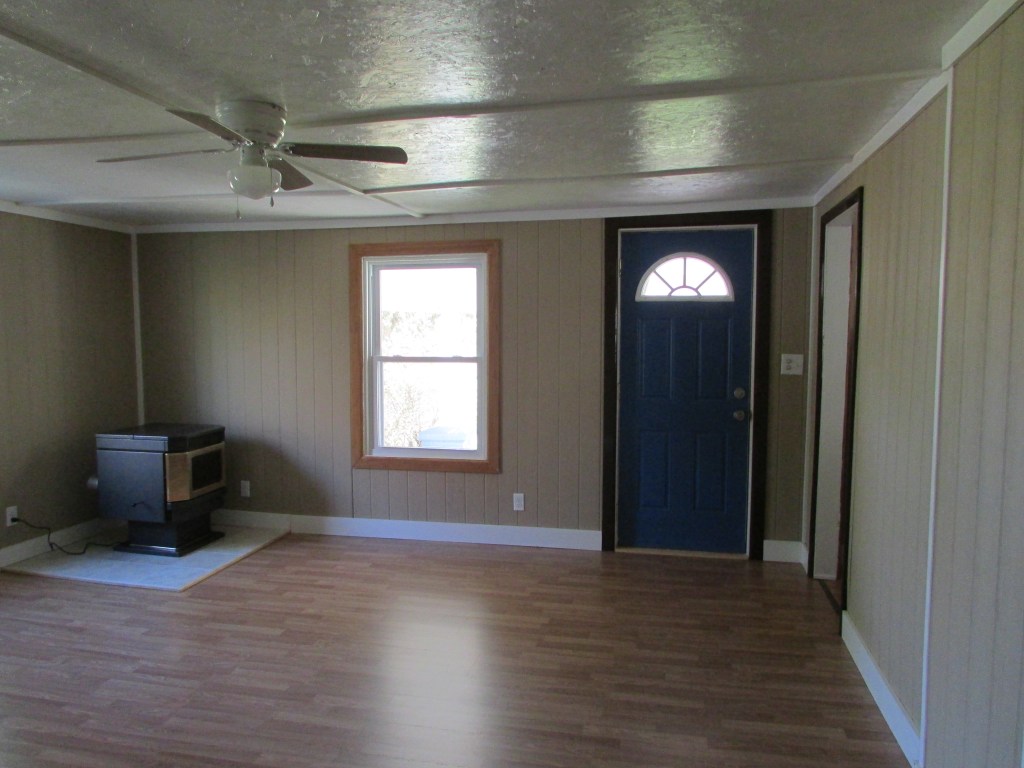
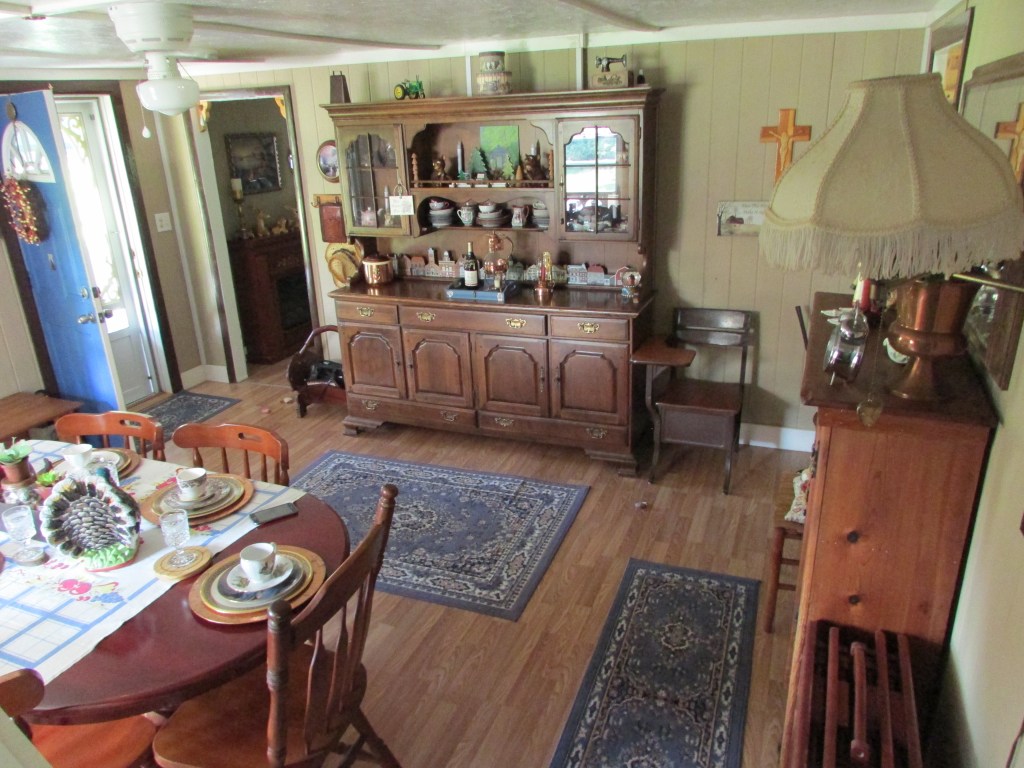
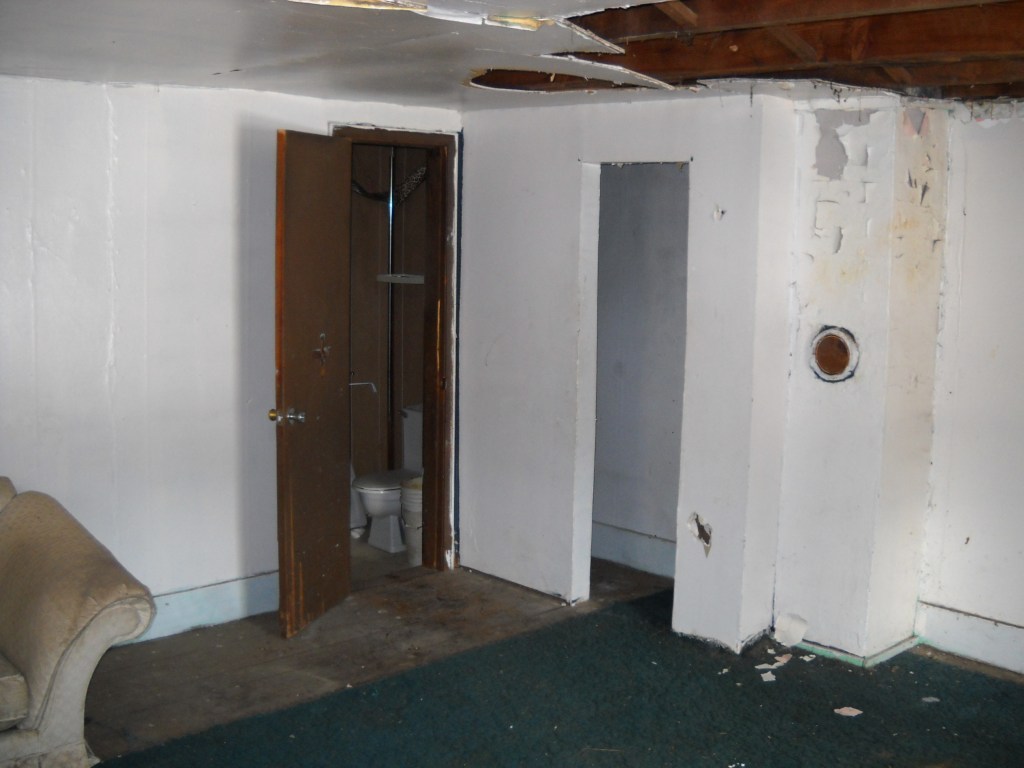
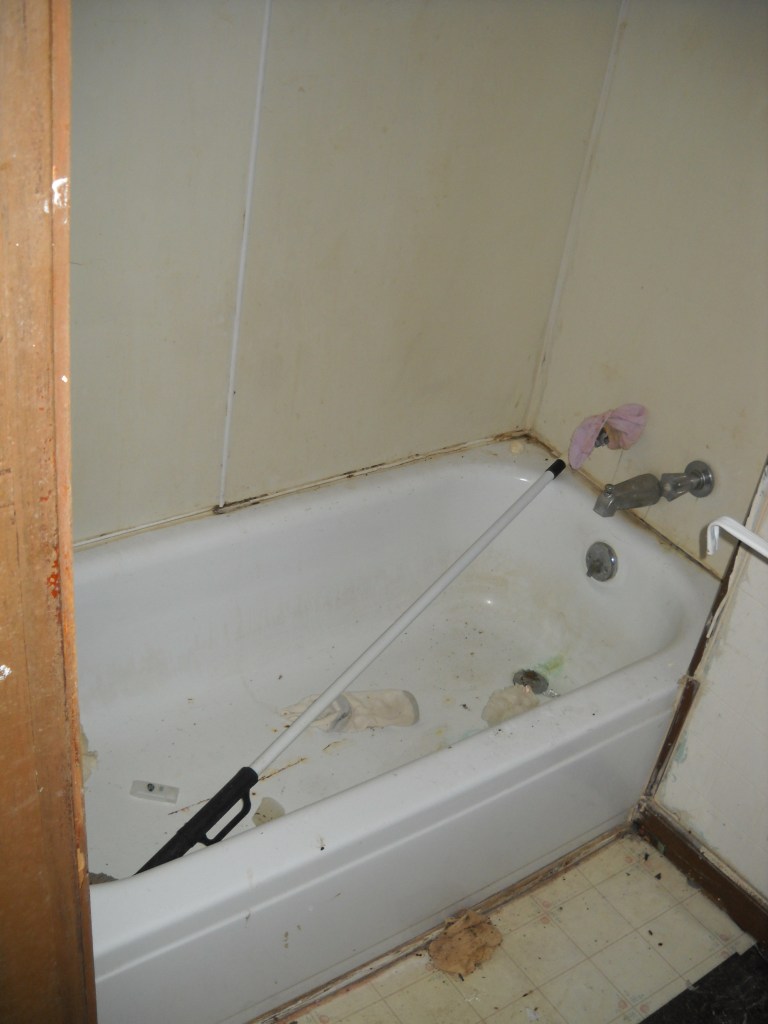
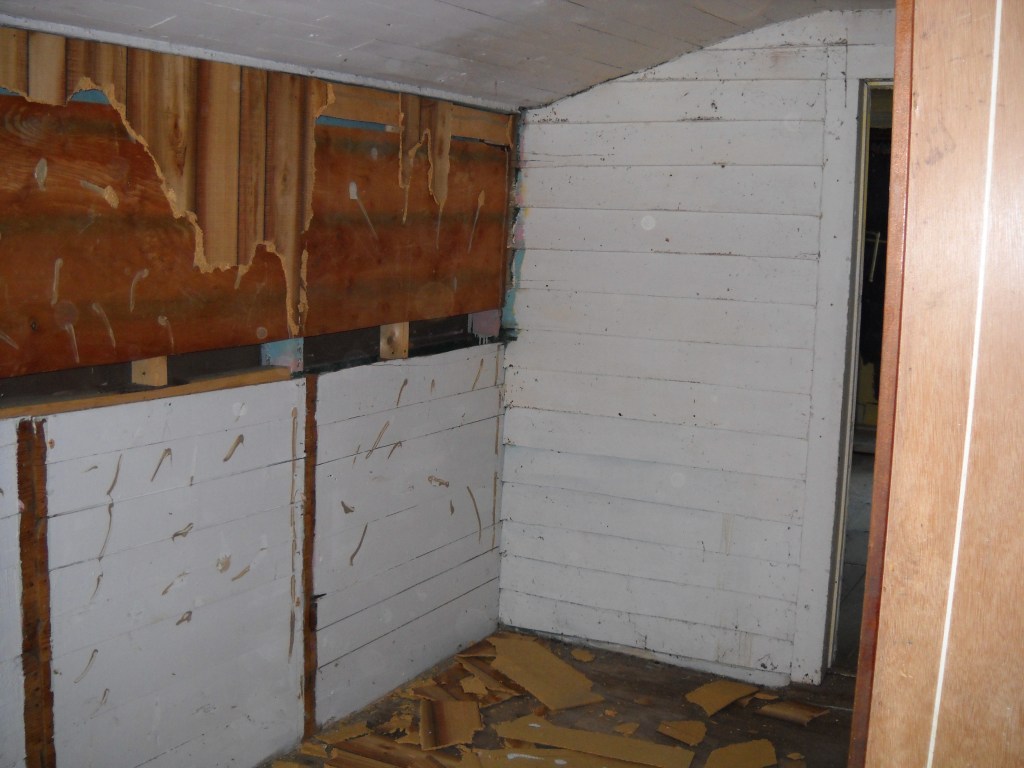
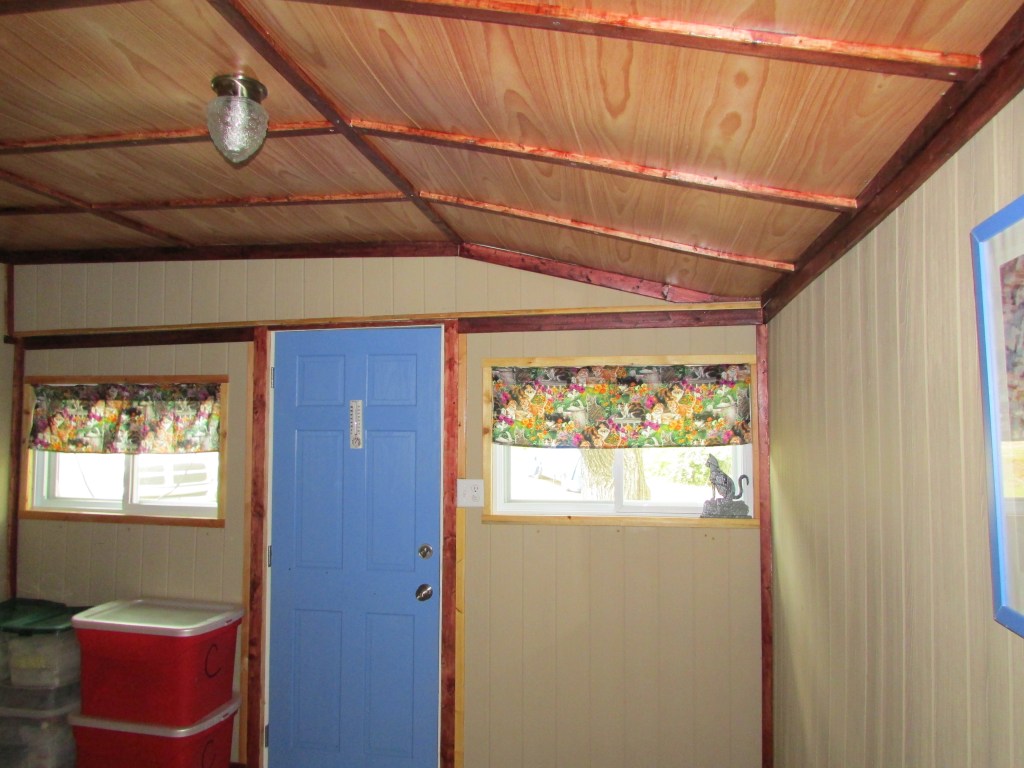
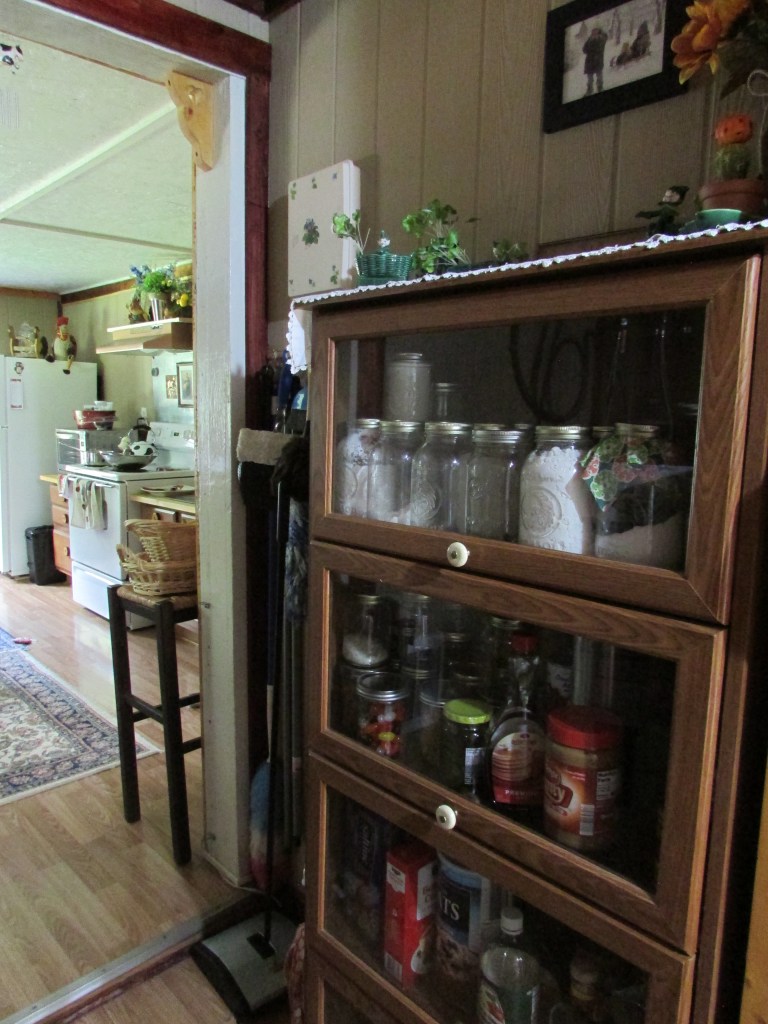
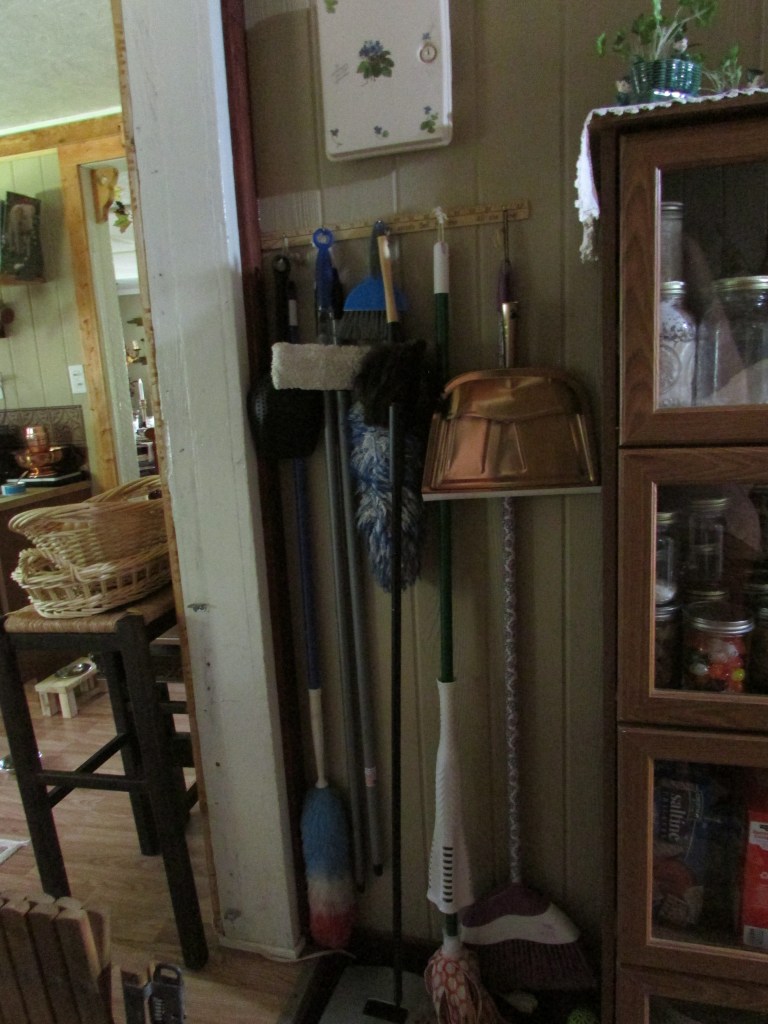
Continuing with the series of blog posts on Fixing an Old Farmhouse, this post will be about the living room. Originally, the previous owner had set up this room as her bedroom, and built a bathroom adjacent to it when she became ill. The farmhouse was listed as a three bedroom house, including this room as a bedroom downstairs. I have no idea as to what the first owner of the house used this room for, or if it was considered a bedroom back then. We set the room up as the living room. This room was in fairly good shape compared to the rest of the house, and by that I mean there was no damage to the wood floor, but some of the walls were in bad shape as well as the ceiling. The closet walls were in good shape and we were able to save this part. We patched some areas, painted it, installed flooring, and set it up as a storage area and coat closet. Everything else we had to change.
For this room we used various materials – new, old, recycled, and contractor surplus, which is brand new material at a great discount purchased from a contractor/builder. Because this house has a center chimney, this room also had the other side of the chimney, and it was clogged up as well, so we had to cleaned it up, and seal it. Ideally, I would have liked to leave the brick exposed but it had a fair amount of damage. We ended up covering it, and we did this upstairs as well. I think this was the biggest challenge in this room. This room is square, measuring 15 x 15 feet (as most rooms in this house) which made things easier. Here are a few before and after pictures of the process.
Before/during.
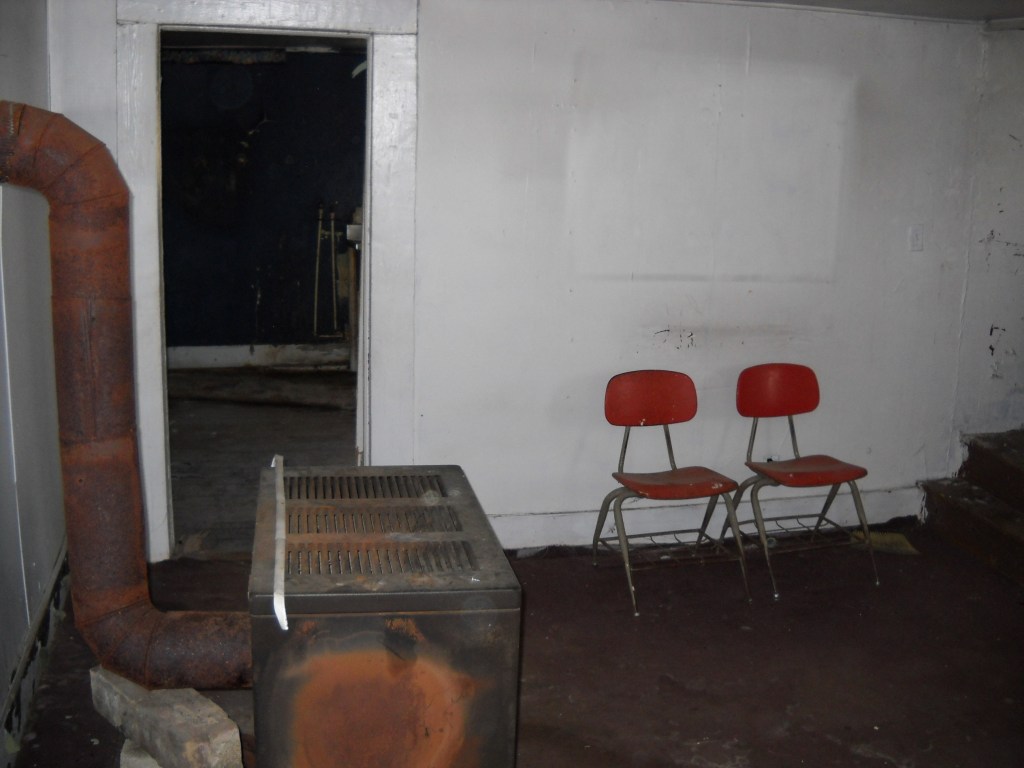
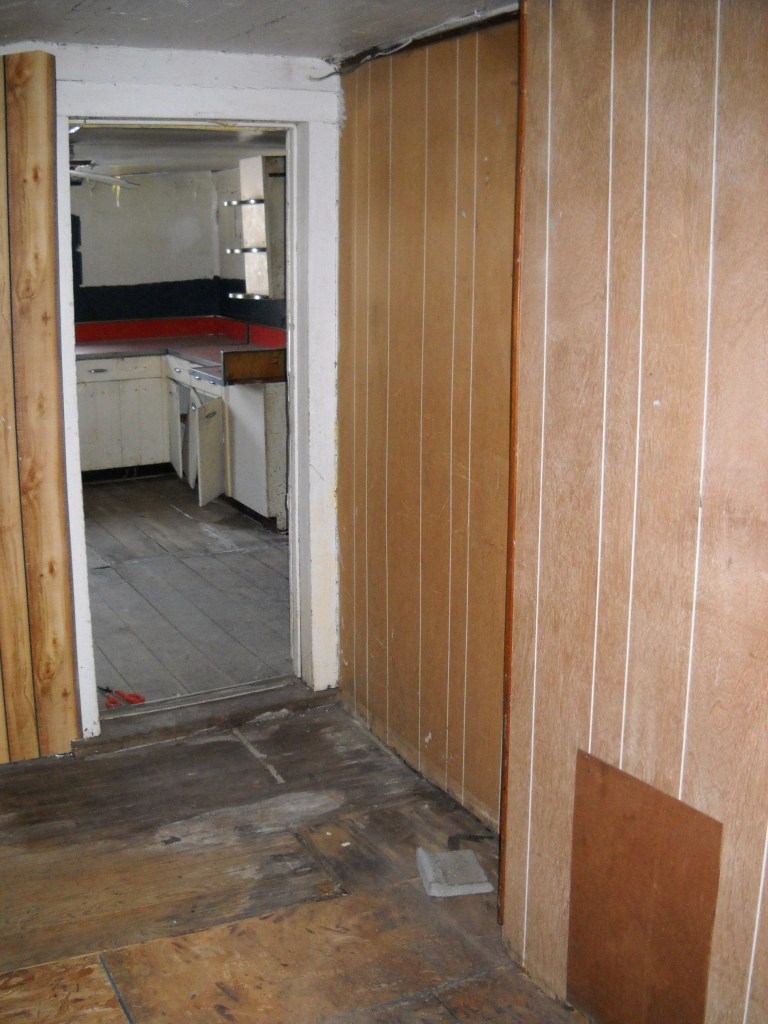
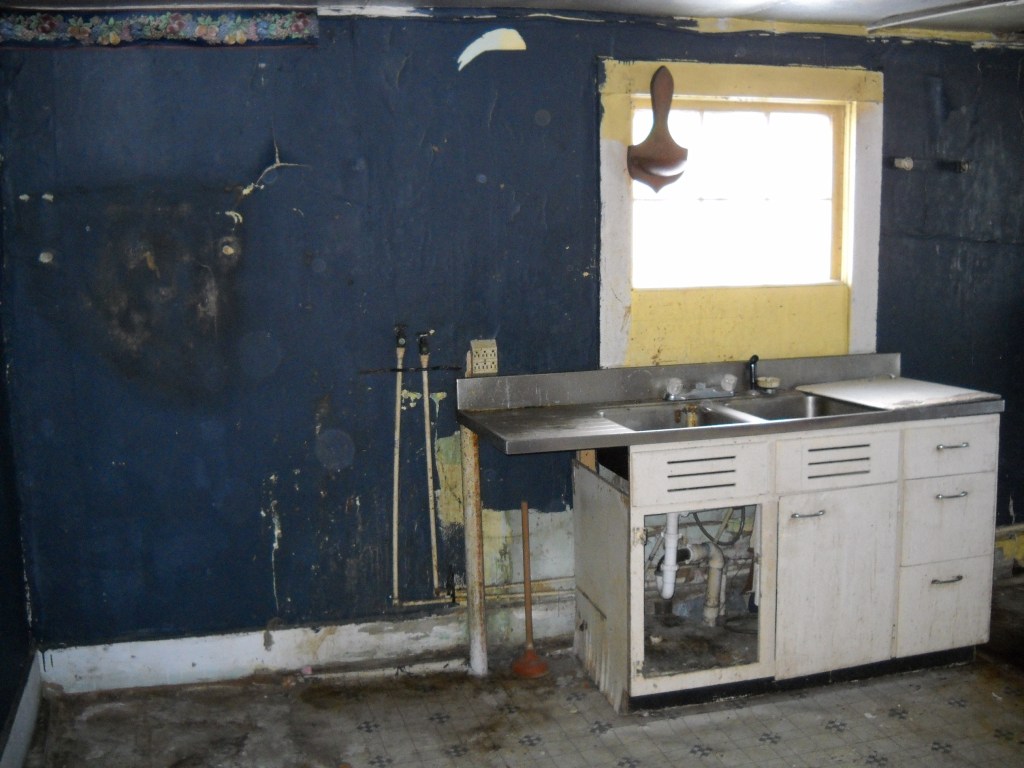
Here you can see the damage to walls and ceiling. The closet walls were not that bad but we had to fix its ceiling. An old and dirty carpet plus layers of linoleum covered the floor. We removed it all and installed laminate flooring.
This is the other side of the room – dirty couch, boarded up window, and damage all around.
This is the opposite side.
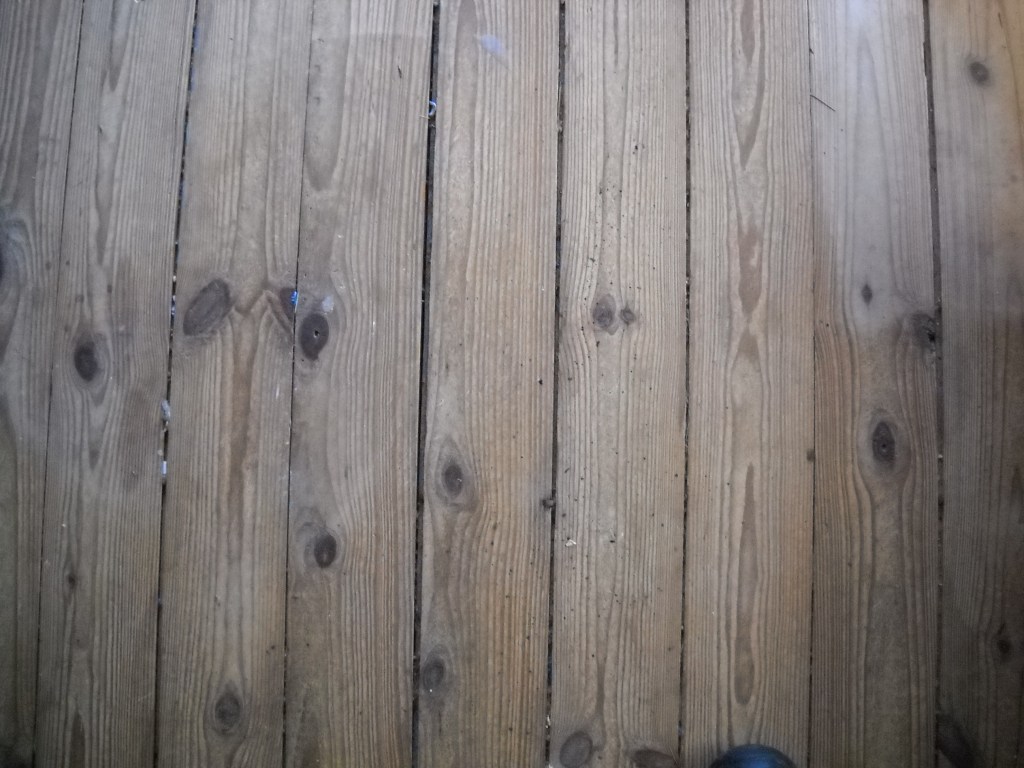
The floor boards were in pretty good shape, however the spacing between each plank varied and would have been an invitation for critters to come inside, so we decided to install laminate flooring. Ideally, I would have preferred the original wood floors but I would not have been at peace with the possibility of bugs coming inside.
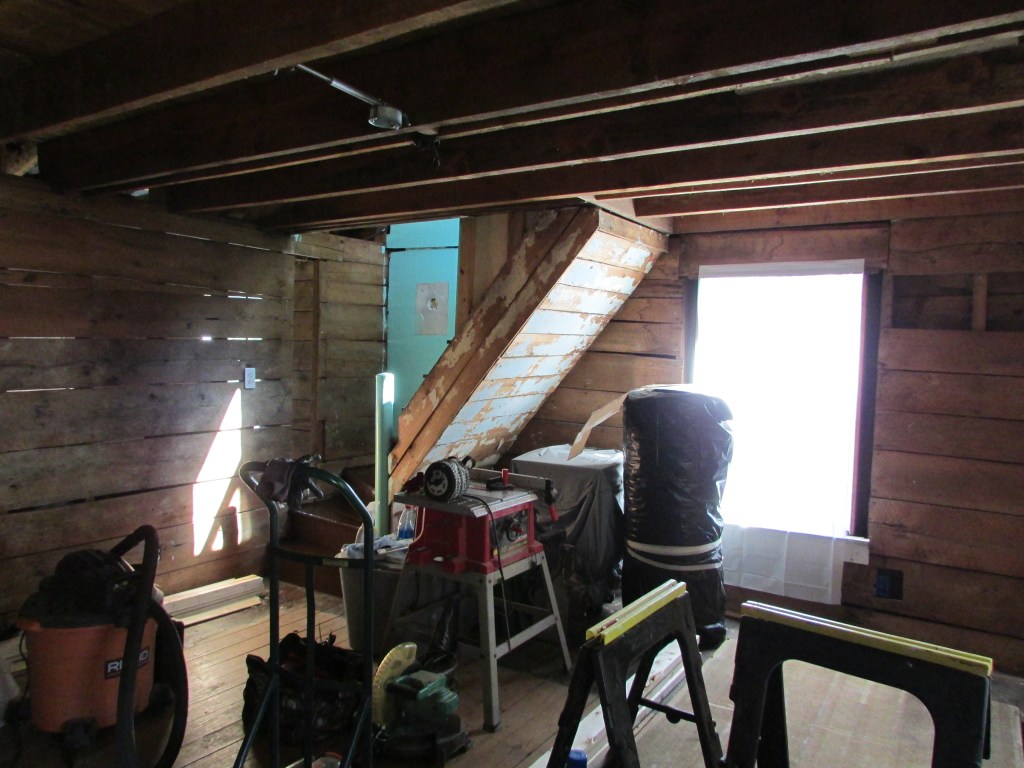
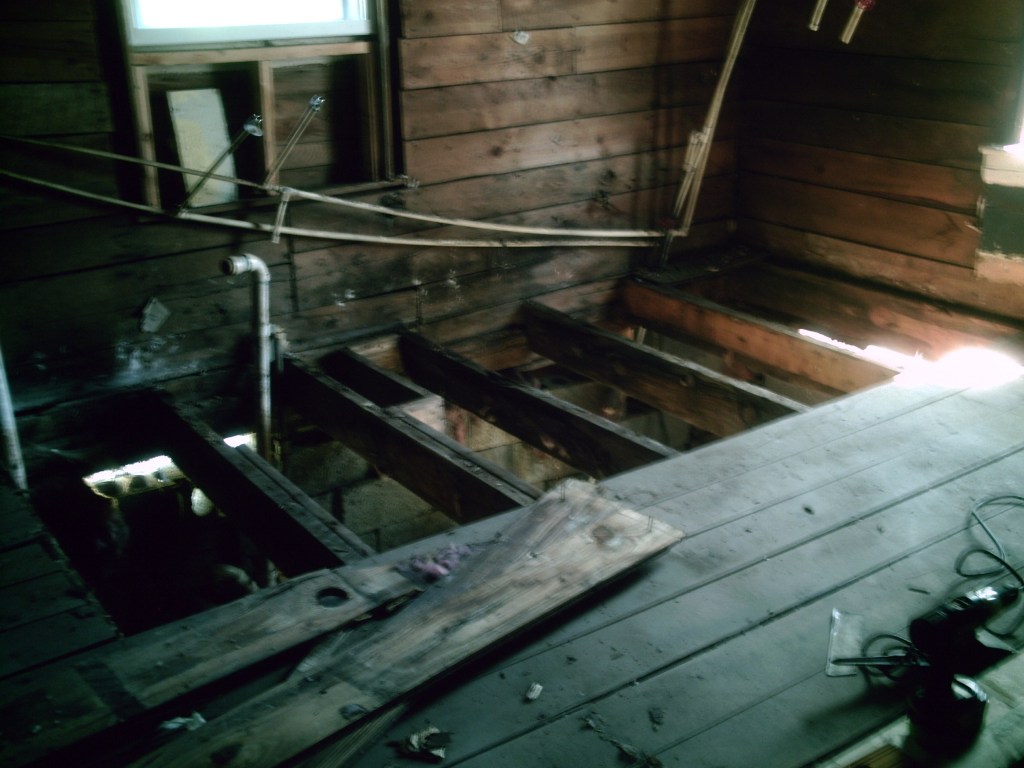
What was behind the sheetrock walls. Notice the old construction, horizontal boards. Most of the house is done in cedar wood, which is great, and the wood/beams are thicker than what is used in today’s construction. The wood is very hard and tough, and it was very difficult to screw in nails or hammer them. Cutting it was a challenge as well, and the aroma of cedar was still strong after more than 100 years. I regret not saving a piece of that wood that was so aromatic.
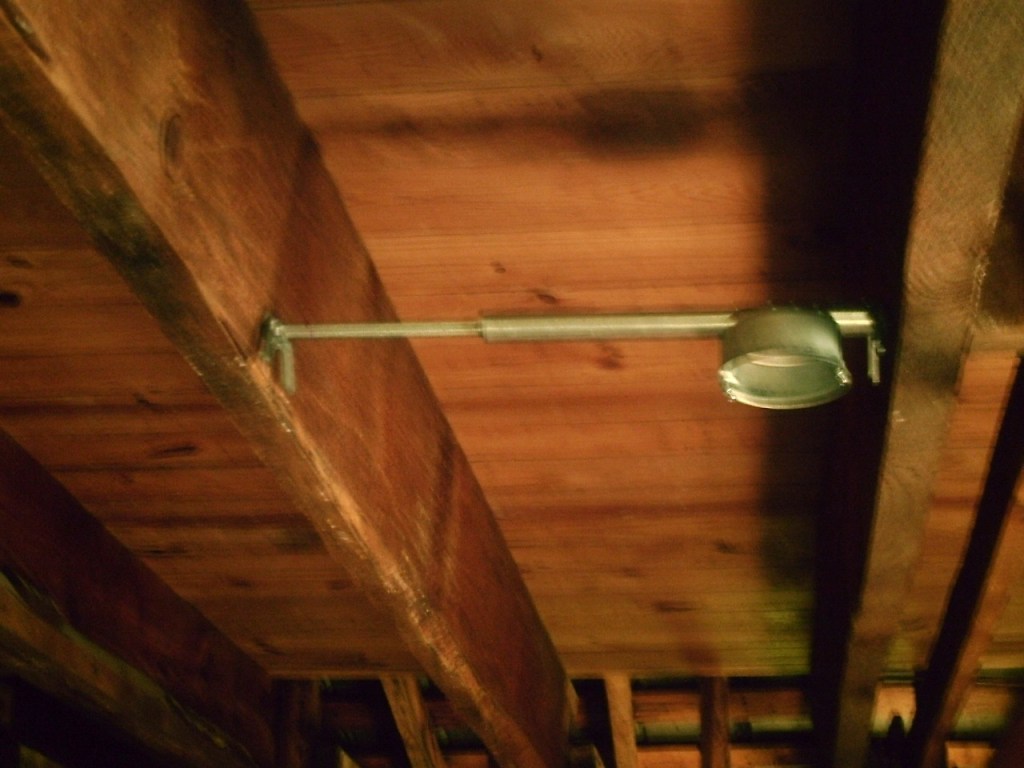
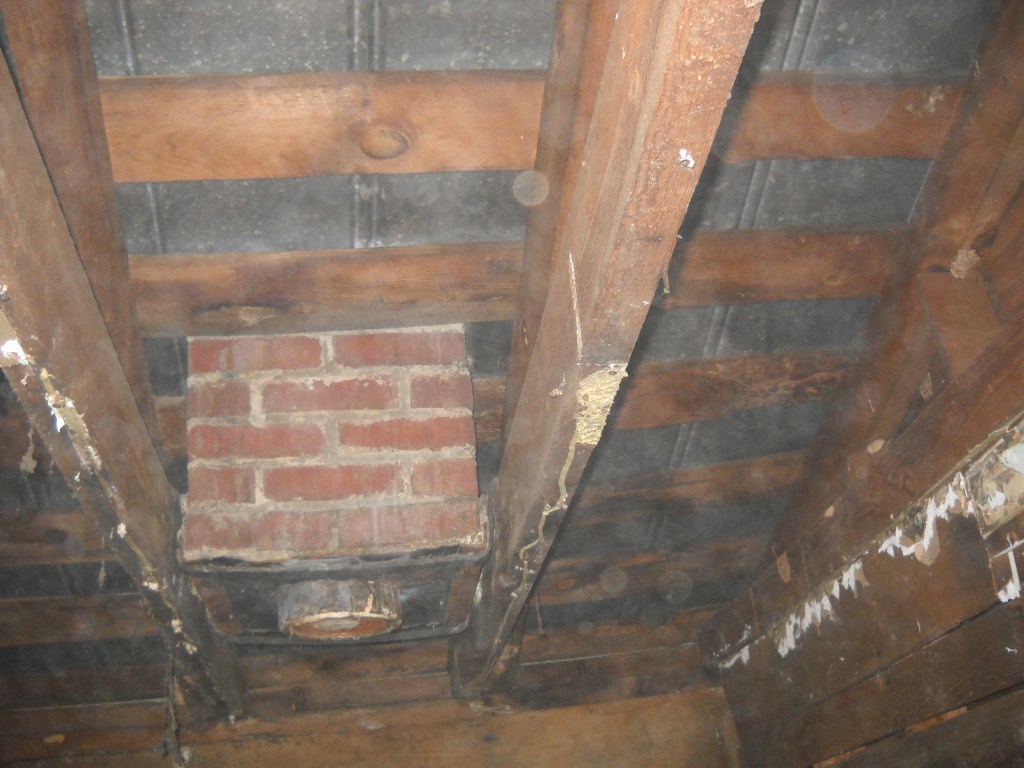
Ceilings. Once the sheetrock and everything else was removed, we had to vacuum and sweep the entire place before starting to work – floors, walls, ceilings.
We eliminated the door.
Wallpaper had been placed over painted sheetrock, and paint over the many layers of wallpaper, more recently by the last renter. I was told that when the house was not being rented anymore and fell in disrepair, squatters might have stayed in it very shortly . Neighbors would call the police, as well as the out of state heir, and the house ended up being boarded up – all windows and doors, after these were broken into. There was window glass everywhere.
After.
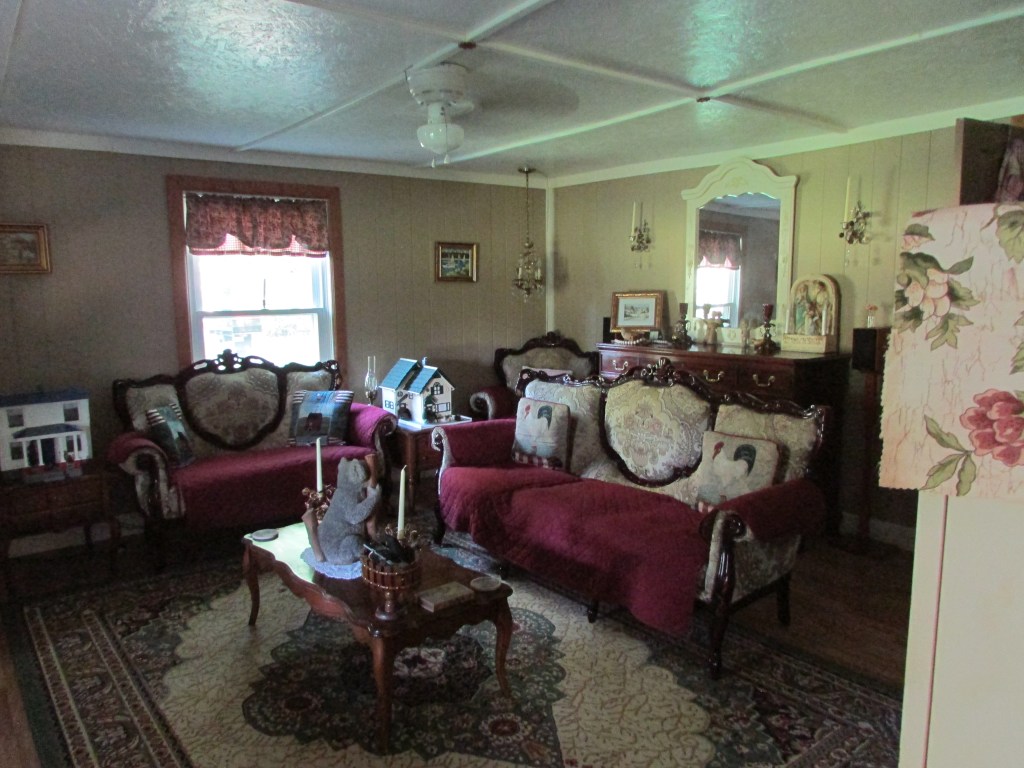
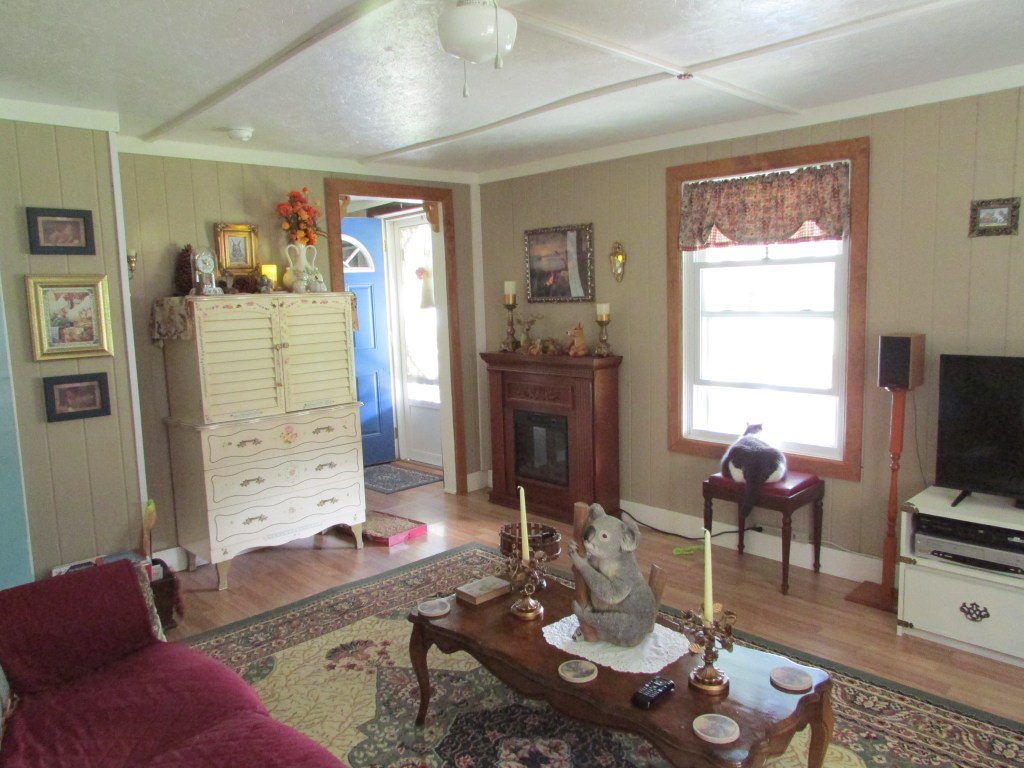
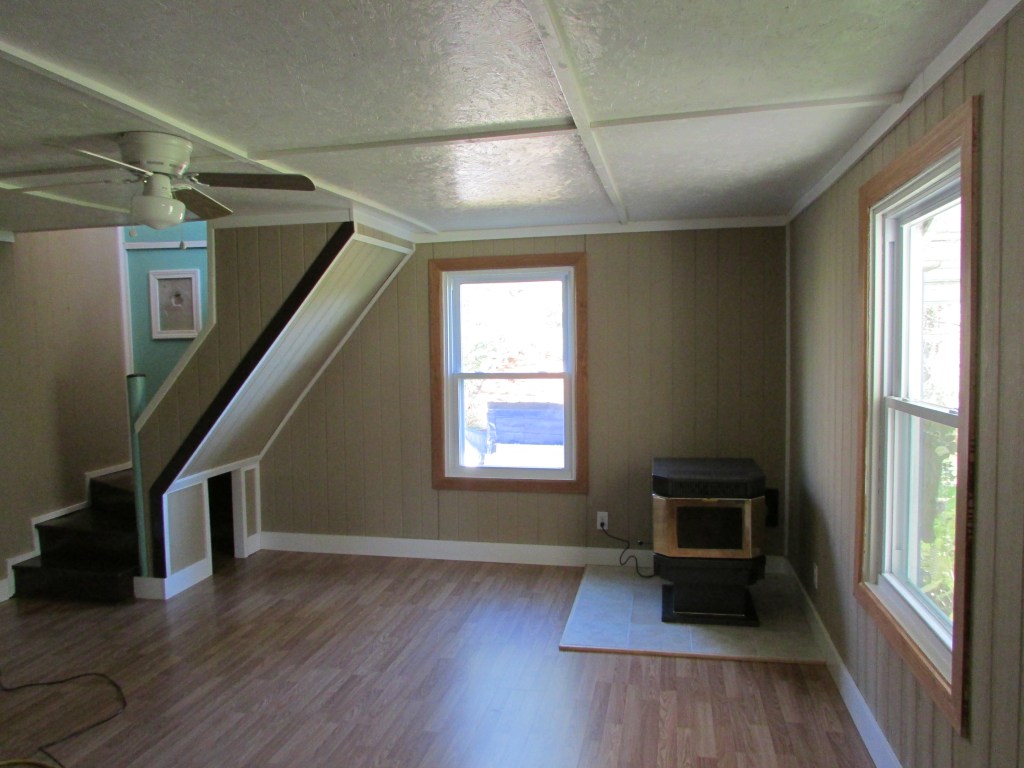
The rooms after they have been finished and furnished. We like a mix of old and new (when old is not possible), and our taste is more traditional/early American, and a bit eclectic. I understand that this might not appeal to everybody, but it is our taste, so bear with me.
The room almost finished.
The coat closet side.
Room as it is now.
The coat closet part.
Where the old door was removed. It connects with the dining room, and the main entrance.
Opposite side of the room.
This concludes the first floor of the farmhouse and what we have done so far. Upcoming blog posts will be about the second floor. I hope that you have enjoyed this renovation so far, and that it inspires you to see potential in areas where it might be difficult to visualize at first.
The inspirational story of how a small miracle – a five-dollar miracle – changed a stranger, a pastor, a congregation, and an entire country.
The Five-dollar Miracle is my latest published book. I have to say that this one broke the mold for me. It is different from my other novels, and does not follow the same style. It does have supernatural elements, however, not in the same way as my other novels. I would say that this book took me by surprise, as a writer that is, because I never expected to write it. It appeared one day as a title in my mind while I was writing Sunrise Souls, and it did not leave my mind until I sat to write it. I had no idea of what it was going to be about, neither did I have any notes or plot idea, only a title. So I went with it for the ride.
My biggest challenge writing The Five-dollar Miracle was to trust the process. With no preconceive ideas to start, it was a bit “nerve-racking”? Every day, I sat to write trusting the process. I had to trust it because I had already announced it as an upcoming novel; I had no choice. I wrote in faith. Although compared to my other novels it is short, the story did not need any add-ons. I tried to make it longer; it did not work. The story was what it was. It is different, and reader friendly.
Currently, I am writing The Girl Who Could Not Love, and I have to say that it has presented its challenges so far. Most likely, it will be ready for next year. As it has happened to many of you, the current affairs in the country and worldwide, have influenced my mood as a writer, and therefore my pen. This book will be ready when it is ready, and I am fine with that. This one, as all my other novels, will be made available via Amazon in paperback and eBook.
I am sharing with you something special today. I came across this YouTube video by The Elliott Homestead, and as I watched it, I felt a sense of serenity, peace, joy, beauty, gratefulness, and love. I decided to share it here because its main message is so beautiful and true. I hope it inspires you to appreciate the beauty that is all around us every single day. Thank you to The Elliot Homestead for making this lovely video and sharing it with the world. It truly touched me. I hope you enjoy it as much as I did.
Technically, this 1910 farmhouse is a three-bedroom house with an eat-in kitchen and bonus room (cat room). We set up the rooms in the way we live. There are two bedrooms upstairs, and the third bedroom is what we set up as the living room, adjacent to the bathroom. The original living room is what we set up as the dining room. One of the upstairs bedrooms is being used as an office, and the other, as our bedroom. These rooms can easily be changed back to their original set up by just moving furniture around. The mudroom could have been used as a dining room, but our cats deserved their own space; we love them that much. The kitchen can easily be converted back into an eat-in kitchen in the event that we would need the living room as a bedroom again, and the living room would move to what is now the dining room. The office could be moved to the mudroom if needed, thus reversing to the original bedroom. This house is very flexible because most rooms are square and measure 15×15 feet, and with the exception of the kitchen, nothing has a permanent fixture that would impede the use of the rooms in a different way. The furniture is moveable and I would not mind disposing of a few pieces if necessary. All rooms mirror each other because of an existing center chimney downstairs and upstairs, not including the kitchen and cat room, that is. This post will be about the dining room, what should have been a living room.
This room was in better shape than the others, meaning there was no water damage and no damage to the wood. The only issues were the condition of the ceiling and walls, and the “never cleaned” chimney that almost started a fire on one of the interior wood beams. We found a bit of charred wood when we took down the walls. It is a miracle that the house had not burnt down. The entire chimney was full of ashes inside. We had to vacuum it up, and because the bricks required extensive work and repair, as well as the inside of it ($$$), we decided to clean what we could and closed it up. Our heating source is a pellet stove, and electric fireplaces that we use as supplemental heat if it gets too cold. In the event of a power outage, the pellet stove can be hooked up to a portable generator. In the future, we would love to install a Generac system and ductless heating/air. Ideally, all that to be powered by solar energy; however, we are not there yet, and things work fine the way they are now. On the low budget end, the smart thing to do would be to install a wood stove, because in a real emergency, there would be no electric service, no gasoline or gas service, and the delivery of things would be disrupted. The more I think of it the more I convince myself that going with a wood stove is the right choice. In the event of a simple power outage, I have candlesticks and candelabras in every room, and there is a candle chandelier in the dining room. In addition, battery-operated candles are an extra option.
As I mentioned before, our style is more reminiscent of an early American rustic farmhouse, and that follows through into the dining room. This room was the third room we fixed. Here are a few pictures of the before and after condition.
BEFORE
The room was being used as the living room; its original set up. The walls were damaged, and we had to open up the stairway area a bit. Under the steps, there is a small storage area that one of my cats uses as a little apartment.
There were two windows in bad shape and broken in this room, and tons of abandoned furniture and debris.
An old cast iron stove was hooked up to a chimney. It was full of ashes and in bad shape.
Sheetrock and many layers of carpet and linoleum were removed. The stairway opened up.
Here you can see the bare wood in the ceiling.
During the mess.
AFTER
The room almost finished. Bella’s apartment under the steps is ready. The stairway is open now.
The other side of the room.
Room as it is now.
View from the stairway.
View from the kitchen.
I hope you enjoyed this room’s before and after photos. Compared to the other three rooms I have shown, this one was less problematic. However, as you can see, it was a ton of work. I hope these series of posts will inspire you to remodel a room in your home, take on a DIY project, or find that dream property that might not be so dreamy at first glance, and give it a little bit of life.
Moonlit Valley is the first novel I published. It is everything I did not intend to write, an omen, and it practically wrote itself. The story morphed over the intended story, leaving me no choice but to go with it wherever it wanted me to follow. Characters revealed themselves, and rebelled against my pen as well. Jeremy Sandbeck, one of the main characters practically made my life miserable. In the end, he won. I have written about his rebellion on another blog post. I thank Jeremy Sandbeck for his insistence; it taught me much along the way. Moonlit Valley gave birth to The Dinorah Chronicles, unintended.
Moonlit Valley follows the story of a couple – Jeremy Sandbeck and Rose Carrigan – who can’t be more different from each other, their losses, and their secrets, as well as their supernatural destiny. It is a paranormal romance infused with a bit of mystery and a dash of suspense.
Rose Carrigan never imagined what awaited her when she left her New Jersey hometown to live in an old farmhouse located in a small southern town called Moonlit Valley. After a series of mysterious clues and unfortunate events, once more, her world turns upside down. This time, the man who she loves, Jeremy Sandbeck, her irresistible and seductive husband, is the one responsible. When she discovers his identity, she must decide between love and destiny, defying the surreal world that she has discovered. Jeremy struggles with love, and what he thinks is his true supernatural and divine duty.
The feeling of publishing your first novel is like no other. It is an indescribable joy that stays with you no matter how many books you write and publish after it. That first published book will remain your precious child forever. Each book is different and comes with its own set of feelings and emotions; however, one always has a special appreciation for that first novel. I have written about my experience as an indie writer and my writing process in other blog posts, as well as why I chose to pursue independent publishing. Writing has been a dream fulfilled for me thanks to today’s technology, and it is the occupation that fits me well. It is the one thing that I could do forever, and forever is a long time.
All my books are found on Amazon in paperback and eBook format.
My previous blog post was about the cat room, a room that had been a porch, and at one point enclosed to make room for a much needed bathroom a previous owner of the house required after becoming ill, hence why I decided to continue with this room next. I was told by a neighbor that at one point the farmhouse used to have an outhouse. There are no buildings in the property that would point to it, so we don’t know the location. Although there was enough room after enclosing the porch to build a bigger bathroom, the previous owner did not. The bathroom was small, and when we fixed it we decided to keep the same blue print for the sake of plumbing (which had to be replaced) and the future use of the mudroom/cat room. We concluded that the existing positioning of fixtures made the best use of the space. A larger mudroom was more important to us than a larger bathroom. Maybe the previous owner thoughts followed the same path, who knows?
If we thought that the cat room was the most challenging room to work with, the bathroom was the grossest room. It had fall into disrepair, was very dirty, had water damage, no water due to a non-working well and broken pipes, and overall, suffered from the condition of the house being abandoned for a while. It could surely make you gag at a glance. The room had to be completely stripped of everything – fixtures, flooring, walls … It was a big mess. There was nothing that could be of use or recycled. This is the reality of fixing an old house that has been neglected and abandoned through the years. These pictures may turn your stomach, fair warning.
Before.
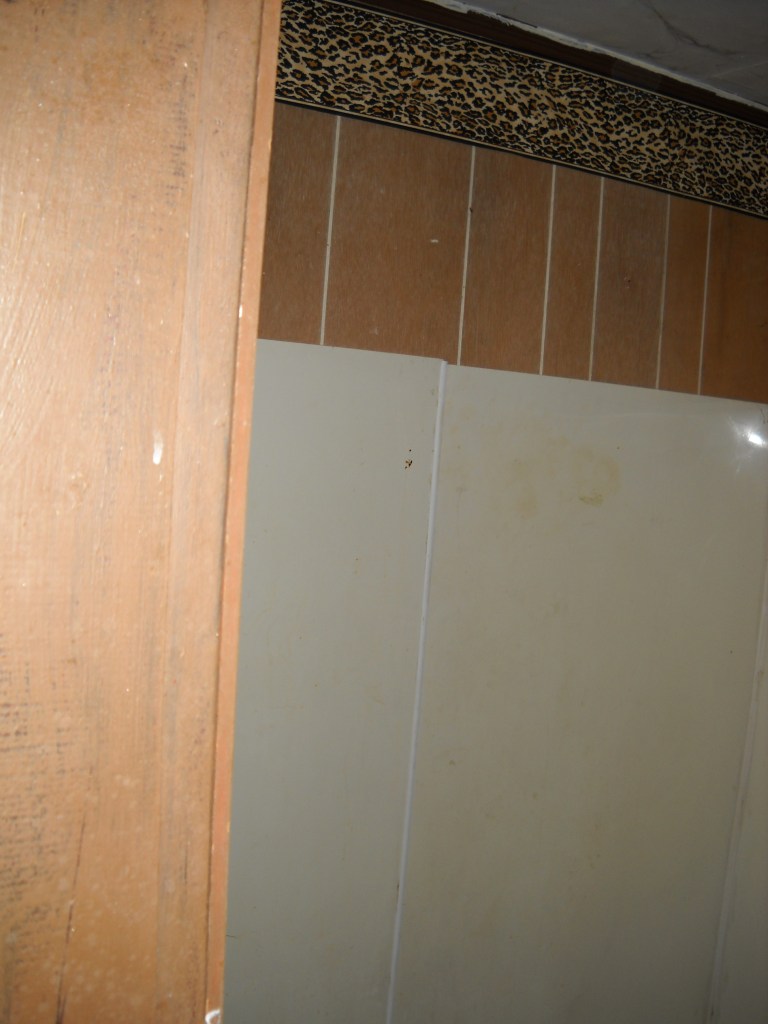
Location of the bathroom is where the brown door is.
Yes, it is what you think it is. At least it was left empty.
A myriad use of materials throughout this tiny space? Paneling, wood, sheetrock, wallpaper … why?
The water damage is obvious here.
Another example of the many materials that were used in this small space by previous tenants throughout the years.
During andAfter.
We decided to install a fiberglass shower instead of a bathtub.
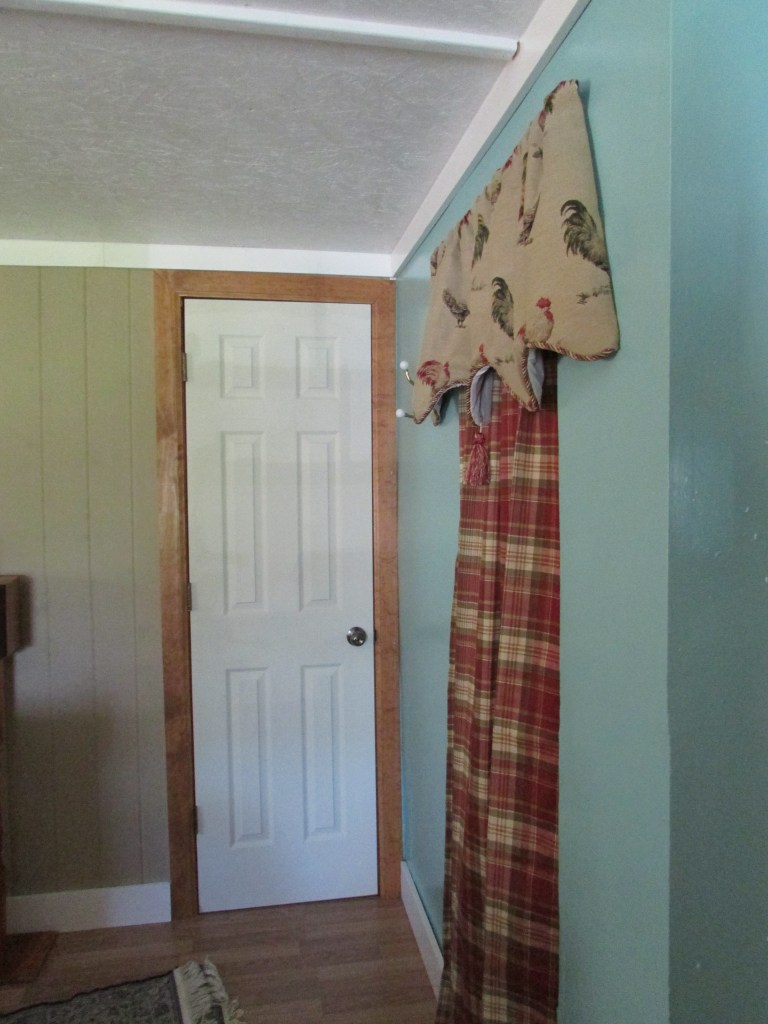
We kept the location of the door but had to change the door and framing. Eventually, we painted the door a nutmeg color.
The location of the new fixtures remain the same.
The location of the toilet remains the same, new toilet and fixtures were installed.
Instead of installing a shower door we decided a shower curtain would be easier to maintain and replace seasonally and as needed.
We kept the style of the bathroom simple and functional. Anything can be replaced easily in the future if necessary. I hope you enjoyed viewing and reading about this project. I hope it inspires you to take on a project with vision.
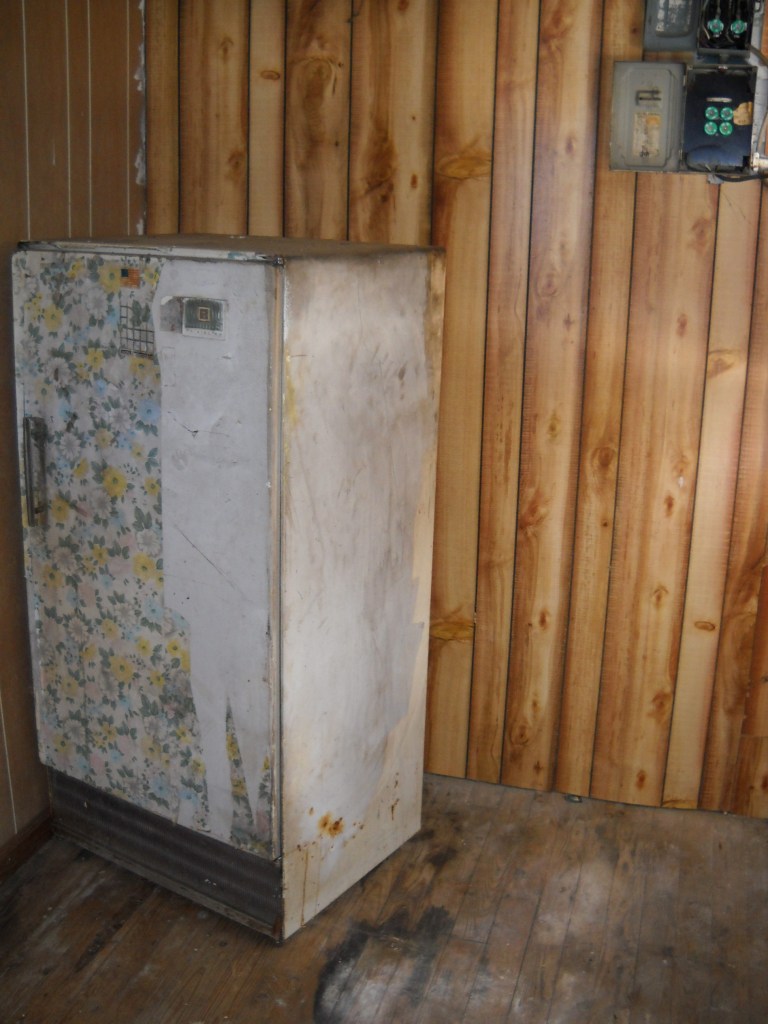
The previous post on “Fixing an old farmhouse” series of posts, was about the kitchen. Adjacent to the kitchen is what I call the cat room. This room serves many purposes now; however, it is the mudroom and where the old refrigerator with the rotten turkey inside was located.
Surprise, surprise!
Originally, it was a side/back porch which the previous owners enclosed and converted into a mudroom. I was told that when the former owner (the second owner) became ill and bedridden, the house required an indoor bathroom (it used to have an outhouse – we have no idea where it is). They decided to enclose the porch and use part of the room to build a bathroom. This is the reason why the cat room is shaped like an L. Now this room serves many purposes – first, a room for my cats, where the cat beds, food, toys, litter, and supplies are kept, side entrance, mudroom where we keep coats, rain boots, work boots, hats, cleaning equipment… We moved the water heater to this location; it used to be in the kitchen. The first part adjacent to the kitchen serves as a pantry. It is a generous size room although shaped like an L. It could have served as a dining room as well, but the cats needed their own space too.
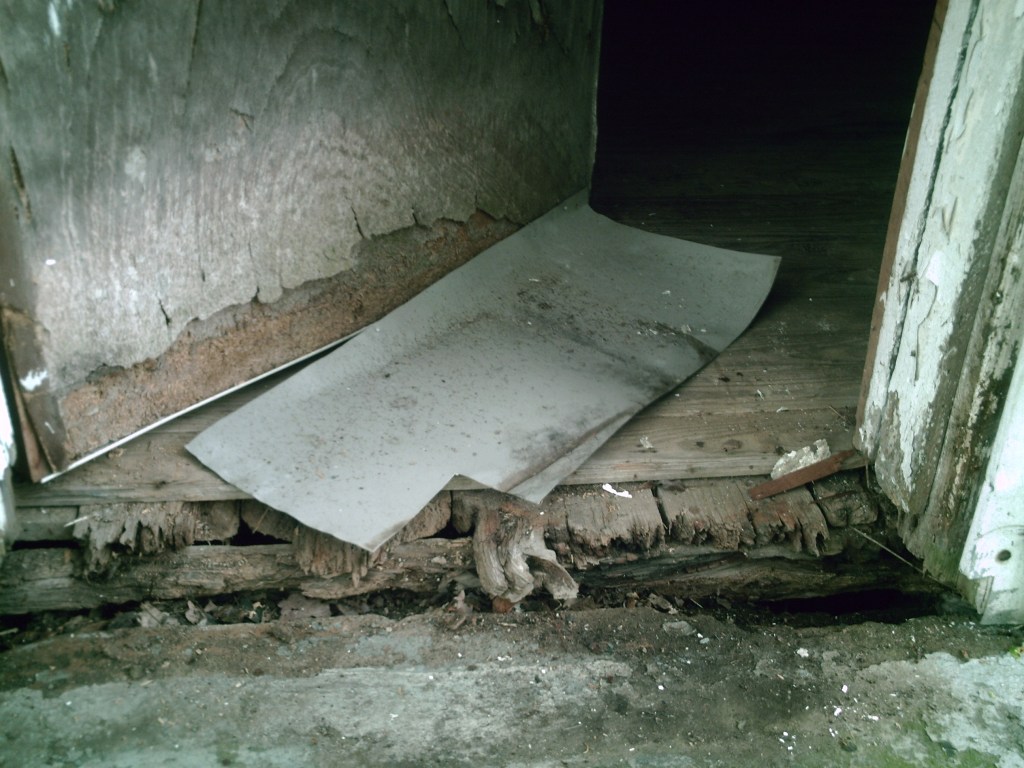
I think this room was the most challenging to work with for many reasons besides its shape. It had water damage due to its proximity to the bathroom. It had a pieced-together subfloor that was in very bad shape and had to be replaced. Someone had attempted to reach the bathroom plumbing through this floor, hence the cut out pieces of subflooring. However, this worked out to our advantage because we had to replace the plumbing. All plumbing had to be replaced. It is where the side door is, and it had suffer considerable water damage on the floor, door, and door frame. This room had a natural inclination because it used to be a porch. On those days, many porches where built like that so when it rained water would not accumulate. We had to do many repairs before starting to work with the walls and ceiling. It was the last room we tackled. Here are some pictures of the process, before and after.
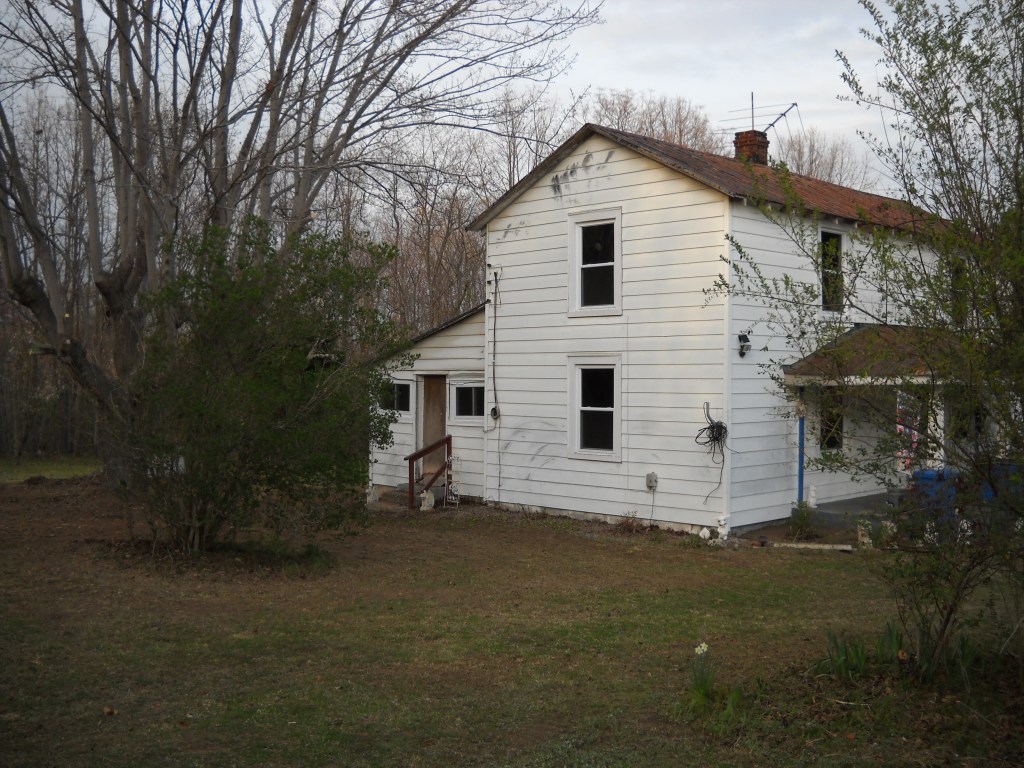
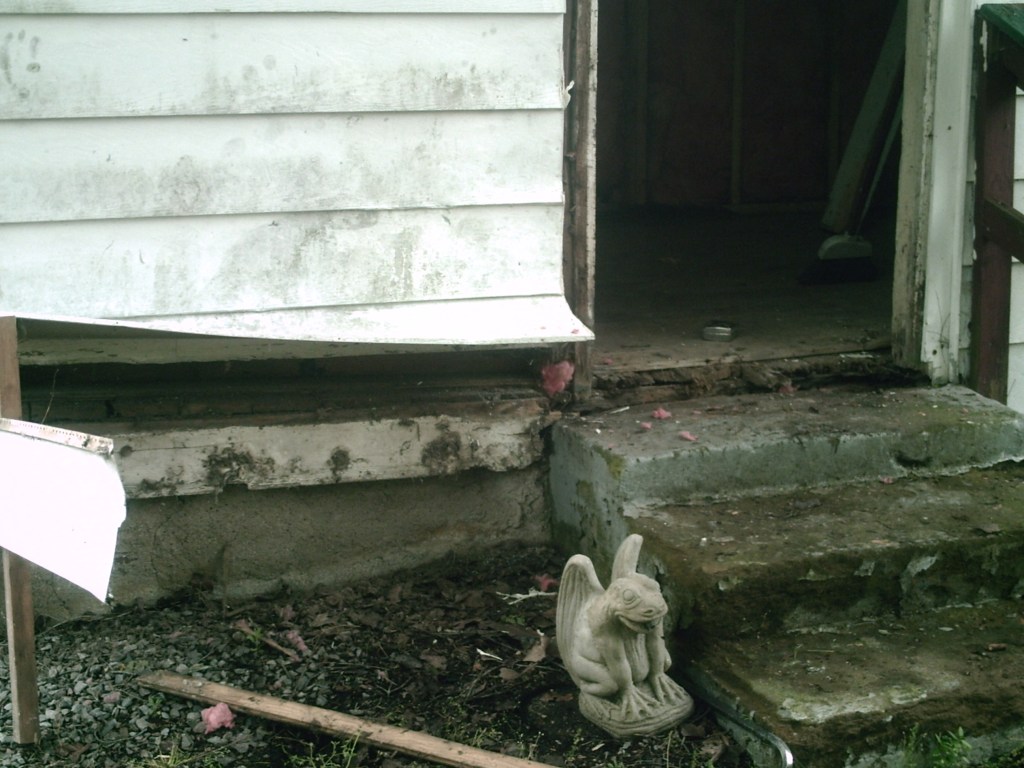
Before – Here you can see the location of the enclosed porch on the side of the house. The door, frame, and steps were damaged.
Water damage to door, frame, and floor – mudroom side entrance.
During the process of fixing the damage.
Another view of the damage that had to be fixed before doing anything else.
Water damage due to proximity to bathroom plumbing – pieced subfloor on section near the kitchen.
There was paneling done by a previous renter.
Here you can see that it was a porch enclosure. You can see the walls.
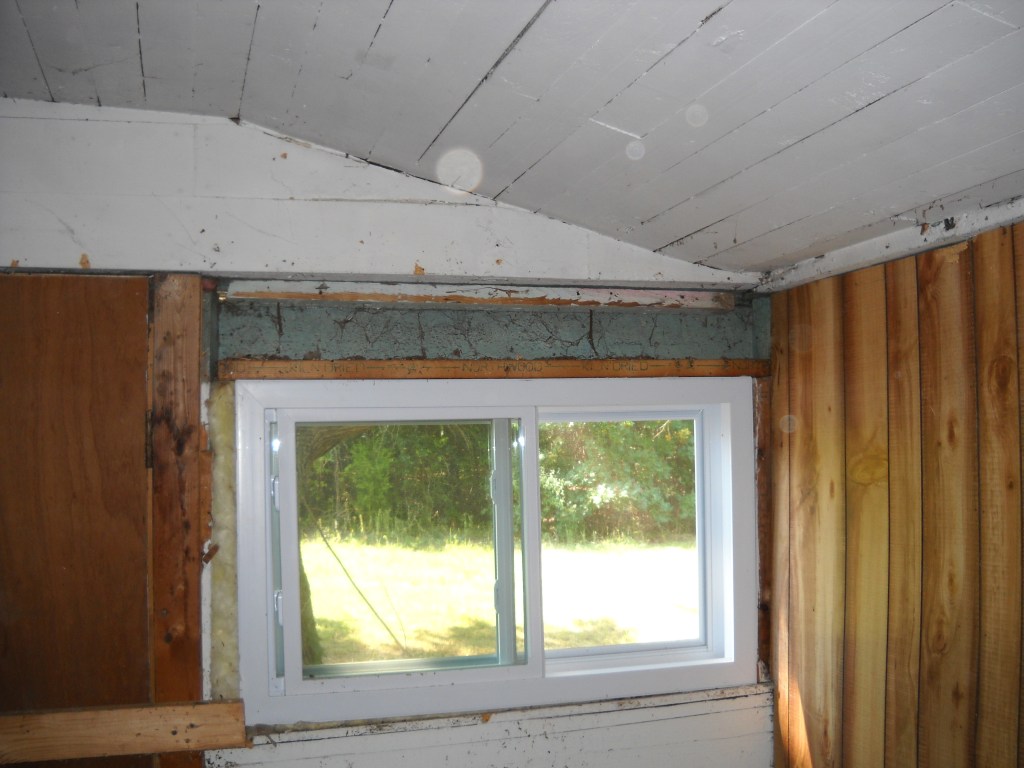
Another view – the existing ceiling. I do like that vintage blue green color.
What was behind the paneling.
The After.
Once walls/floors/door/windows were fixed and some cat décor placed. The ceiling had large openings in between boards so we had to seal and cover it.
The other side.
Side entrance fixed.
Now, part of this room serves as a pantry.
Accessible cleaning equipment area.
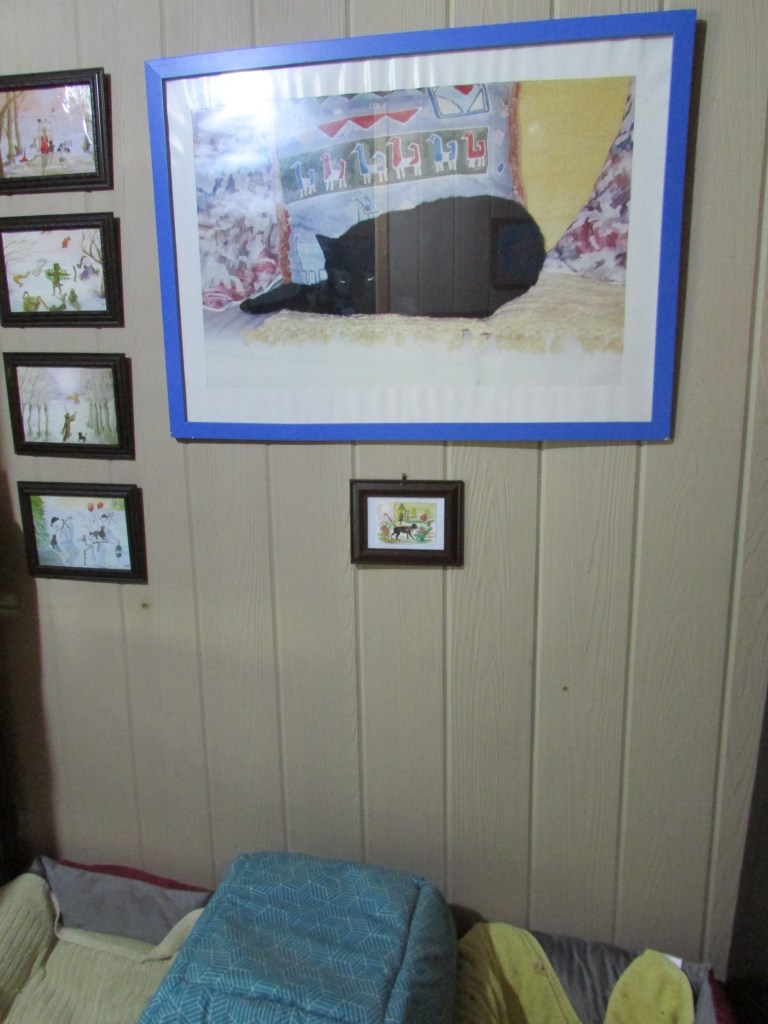
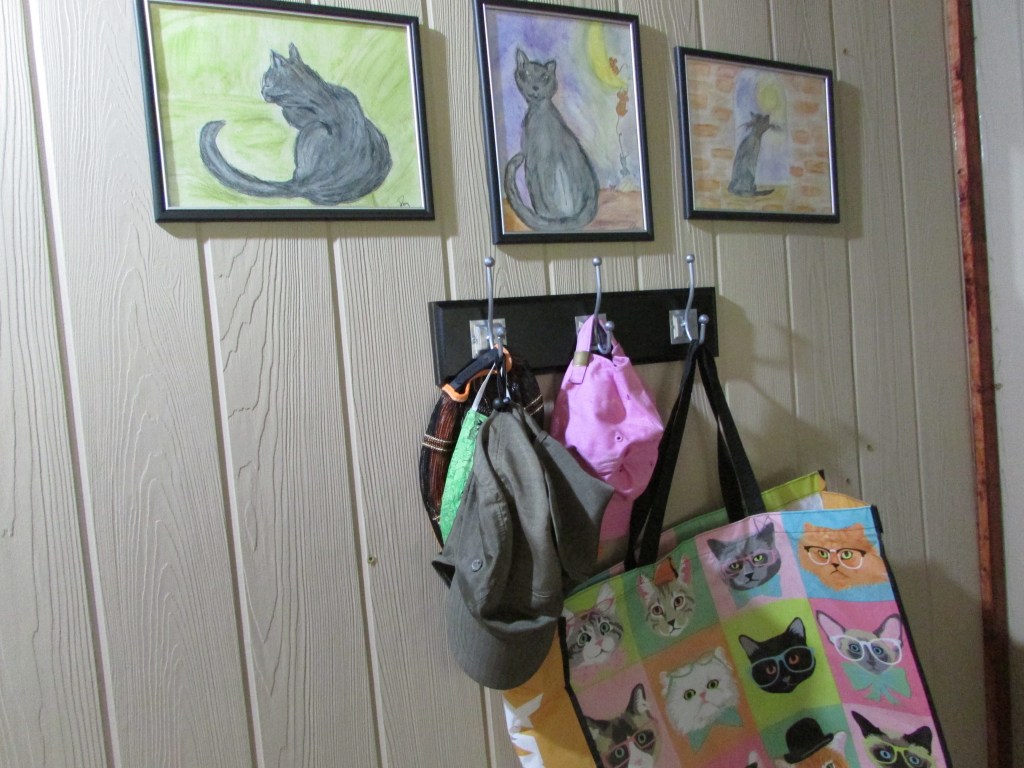
Cat sleeping area. Only one cat uses it. The others prefer the rest of the house. All art is cat related. The smaller framed art is from artist Anne Rymer.
A place for everything and everything in its place. Kitty cat approved.
This was not an easy room to work with, and there are a few things we would like to add such as a wooden cabinet for more food/supplies storage, and repositioning of the cat’s beds. Something to do in the future. For now, it is very functional. I hope you enjoyed this post.
“As light breaks the shadows so does my light will shine upon the Sunrise Souls. They will shine their light upon this world, and my light will pour in blessings to humanity. The planet will hear of my love, and from the four corners of the world a voice will sound as thunder, announcing my kingdom, the Kingdom of Love.”
(The Dinorah Chronicles -Sunrise Souls)
Sunrise Souls is the last book in The Dinorah Chronicles trilogy. It is the conclusion and fulfilment of Dinorah Sandbeck’s birthright. This book encompasses the main story, Dinorah’s story, and fulfills books one and two. The way the trilogy is written, each book stands for itself, and one can read any book without having to read the others first. However, the main story permeates all three novels, and there is a bond that keeps the trilogy together.
Writing this last book was challenging in the sense of pulling it all together – Dinorah’s quest and her reason for being, the prophecies, as well as each character’s role individually while weaving the main story. Every character came together in purpose. I enjoyed writing this book as it was taking me along with the ending of the story. Because I prefer writing single stories more than trilogies or series, it was also a relief.
Throughout the trilogy, the characters have evolved and this is more obvious in this book. Dinorah Sandbeck has fully accepted her birthright, and in the process accepted herself; her Human and Anarth sides have finally come together. Not only is she stronger but has found her peace. Sometimes the thing that we fight the most can bring us to the peace we crave.
All my books can be found on Amazon in eBook and paperback formats.
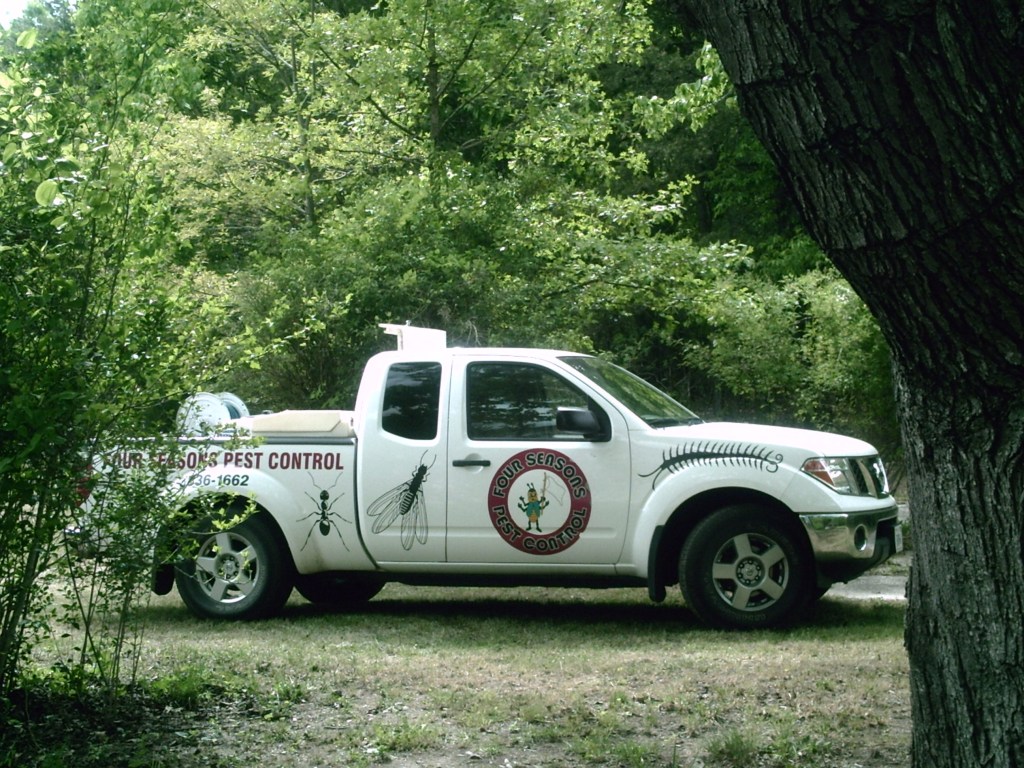
Fixing this 1910 old farmhouse has not been easy. It has required a budget, vision, stamina, time, tons of patience, but most important faith. It would have been easier if its condition would have been better, and by better I mean with less destruction and abandonment inside and out. On previous posts, I have given you a glimpse of what we have done so far on the outside, and an idea of what it looked on the inside. Once we disposed of all the garbage and of the entire interior furnishings and fixtures in extremely bad shape, we knew we had to handle the walls, ceilings, and floors, whether taking them off, replacing, or fixing what needed to be fixed. Same process was applied to everything else that had to be done. We were discovering issues as we worked. After that, we gave the place a good cleaning, inspected the wood beams and the walls for any signs of termites, and amazingly there was no termite damage at all. The house was built from cedar and possibly another insect resistant wood according to the home inspector. We called in an exterminator to inspect and spray the entire interior, and to apply a termite treatment inside and outside, just in case. Once that was done, we could start the work inside the house. It took us 7 months to complete the interior, but fixing the well and hooking up the electricity took longer because we had to wait for an electricity pole (ours disappeared one day), and hire experts for those two jobs. Patience is a virtue. We stayed with my sister and brother in law during that time and traveled over an hour everyday while fixing the house. We will be grateful to them forever for putting up with us and the cats for that long. Again, patience is a virtue. We worked from sun up to sun down and used a generator to power up the tools and anything else that needed to be powered up. Luckily, it did not turn out to be a heavy winter. We packed our lunches everyday.
We started our work on the second floor, and worked our way down. One characteristic of this house that made things “easier” is that all rooms measure 15 x 15 feet, except for the tiny bathroom added much later, and the mudroom, which was a side/back porch that the previous owners enclosed; however it is a nice size. I already mentioned on the previous post that we had a small budget and had to be very creative and resourceful with materials. We worked with a variety of materials, from recycled to new, and also used a resource that is sometimes overlooked – contractor’s surplus. It saved us a lot of money. When deciding on the style and feel we wanted to achieve, we decided that we wanted a warm, rustic, back in time, close to early American/colonial feel, but had to work with the materials we already had at hand, and the decorative items we brought with us when we moved. It is a mix of country charm, rustic, and early American. I understand that this might not appeal to everyone, but it is “our style,” so bear with me while you bare with me.
I decided to start with the kitchen, since it is the heart of the home. Here are some pictures of the before and after.
Before doing any work, this was a very important step. These people were awesome.
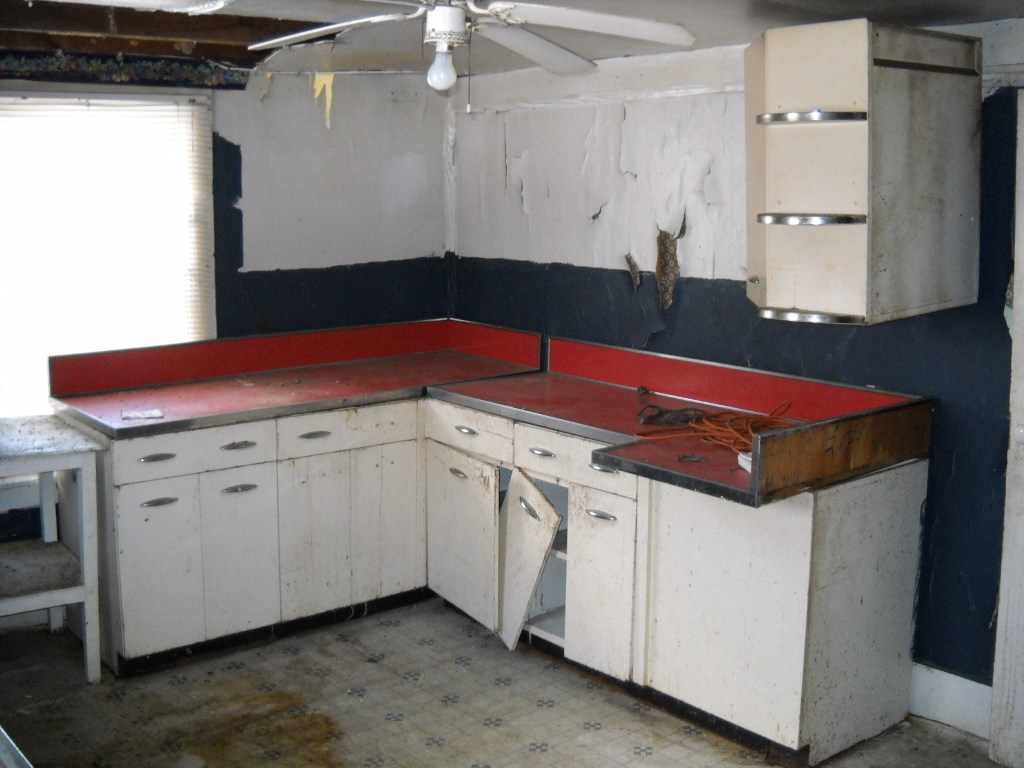
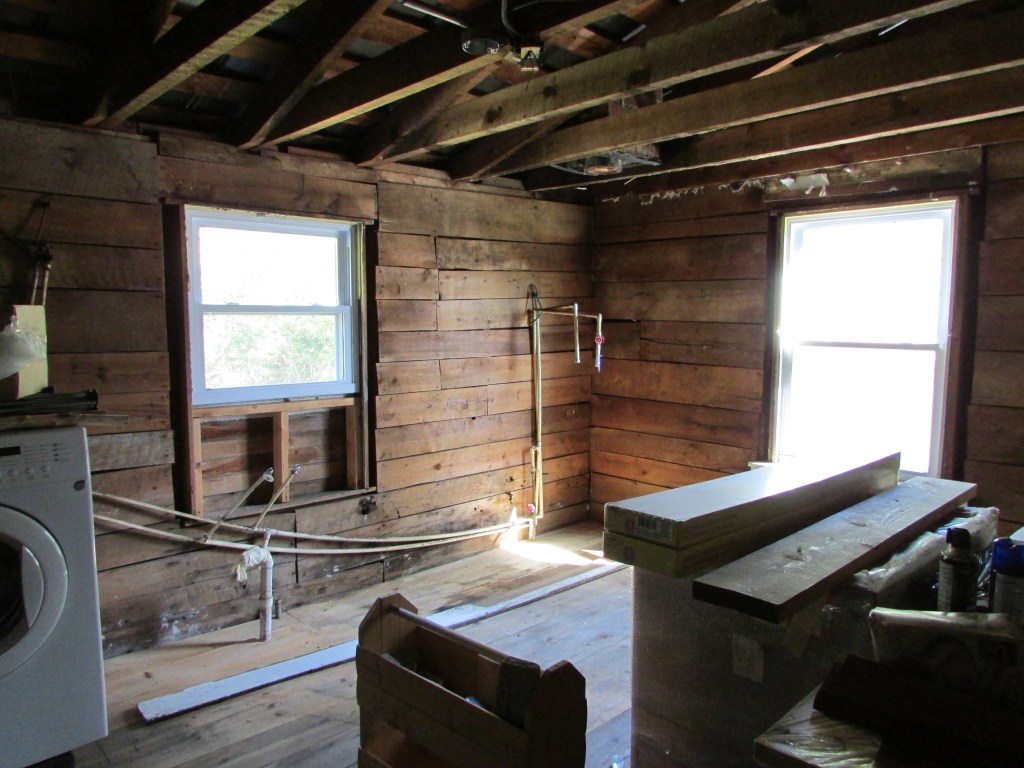
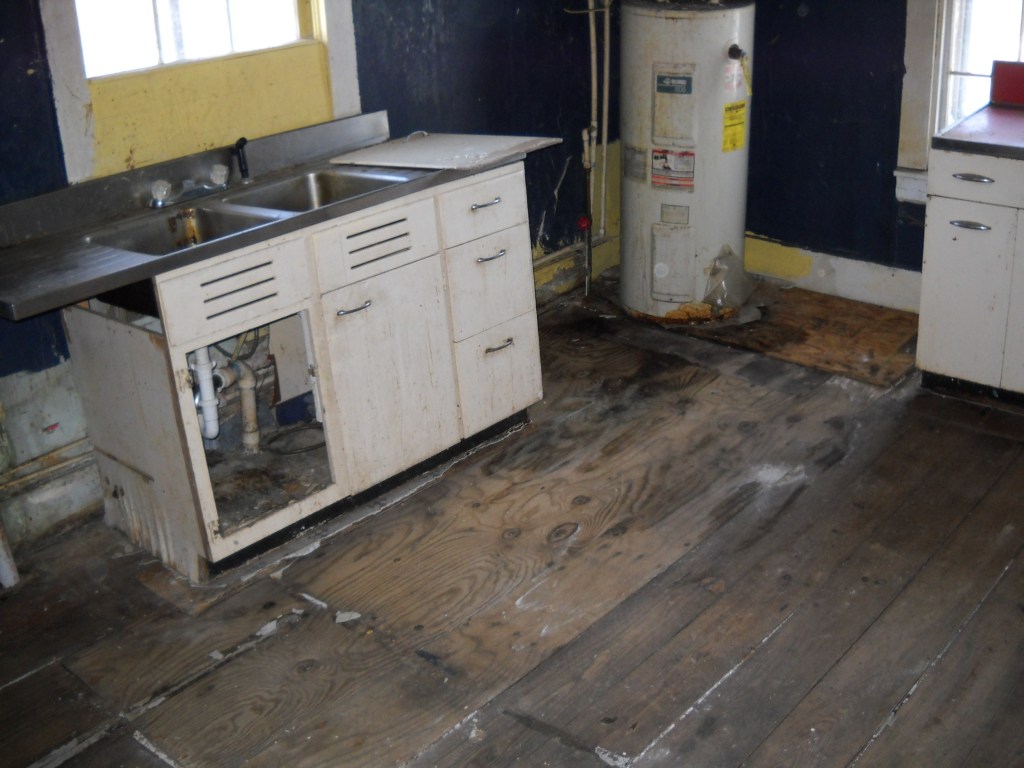
The kitchen as you can see was in extremely bad shape. The vintage metal cabinets were rusty inside, and could not be saved. The floor had water damage and most of it had to be replaced.
Right side of the kitchen
One thing I regret is not using the metal sink top for an outdoors garden sink application. I wasn’t thinking about it at that point.
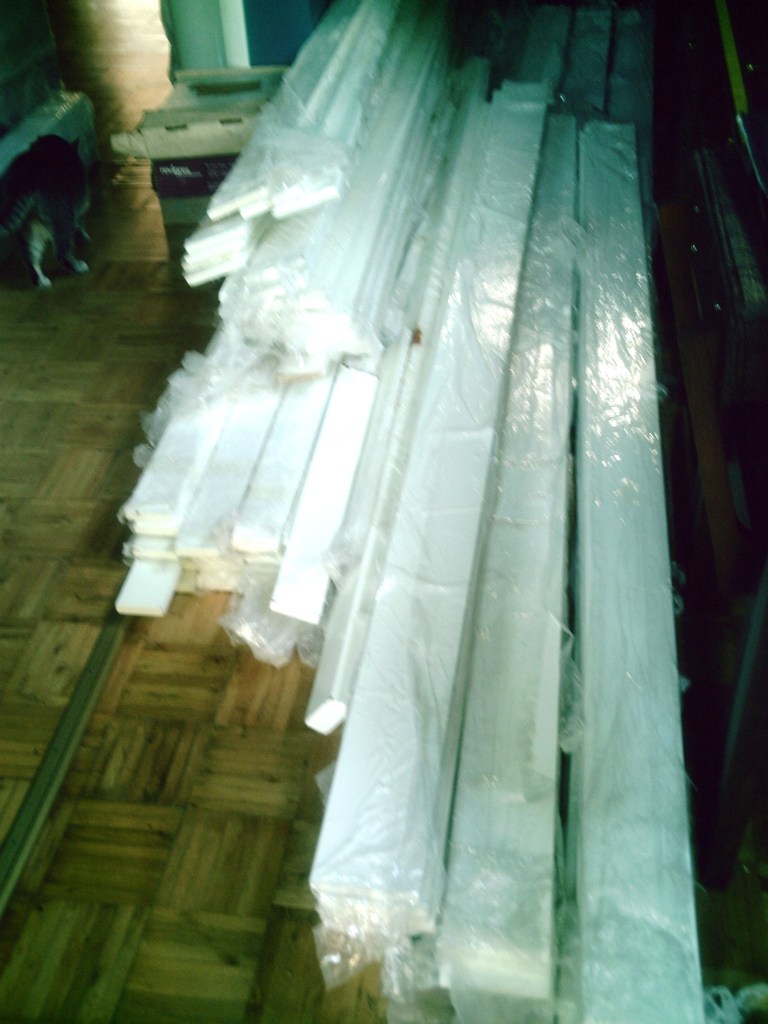
Contractor surplus – brand new molding material at phenomenal savings.
Another example of contractor surplus – cabinets and flooring.
Replacing the damaged wood floor boards – water damage. Notice the old construction style on the walls, boards running side to side, that is the actual wall, the sheetrock and paneling were removed.
Matching the new wood planks to the old original ones was tricky, We could have just sand, polish, and stain the wood, but later on decided to install laminated flooring. It gave an extra layer of insulation. Old farmhouses tend to be cold during the winter, and cool during the summer.
The ceiling. The kitchen chimney was removed, and the bricks were reused in the front garden.
During the mess.
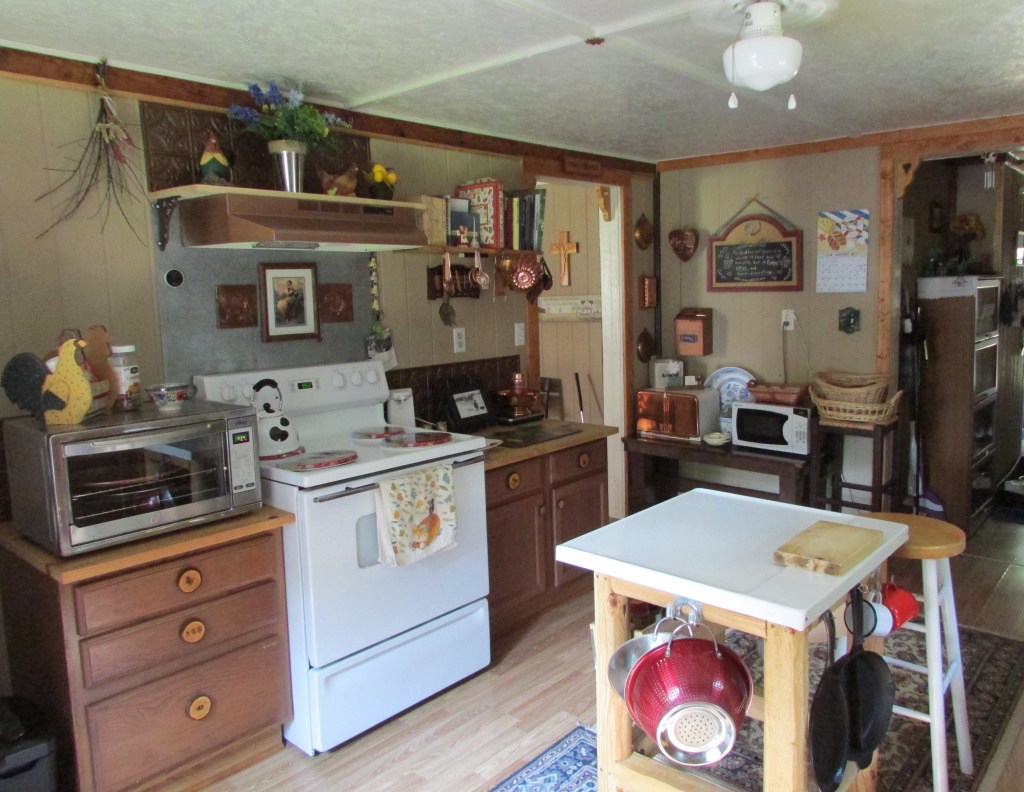
After – The Kitchen as it is today.
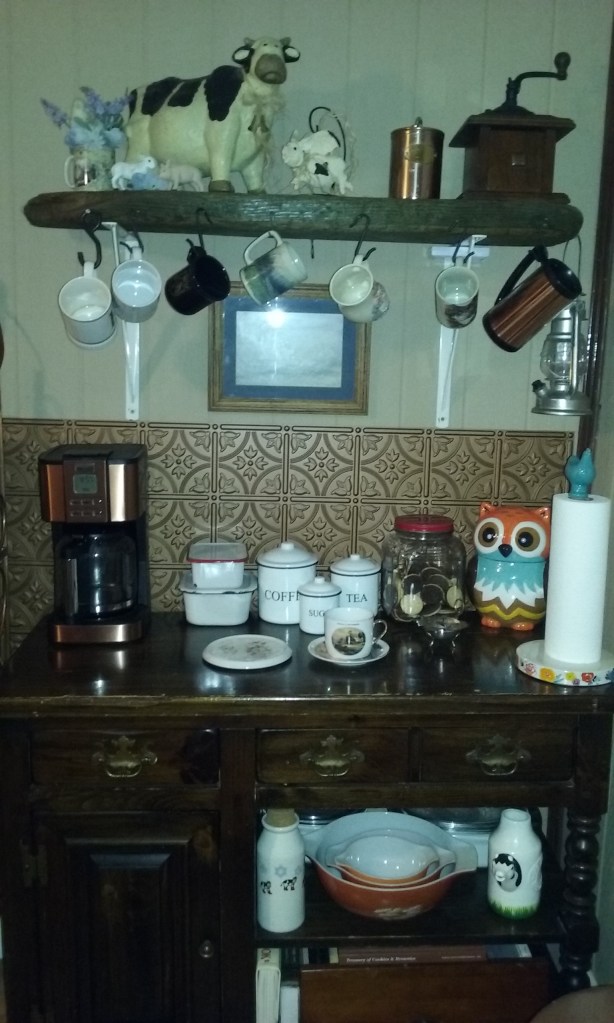
When placing things in the kitchen, we thought about the space we had, but also, the way I cook. I knew it would bother me to have a coffee pot in the same area where I would prepare a meal, so the coffee pot was placed in a corner of the kitchen as a separate coffee station, utilizing an antique French buffet, which also offers extra storage. In the morning, my husband prepares his lunch to take to work in that area while I prepare breakfast on the opposite side, and we are out of each other’s way. Atop that area, we placed a very rustic shelf made of heavy drift wood from the Jersey shore where I lived, a pleasant memory, a memento. Every time I look at it, I smile. I knew I dislike top cabinets so we did not installed those; instead, we put on shelving. As far as cabinets go, we found a great deal from a contractor, and we bought three pieces – one for the kitchen sink, and two for the opposite side in between the location of the stove. We decided to install butcher block counters. My husband made the cabinet knobs for me out of wood. I needed a center table to prep meals, and my husband built one for me – a rustic butcher block where I place things I use often and a spice rack. We installed a fan/light because the house does not have central air conditioning, so there are ceiling fans in every room downstairs. Eventually, we might install a ductless system. A metal sheet serves as backsplash behind the stove and it is a place where to attach a recipe using magnets. Cooking books are kept atop a shelf nearby. For now, the microwave and other things rest on a table my husband built out of recycled materials, however, I am on the look for a sideboard that will serve the purpose in that area. We installed laminate flooring throughout. We installed a double sink, which makes life easier. I am the only person on Earth (probably) that loves washing dishes and finds it relaxing, no need for a dishwasher. I love the scent of the dish liquid and the bubbles floating sometimes in the air, when you squeeze it. I love looking through the window, and the moment makes for perfect “thinking time.” My love of old things and copper dictated the décor. Here are some pictures. Hopefully, you will be transported to another time.
I am not a minimalist and I like old things.
Another view.
The coffee station.
We fixed the home for us, to our liking, not focusing on resale value, although we already multiplied its value four times plus, after valuation. We intend to live here for a long time. I hope you enjoyed this post and that it inspires you to take on a challenging project in the future.
I wasn’t sure how to start this post, which is a natural progression from the outside/garden series of posts, continuing with the “fixing an old farmhouse” series but doing it without the blog posts being too long or too overwhelming for the reader. I will do so room by room, starting with this first post about the overall condition of the farmhouse. If you are familiar with my previous posts, you know that the entire property was abandoned for years and covered in weeds and overgrown vegetation, inside and out, and that it had been left to rot. The inside had been pretty much destroyed by the previous guests, whether human or animal. All kinds of critters had welcomed themselves inside and made all kinds of nests, from birds to wasps, snakes, spiders… There was also a large amount of garbage (scary) and many areas of destruction topped by poor attempts to fix something broken at one point. The large water heater had burst at one point and caused water damage on the kitchen floor, being that, more than half of the wood floor boards had to be replaced. There was also an old refrigerator on what is now the mudroom/cat room, and it had a rotten turkey inside, still in the wrapper, waiting for Thanksgiving day, which never came. The sheetrock was damaged all over the house and ceilings, meaning that hardly anything could be saved. Dirt and disarray were everywhere, and there was nothing that could be of use or salvageable – believe me, we tried; we had a limited budget to make the house livable. We could only save four things, and that was after serious consideration – the original steps to the upstairs and the wall and handrail attached to them. The fourth item was the closet walls in what is now the living room. However, there was potential, and we could see it. The before pictures will speak for themselves. I warn you – these pictures are not pretty, some of it will gross you out, and it is not for the faint of heart.
The Before.
The old fridge with the rotten turkey surprise inside.
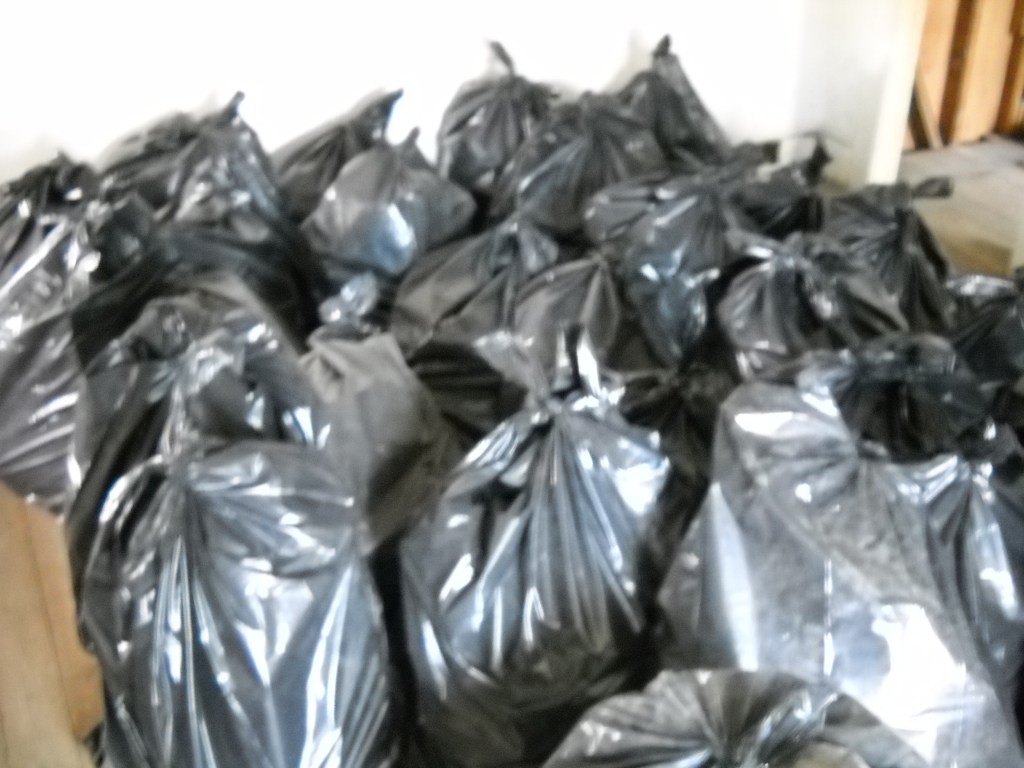
This is just a small sample of all the garbage we took out. I stopped counting once we hit 34 bags.
Extensive damage could be found all throughout the place.
The kitchen floor had suffered water damage, and everything was in rusty bad shape.
This picture says it all, and it also gives you an idea of the array of materials on the walls – various layers of wallpaper, panel, sheetrock, wood …
This gives you a clear idea of the condition of the place, and the challenge ahead. I will not lie, at one point I asked myself if this was a mistake; however, I always saw potential. This is an introduction to a series of posts on the work on the inside. Having a very small budget to work with, we had to get creative as far as materials and sources for those. We used recycled materials, repurposed many things, and found materials online as well from independent sellers. We also bought contractor left overs, and that saved a ton of money. Craigslist is an excellent source for finding contractor’s surplus. Brand new material at huge discounts. We also bought new materials from the big Home Centers when needed.
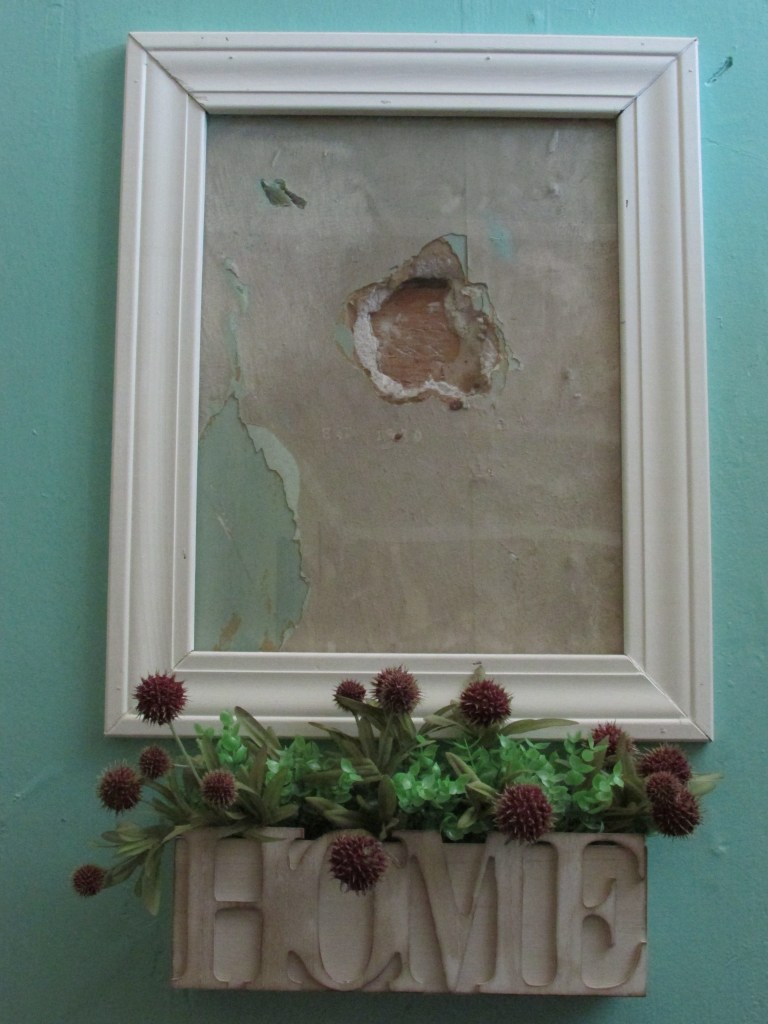
There was one area that we left as it was on purpose. We wanted to have a reminder of where we started and where we had been. It reminds us of many things, and also lets us appreciate the final product. I decided to frame it. It is located at the wall by the steps leading upstairs, the one we kept. Here is a picture of it.
A reminder, an inspiration.
It would be wrong to call this a restoration, as nothing has been historically restored, if anything, the soul to this house has been restored. It is our attempt to give life to a place we could call home. I will continue to share more on this endeavor, room by room. I hope you enjoy this post.