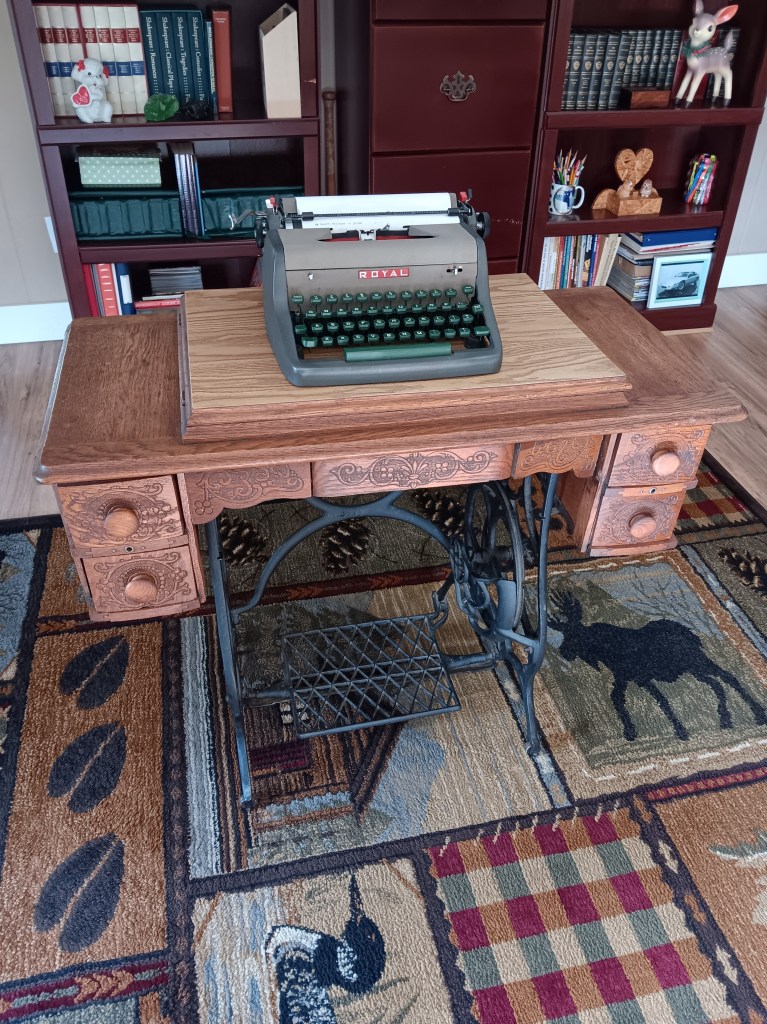
Sewing Words
Evil is a theme in my novels, but it is viewed in a supernatural way, not so much as a real condition, such as in a crime novel. Unless you are a victim of evil personified, most people think of it as something remote; it exists, might be supernatural or not, depending on your spiritual beliefs, and it manifests through human behavior. Since I can remember, I have always considered the supernatural side of evil to be real, but also, I was raised by a religious and devoted catholic grandmother, one who would tell me stories of old, ingrained in an ancient culture, stories of witches and demons, and supernatural beings that happened in the past. Lore or not? It doesn’t matter, but it did permeate into my novels. It probably shaped my views and interest in the topic, but also, fueled my curiosity; so much, that once, I dared asked a priest if he believed that evil was real. He answered something generic, that evil was in this world … I interrupted him and rephrased the question: “Do you believe that the Devil is real, that demons exist?” He looked at me a bit surprised, but calmly he said, “Yes, it is real.” I asked, “Why doesn’t the church tell people the truth?” His answer resonates in my memory until this day. He said, “Because most people would not be able to handle the truth.” I understood and I did not keep pressing him on the topic. I never asked again, but I always remember the answer.
More than three decades have gone by, which takes me back to my novels and the theme of good vs. evil in the supernatural sense. The current novel I was writing (and I say was writing because I stepped away from it for a while) does not follow the same lines, as far as this theme goes, although it has a bit of a supernatural flair mixed in more with the human condition. I asked myself the other day, did I step away from my “niche,” did I abandon my personal quest? Is this why the current novel seems so challenging or is there something more to it? I am not forcing the writing of this novel, but I know one hundred percent that I have to write the story, however the flow of it is very different, but I know that I am the one causing it. There are a few stories that are waiting to be written, all of them calling me at once, however, I know that until I conquer this one, in mind and soul, I will not be able to tend to the next one. Now, it is personal.
Will writers even bother to write if competing with a large number of AI generated stories? That is a question that only time will answer. There have been incidents where many AI generated books have made it to best seller lists. Scammers also may use AI to generate reworded versions of actual books. They can think of anything to make a quick buck out of the sweat of real authors by using AI to alter their work. Although Amazon has made a few efforts to alleviate the problem, it continues, and as of now AI generated content must be disclosed when submitted, something that helps but does not solve much.
Artificial Intelligence is becoming better and soon it will be just a matter of time when we could hardly be able to tell the difference between written works by real authors and a piece of junk from Robotina. People who care more about making a quick buck than about the craft are able to generate a story, from cover to content, and illustrations in a matter of minutes, especially children’s books. AI saturated market is the worst nightmare for true writers who love their craft and who bleed through the pages of a novel until it is finished.
How will readers find your work when they have to navigate a system which is so saturated by fakes? Will they even care or will they voraciously consume AI generated content as long as it is good enough to fill an entertaining need or any other specific need? If we have people dating AI generated people, what prevents readers to make a switch to AI generated books? Only time will tell, but one thing is certain, authors are now competing with a new form of “art,” one that has eliminated the middleman aka real author and goes straight to making a product for profit in no time at all. Will authors become discouraged? Will real writing even matter anymore? Will AI mimic our blood and sweat in the pages? Will writers write? Only time will tell.
Faster and faster, we are being replaced by our own creation, maybe to the point of becoming obsolete by our own hand. The creator ceases to exist, absorbed by its own creation. Maybe time is all we have left, or do we? Will AI alter our perception of time, eventually? Will we be able to tell?
It is October and spooky is everywhere, so I decided to share an excerpt from Sunrise Souls, last book in The Dinorah Chronicles trilogy. It is found on page 66.
… but this time I saw the evil energy that embodied her soul gazing through her eyes. A blaze of fire danced in her eyes with the fury of an unholy cadence. I jumped and delivered a lethal kick to her chest as she came charging with the force of a raging bull. We met in mid-air as she fell back foaming in hate, her mouth spouting a poisonous river of filth.

The topic of survival is one that I have included in my novels. It is interesting to see how survival can bring out the best or worst in people. It separates heroes from the not so good characters. So is in real life, although I believe that there is redemption for everyone. When a person is in survival mode, it forces the individual to act one way or the other; it brings about the truth of that person. In other words, you cannot fake it when you are in survival mode. It forces you to be what you already are. It shows a person’s true colors.
I will venture to say that in today’s USA, many people are in survival mode, probably more people than we realize. Younger generations are having a tough time keeping up with a very high and unrealistic cost of living and many people are working two plus jobs and hardly making it. Young couples simply cannot afford giving birth because hospital care is simply unaffordable. Food prices, daycare costs, and rent or home prices are truly out of reach for most of the younger generation. It is simple very different from what it was for other generations. In simple words, this generation is being hit from all angles. Most politicians fail to see the struggle, or they are simply not in touch with reality out there. People are struggling to keep a roof over their head and put food on the table, even the most frugal people. Most of Americans are in survival mode. Many people are truly doing all they can, working all they can, and cutting costs as much as they can, and they are still not making it. The disparage and disproportion between wages, education, and labor is ridiculous. The middle class is slowly disappearing in this country. It is easy to put a blindfold and label a generation of being lazy without considering all factors and influences at play.
I have always been an observer by nature. How many times have I witnessed someone at the supermarket leave just a few groceries because the card did not take? How many times have I heard a mother tell her child, “Sorry honey, we don’t have enough for “this” today;” “this” being a food item, not a toy? How many times have I witnessed someone staring blank at the insane prices in the meat isle at the supermarket, a hopeless stare followed by bypassing the product section, or even putting groceries back? I can tell you more examples, from couples quietly arguing about food, to older people with less than five items in the food cart, oh, so much more. Food is a basic need, and people can’t even eat in what we call the richest country in the world. Many people are in denial, but that is just a coping mechanism when you are or are about to be in survival mode.
If you have ever been in survival mode and have come through, you know well that there is a lesson to be learned from all of it, and most likely, you recognize that lesson. Most likely, you come out with a sense of gratefulness, stronger, and wiser. Most likely, you have learned about yourself, your true self, and the things that are not to be taken for granted anymore. Most likely, there is a sense of renewal and hope, of clarity and inner peace, and a healthy dose of pride after surviving the event. Having experienced survival mode at one time in my life, I can say that faith is an important component to make it through, that is, faith in yourself, and faith in a higher power. Don’t forget to count your blessings because they are many, in any circumstance.
Must every criminal or drug lord last name be Diaz on TV shows? I am truly tired of it. Writers please, if you are creating a Hispanic/Latino character, there are more last names other than that one, I assure you. Show a little more creativity, please? Examples of these shows are Law and Order, The Closer, Major Crimes …
Why is this so bad? We learn in many ways, but one of these is by repetition and association. When we hear something over and over, we make a mental association, negative or positive, whether we realize it or not. Stereotypes have existed for as long as we have, I guess. Society has accepted many of these and therefore, help perpetuate these stereotypes. As writers, we owe to ourselves to put out our best work and not perpetuate many of these stereotypes. Sometimes, that will mean going against the grain or mainstream, but most of the time, it is taking the care and time to educate ourselves as much as we can on a topic, subject, culture … We can only do our best, and laziness falls short of it.
Yes, my last name is Diaz, and I assure you that I am not a criminal, I don’t use or deal drugs, and I won’t harm you in any way. So fellow writers, let our creativity shine, and let us break the chains that held our pen captive for so long.
As a writer, I like to explore all kinds of topics for future works. Greed is a common theme found in many novels. Family greed reaches another level and depth. I once heard someone say that money reveals what is already in your heart and amplifies who you already are. I think that is true. I have seen families “change” once there is an inheritance pending. People will do many unexpected things for money; however, this behavior is not created by money, only revealed. Whether backstabbing, stealing, lies, and even murder, it all originates from a greedy heart. The generous and kind person will continue to be such and able to bless others in new ways.
Family dynamics are complex by nature. There are no perfect families, but family greed revealed by money will change the most “perfect” of families, and once someone’s true character has been revealed it is hard to see them in another light. As writers, when approaching the topic of family greed, we might consider all the layers and choose to unravel many via different characters or focus on just one being amplified by one character. Family greed is a very deep and interesting topic with great possibility.
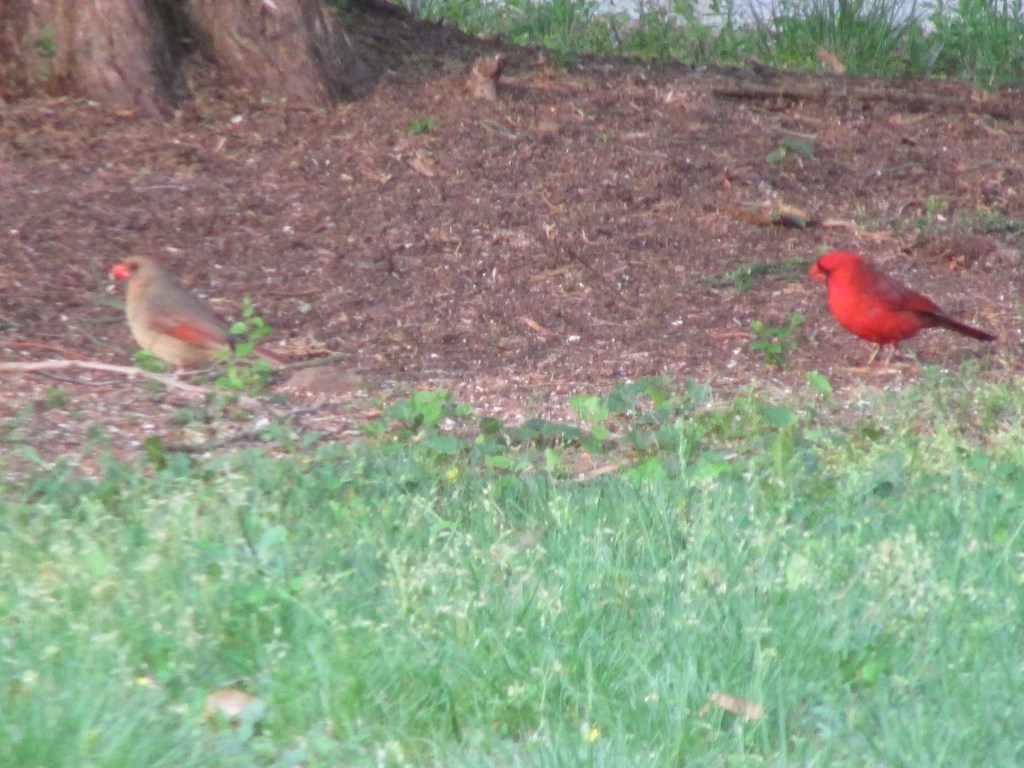
I had never heard of writing dice. One of my lovely nieces gifted me with this interesting writing prop. It looks fun and certainly has the potential to spark creativity. It is a series of color-coded dice with words/categories written on the dice. The way it works is by throwing the dice and creating a story with the words/categories obtained. Each color means something, for example, yellow represents time/place, white is point of view, and so on. Here’s what it looks like.
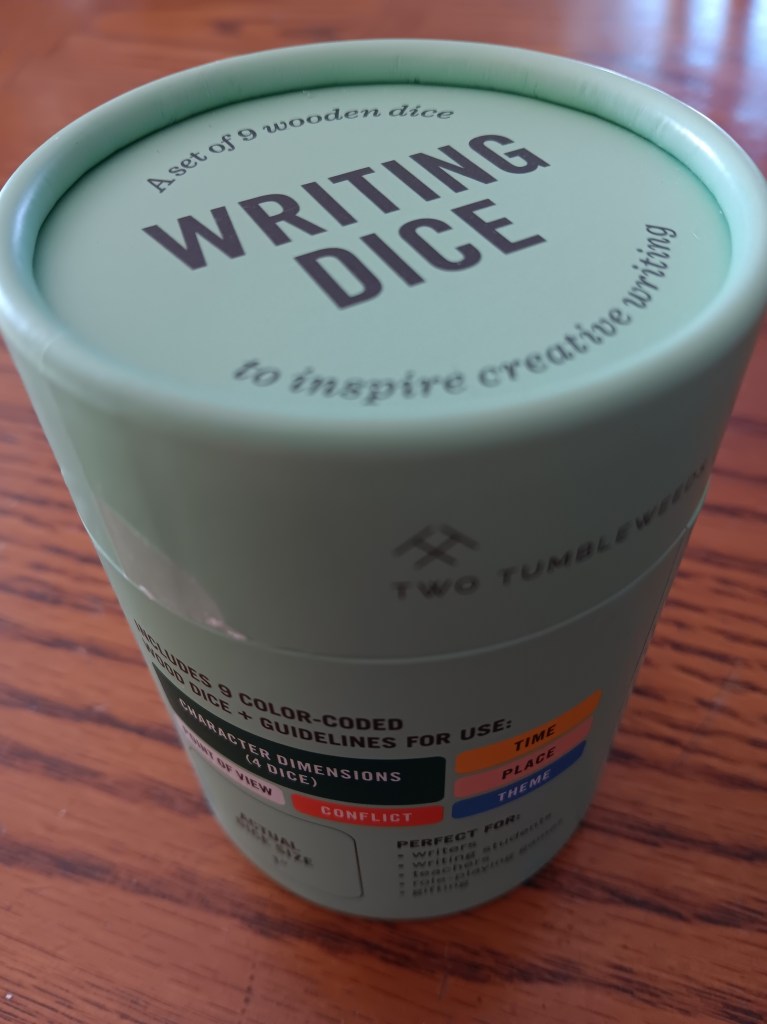

If I was to apply the example of dice in the picture to my first novel, Moonlit Valley*, it would be like this: written from the protagonist point of view (Rose Carrigan)(white dice), who is very witty (green dice), and taking place in a small rural town (Moonlit Valley)(pink dice); she is presented with an unexpected destiny, that challenges her identity (blue dice), as well as everything she thought she knew about her husband (yellow dice), in a supernatural twist of fate (orange dice). Now the funny thing is those were the dice (in the picture) that came out at my first try. Made me smile for sure. What a fun writing prop.
*You can find Moonlit Valley on Amazon, in eBook and printed format.
As a writer, I find that my current novel is always present in my mind, no matter what I am doing; it lingers. The other day, as usual, I woke up at five in the morning, and as I was ready to prepare breakfast for me and my husband, the ending to my novel in progress just presented itself in my thoughts, just as if my mind was playing a movie. I knew that I had to grab pen and paper quickly and write. I wrote the entire abbreviated scene. My husband observed me and finally asked. I told him that I had the ending to my novel, but now I had to figure out how to get there from where I was.
This is wonderful because if I had any doubt about where this story was headed, I don’t have it anymore. After all, if there is an ending, there is a story behind it; I just have to uncover it. I have to admit that it feels as a mysterious quest, as if I am embarking on a journey of the mind and soul. Every story is (feels) different, but in every story, there is mind and soul. As writers, sometimes we feel the pressure to deliver “the ending” to our carefully crafted story. In a way, it takes a bit of that pressure off; it releases the pen.
I am thankful for those few minutes of clarity, and in a way, this moment has cemented my commitment to the story and strengthen the bond between us.
Should I give my chapters a title? I’ve asked myself that question, and while there is no right or wrong answer, I prefer numbering the chapters. However, in a few of my novels, I opted to give chapters a title. I think there are pros and cons to that approach, and it depends on what I am writing. Titles can be grounding to me, as the writer; it gives me a parameter to adhere to as I write. For a reader, it might enhance anticipation, or arouse curiosity and the need to continue reading, however, it might also set expectation. The reader might expect something different.
Is the title a giveaway of the entire chapter? Not necessarily, a hint maybe, but I don’t think chapter titles should be written like a blog/article title, hence letting the reader know what the content is about. I think of it more like an invitation to continue reading, a mystery that unravels in the next few pages. In Moonlit Valley, I used chapter titles such as: Exile (for chapter 1), Boundaries, A New Truth … These titles don’t say much, however, they set the stage for what’s coming in the next few pages. In Ramblings of the Spirit (book 1 of The Dinorah Chronicles) I used a combination of chapter number followed by title. For example, Chapter 4 Dark Waters. I used the same format for the entire trilogy. However, when I wrote The Five-dollar Miracle, I numbered the chapters, only. For my current novel, The Girl Who Could Not Love, I prefer to use chapter numbers, although I could have used titles instead. For that particular novel, both formats seemed to fit well.
For me, the flow of the story dictates what I will do, but I find that the traditional numbered chapters work well always.
 Inkspeare