This morning, as I sipped my coffee outside, I was talking to my husband and noticed one Monarch butterfly wing on the ground. I picked it up and was observing its beauty and for the first time realized that it feels similar to a bird wing, except thinner. Then my husband told me that he saw another one behind the butterfly bush. We went to see if we could find it and found tons of butterfly wings all over. It was a sad and beautiful thing at the same time – the only way I can describe it. I picked up the wings and believed that there most have been tons of butterflies that die; however upon closer inspection of the wings, I realized that maybe only 4 or 5, according to the wings remains.
What caused their death? I am not sure, but the other day, as I was observing one that was flying I realized that it was too cold for them and wondered why they were still around. I am not sure if these are the last generation of this year matting but it certainly looks that way, as their color is very intense and bright. This means that these butterflies did not make it to migration to the south. A few wings were showing sings of a predator picking thru it, but most were whole. Later, I decided to learn a bit about monarch butterflies and found a great website which I will share with you for when you want to learn a few interesting bits of info – http://www.monarch-butterfly.com/
On my research I learned that most of the wings belonged to male butterflies, as they have a black dot in one of the veins. I also learned that there are four generations in a year – March/April, May/June, July/August, and September/October. The last generation is the only one that gets to migrate, the earlier generations die. So I am not sure if these are from a third generation that died or from a fourth generation that was born and died due to the recent cold temperatures. I doubt that they were eaten by predators, since Monarchs are mostly poisonous to birds, insects, and mammals due to their diet – Milkweed.
When we moved into this house there were no flowers or plants only grass. Over 10 years, I had grown a garden and planted two butterfly bushes which feed a lot of butterflies and even the occasional hummingbird. I get tons of hummingbird moths as well, an amazing sight. One time I attempted planting carrots and got butterfly larvae eating on them. I left the plants so the larvae could nourish from it and continue its life cycle. The larvae was Monarch butterfly larvae. It was feeding from carrots; however most information I have read points out that it only survives from milkweed. I don’t know but they were eating carrot plants and pooping to their contentment. Later that season I saw tons of beautiful monarchs being born. One of them even came to me when I was sitting on my steps, and rested on my hand, as if saying thank you for feeding me.
Here are the pictures of this morning’s findings, what looked like tons of fairy wings.
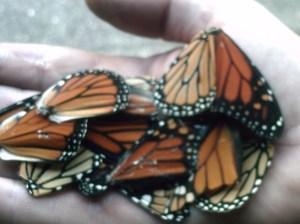
Tons of monarch wings in hubby’s hand.

Monarch wing. This is a male, see the black dot in the vein. The rich colors suggest that this might be a fourth generation that never got to migrate.
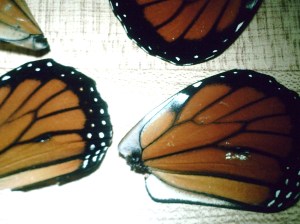
More male wings. I think by the amount of wings we found on the floor, maybe four or five butterflies the most – two or three males and maybe the others were female. These were Monarchs and not Viceroy butterflies which look very similar. Check out this link to see the differences in the wing pattern, go down to the picture at the end comparing the two butterflies – http://en.wikipedia.org/wiki/Monarch_(butterfly