Evil is a theme in my novels, but it is viewed in a supernatural way, not so much as a real condition, such as in a crime novel. Unless you are a victim of evil personified, most people think of it as something remote; it exists, might be supernatural or not, depending on your spiritual beliefs, and it manifests through human behavior. Since I can remember, I have always considered the supernatural side of evil to be real, but also, I was raised by a religious and devoted catholic grandmother, one who would tell me stories of old, ingrained in an ancient culture, stories of witches and demons, and supernatural beings that happened in the past. Lore or not? It doesn’t matter, but it did permeate into my novels. It probably shaped my views and interest in the topic, but also, fueled my curiosity; so much, that once, I dared asked a priest if he believed that evil was real. He answered something generic, that evil was in this world … I interrupted him and rephrased the question: “Do you believe that the Devil is real, that demons exist?” He looked at me a bit surprised, but calmly he said, “Yes, it is real.” I asked, “Why doesn’t the church tell people the truth?” His answer resonates in my memory until this day. He said, “Because most people would not be able to handle the truth.” I understood and I did not keep pressing him on the topic. I never asked again, but I always remember the answer.
More than three decades have gone by, which takes me back to my novels and the theme of good vs. evil in the supernatural sense. The current novel I was writing (and I say was writing because I stepped away from it for a while) does not follow the same lines, as far as this theme goes, although it has a bit of a supernatural flair mixed in more with the human condition. I asked myself the other day, did I step away from my “niche,” did I abandon my personal quest? Is this why the current novel seems so challenging or is there something more to it? I am not forcing the writing of this novel, but I know one hundred percent that I have to write the story, however the flow of it is very different, but I know that I am the one causing it. There are a few stories that are waiting to be written, all of them calling me at once, however, I know that until I conquer this one, in mind and soul, I will not be able to tend to the next one. Now, it is personal.
It is October and spooky is everywhere, so I decided to share an excerpt from Sunrise Souls, last book in The Dinorah Chronicles trilogy. It is found on page 66.
… but this time I saw the evil energy that embodied her soul gazing through her eyes. A blaze of fire danced in her eyes with the fury of an unholy cadence. I jumped and delivered a lethal kick to her chest as she came charging with the force of a raging bull. We met in mid-air as she fell back foaming in hate, her mouth spouting a poisonous river of filth.
You can find SUNRISE SOULS on Amazon or order it where books are sold.
As a writer, I like to explore all kinds of topics for future works. Greed is a common theme found in many novels. Family greed reaches another level and depth. I once heard someone say that money reveals what is already in your heart and amplifies who you already are. I think that is true. I have seen families “change” once there is an inheritance pending. People will do many unexpected things for money; however, this behavior is not created by money, only revealed. Whether backstabbing, stealing, lies, and even murder, it all originates from a greedy heart. The generous and kind person will continue to be such and able to bless others in new ways.
Family dynamics are complex by nature. There are no perfect families, but family greed revealed by money will change the most “perfect” of families, and once someone’s true character has been revealed it is hard to see them in another light. As writers, when approaching the topic of family greed, we might consider all the layers and choose to unravel many via different characters or focus on just one being amplified by one character. Family greed is a very deep and interesting topic with great possibility.
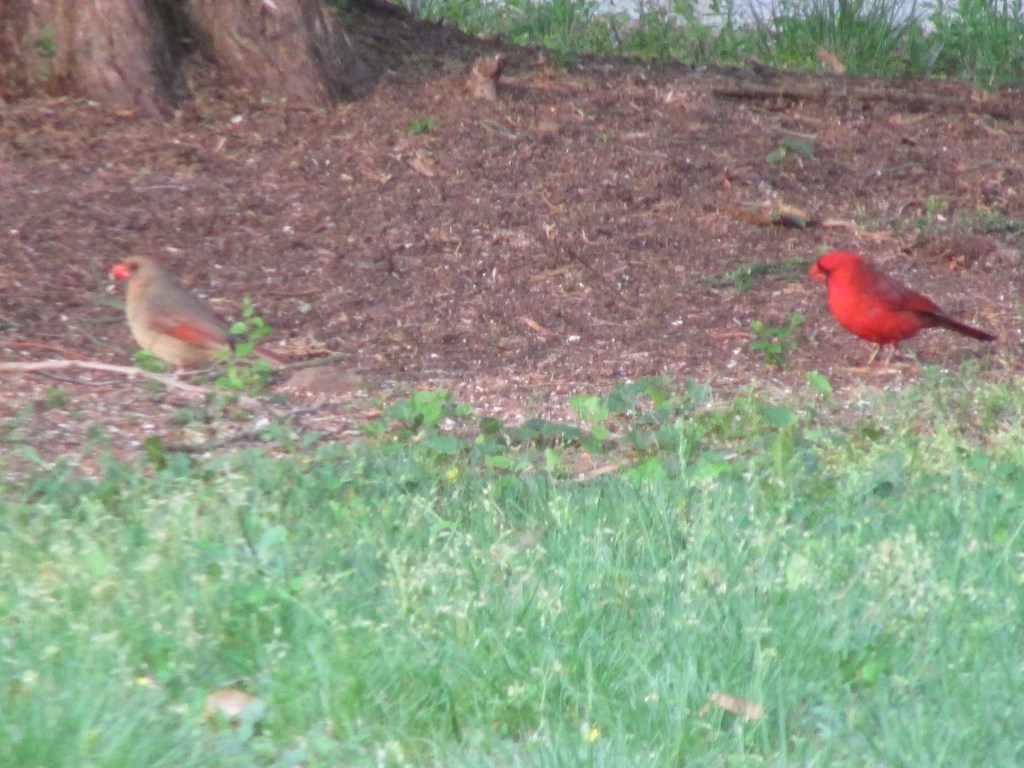
Certainly, no greed here. He first took her to eat at the birdfeeder, and later, he flew her to the birdbath for a little drink. Wining and dining his love.
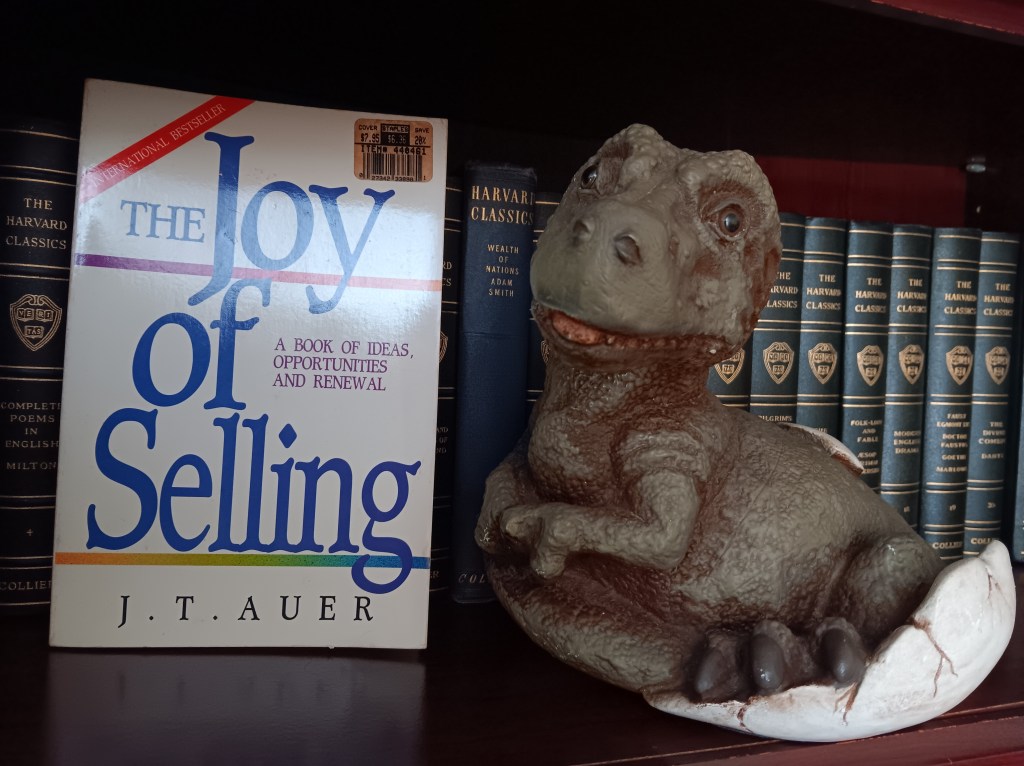
I am re-reading The Joy of Selling by J.T. Auer before I let it go. It is an oldie (1989), an international bestseller. I read it in my younger years. Although a book for the professional salesperson, its principles can be adapted and applied to many areas of living, working, and interrelationship with others; after all, we are always selling or being sold something in our daily interactions with others, whether we realize it or not. We “sell” ourselves every single day at any moment, our opinion, point of view, values, desires …
Although an older book with its dated technical jargon, this book is written in a simple, down to earth approach, and its principles are what makes it still useful today. Whether you are in the sales profession or not, it is still relevant.
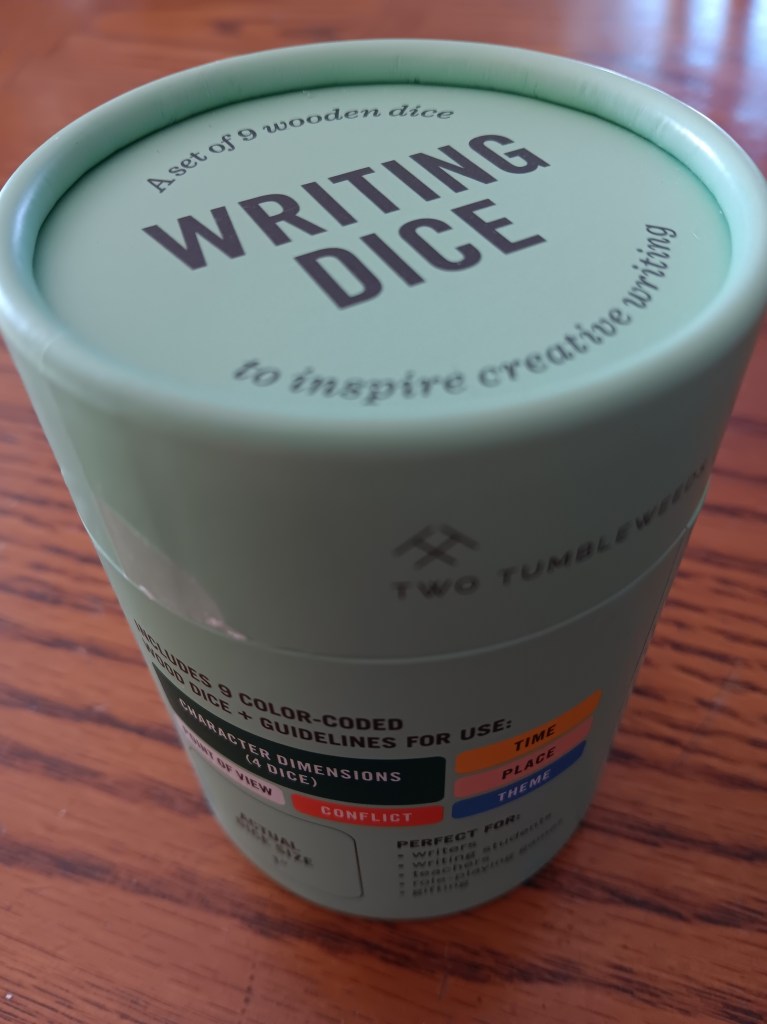
I had never heard of writing dice. One of my lovely nieces gifted me with this interesting writing prop. It looks fun and certainly has the potential to spark creativity. It is a series of color-coded dice with words/categories written on the dice. The way it works is by throwing the dice and creating a story with the words/categories obtained. Each color means something, for example, yellow represents time/place, white is point of view, and so on. Here’s what it looks like.
Photo by M.A.D.Photo by M.A.D.
If I was to apply the example of dice in the picture to my first novel, Moonlit Valley*, it would be like this: written from the protagonist point of view (Rose Carrigan)(white dice), who is very witty (green dice), and taking place in a small rural town (Moonlit Valley)(pink dice); she is presented with an unexpected destiny, that challenges her identity (blue dice), as well as everything she thought she knew about her husband (yellow dice), in a supernatural twist of fate (orange dice). Now the funny thing is those were the dice (in the picture) that came out at my first try. Made me smile for sure. What a fun writing prop.
*You can find Moonlit Valley on Amazon, in eBook and printed format.
Should I give my chapters a title? I’ve asked myself that question, and while there is no right or wrong answer, I prefer numbering the chapters. However, in a few of my novels, I opted to give chapters a title. I think there are pros and cons to that approach, and it depends on what I am writing. Titles can be grounding to me, as the writer; it gives me a parameter to adhere to as I write. For a reader, it might enhance anticipation, or arouse curiosity and the need to continue reading, however, it might also set expectation. The reader might expect something different.
Is the title a giveaway of the entire chapter? Not necessarily, a hint maybe, but I don’t think chapter titles should be written like a blog/article title, hence letting the reader know what the content is about. I think of it more like an invitation to continue reading, a mystery that unravels in the next few pages. In Moonlit Valley, I used chapter titles such as: Exile (for chapter 1), Boundaries, A New Truth … These titles don’t say much, however, they set the stage for what’s coming in the next few pages. In Ramblings of the Spirit (book 1 of The Dinorah Chronicles) I used a combination of chapter number followed by title. For example, Chapter 4 Dark Waters. I used the same format for the entire trilogy. However, when I wrote The Five-dollar Miracle, I numbered the chapters, only. For my current novel, The Girl Who Could Not Love, I prefer to use chapter numbers, although I could have used titles instead. For that particular novel, both formats seemed to fit well.
For me, the flow of the story dictates what I will do, but I find that the traditional numbered chapters work well always.
In part, a purpose for this blog is to write about my journey as a writer, as well as to share what has worked for me, and my approach to writing a novel. There are so many books and information online on this topic, which will always be of some benefit; however, I find that much of that information is very technical and sometimes, even discouraging to someone who is just starting the journey, hence why I try to simplify when I am writing about a subject. In this case, dialogue, specifically, when it needs to be long.
When I am writing a novel, I strive to have a balance between dialogue, description, and narration. My novels tend to be rich in dialogue, sometimes long (if needed). If not careful, the reader might be lost in the conversation. Although sometimes a long conversation is required between two or more characters, I try my best to include other elements, whether having a character make a gesture, change positions, observe something, or anything that might give the reader a small break from the dialogue. I have a tendency to write in long sentences, as you might have noticed if you have been following this blog, and that is reason enough for me to be aware when I am writing dialogue, or even description in my novels (there you go, that was a long sentence.)
When dialogue is long, such as in the case of a character recounting a story, or a past event, I interject with something in the third person. As an example, Joe is recounting an event. He has been talking for a while, so in order to break it up a bit, as the writer, I can interject with having Emily react to what Joe is saying. Emily’s eyes grew wider with anticipation… or depending on the scene, Emily grabbed Victor’s hand tightly while Joey …. or a character might break the dialog with a question. These are all actions but should never feel forced on the characters. Those small breaks in dialogue give a break to the reader, but also make the other characters present in the conversation while they are silent. When I write dialogue, I want to make it as natural as when I am in conversation with another person or group of people. Characters have different personalities and when they are active in dialogue, their personalities are reflected through their words. It goes a step beyond she said/he said. A reader should never be confused about who said what. Just as chapters are a continuous clean break, so should interjections in dialogue. One follows the next naturally, without leaving the reader behind.
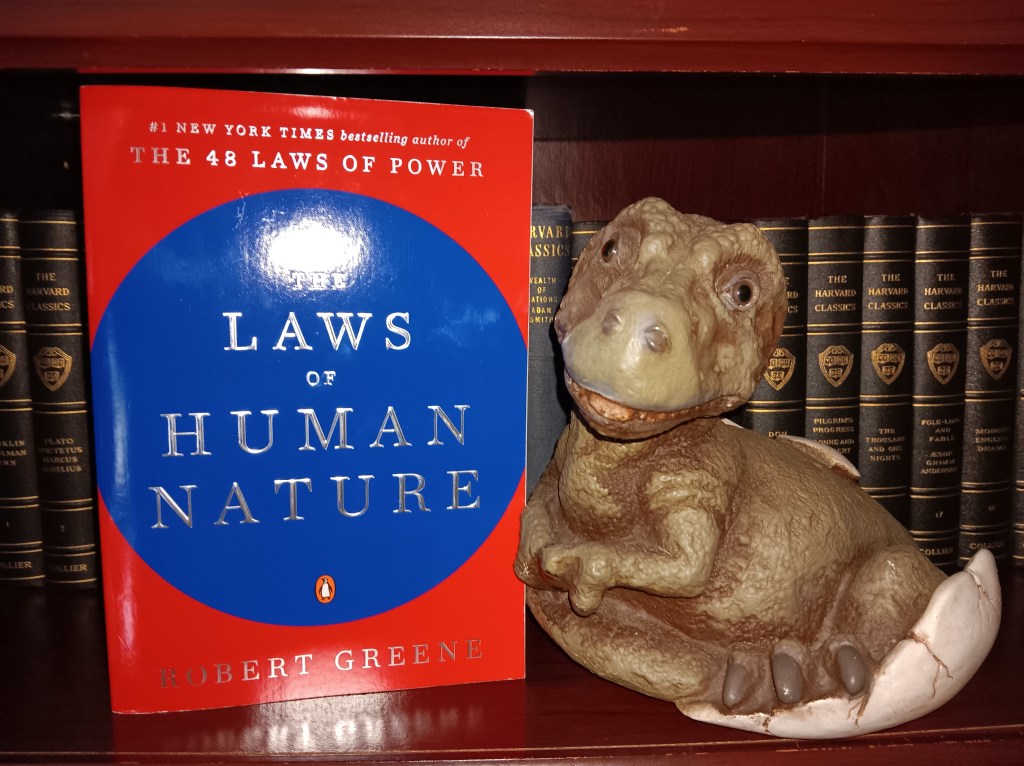
Herbert presents, The Laws of Human Nature by Robert Greene (Photo by M.A.D.)
This was a lovely surprise, a gift from my nephew on my birthday. The Laws of Human Nature by Robert Greene is about the understanding of human behavior but from a historical perspective, with examples throughout history. The bestselling author explains basic human nature behavior through historical examples in order to teach you how to apply decoding the same behavior today, in others and in yourself, and how to better understand and get a hold of your emotions once you understand this behavior, as well as become more understanding of others, thus improving your relationships.
So far, I am enjoying this book immensely; so far, a good read for sure.
For most of my life, writing and publishing seemed a dream hard to reach. Mostly because the image of most famous writers that was presented by the media to my generation was a bit intimidating and hard to reach. It was one of seclusion, selectivity, money, unwanted-wanted fame, and reserved for the few great ones. This was a different time, one without internet, social media, and writer-friendly technology. Traditional publishing ruled the roost, and the few brave independent authors who dared cross to another dimension were viewed as vane, and even rebels who could not abide and bow down to a perfectly run system that would vomit you if you were deemed not good enough, or below its standards. Many dreamers like me would not dare enter the nightmare, and the ones who became rebels of the system knew they have to pay the price, and a very expensive one it was, literally and figurative, reputation included, and with it, down the dream of being even considered for a traditional publishing contract. Independent publishing was viewed as a mortal sin. Thank God these days are different, although not without its problems. When I realized that my dream of writing could be resuscitated under a new set of rules, I didn’t think twice. It was a new dawn. However, I had many questions. Many of these questions are the same ones that aspiring writers have today, although it is much easier to find the answers now. This post is about some of those questions and how I answered them, as well as questions I’ve encountered.
I want to write, but how do I start?
The short answer to that is just do it, write, but there is so much more to that. When I thought about that question, it wasn’t as easy to answer as I thought it would be. There was so much to consider, and so much more knowledge I needed to gather. I spent nearly two years learning (while writing and transitioning) as much as I could about this new system and independent publishing, but as well about traditional publishing at the time. Many myths were alive, other were just that. I found that the most important issue was my Why. Why did I want to write? Was it just because it was a life dream resurrected or was there more to it? I knew I had to answer that question before taking the plunge. I did. My why is not relevant here, every writer will have a why. So, to answer the question, start with your why. Why do you want to write? How do you see yourself as a writer? Is it for money or a call, or something else? When did your desire/passion for writing start? What triggered it? Have you written anything in the past? Why not? Were you intimidated by misinformation? How do you view writing? As a business? As a hobby? As a career? As a calling? How do you view other writers? Would you consider becoming an independent writer (indie writer) or does traditional publishing align more with your vision? Would you consider becoming a hybrid author?
How do I publish my book?
There is much to learn about this subject, and the good news is that today there is much information on this subject online and in books written by many independent authors, as well as hybrid authors. A hybrid author is one who has published via the traditional model, but also independently. The way to answer this question is for you to educate yourself as much about the publishing industry as you can. Learn about both models, but also, about the different methods to publish your work independently, because there are many, and the cost vary widely between these, from very minimal expense to thousands of dollars. Most important, and once you study this information, is to apply what you learned when you answered question number 1 to answering these other questions about publishing. What attracts you more about each model? Which model mirrors more your work ethic? Would you consider becoming a hybrid author? Would you consider working with an agent? What is your ultimate publishing goal?
Do I have to be an avid reader to be a writer?
Most writers are. It is part of your education. You will learn different styles, voices … Develop your writing style and voice. Never try to imitate another writer. It is a disservice to you, and you would be disrespecting your craft. There is nothing wrong with admiring a best-selling author and learning from that author’s style and work; however, develop your own. Understand that it takes time to learn and grow. Most likely, the author that you admire most has been at it for decades.
Do I have to belong to book clubs or writer’s groups?
Short answer, no, and in other words, you do you (or to each its own). You know what you like and dislike, you know your personality well, and you know what ultimately educates you and fuels you. If these groups work for you and excite you, then go for it. If not, there is no sin in that. These can be a great educational tool, but it depends on your personality, preferences, and goals as a writer.
What is the process of writing and publishing a book?
First, read and learn as much as you can about the topic. Aside from the educational part of this question, it is different for every writer. Inspiration comes in many ways. Most serious writers are disciplined enough to have a schedule or method. Many writers use an outline before writing a book, other writers do not. I don’t outline, but a small outline sometimes develops on the side as I am writing. Many times, as a way of remembering important points, or as new ideas pop. There is no right or wrong way here. It also depends on what publishing model you decide better fits your working style and ethic. There are many ways of publishing a book; learn those venues and their differences. Cost ranges from minimal expense to thousands of dollars. The more you contract out the more money you spend. You can use a publishing house for independent writers, which takes care of formatting, editing, etc. or you can hire each phase yourself, from formatting, to edition, from cover to cover, all the way to publishing your book, hardcopy or electronically (eBook). Amazon is a great way to start, if in doubt, and in my opinion, one of the least expensive ways to publish a book, and still put out a decent product. They offer editing and other services as well. There is also a good amount of information on their site, as a way to educate aspiring writers, which translate in more revenue for the company, eventually. Follow the method that you prefer and one that lets you present a well-crafted quality book for your readers, one that you are proud to offer.
Who promotes my book?
You do. Whether you publish traditionally or independently, you will have to do some work to promote your book, and the venue you use is up to you, whether that is social media, blogging, related products (physical products) and promotional materials, giveaways, activities … However, when you have a team behind you, such as in traditional publishing, there are advantages to that, as well as an established name behind your book and proven methods to spread the good news. As an indie writer and publisher, you can do the job yourself or hire people to do it for you, depending on how deep your pockets are. There is also the issue of personal preferences, for example, you might not enjoy social media as much, but prefer blogging, or other methods. I have to say, although I don’t follow this, that being robustly involved in social media, having a YouTube channel, a podcast … does help in spreading the good news about your work faster and widely. It is something that I recognize as a great advantage but not necessarily follow. It all depends on what your ultimate goal is. There are three very good sources to further your education that I like, that is, if you don’t know where to start. One is Stephen King’s book On Writing, Joanna Penn’s book The Indie Author Guide, and a copy of The Writer’s Market (for traditional publishing). Joanna Penn is an independent best-selling author. Her YouTube channel and blog are a great place to start. There are more suggestions under the tab On Writing -FAQ on this blog.
Do I need to be involved in social media? How much is too much?
The short answer is yes. You should have some kind of internet presence. Times have changed, and it is part of a very fast environment and culture development. However, you should not have to feel obligated to join every social media site. If you enjoy that, by all means, the more exposure the better, but not at the expense of your writing time. I think balance is key. I only have this blog as my online platform; other authors prefer a much robust involvement in social media venues. There is an advantage to online exposure and interaction. Again, it depends on your ultimate goal. If selling as many books as you can is your goal, then you will need a well-crafted and thought-out online presence.
Will I make tons of money?
Making tons of money is the wrong reason to enter the writing world. Most writers, good or bad, do not make a high income. A better approach would be to treat “making money” as a byproduct of your love for writing; however, passion/love alone doesn’t pay the bills. At one point, you will reconsider and go back to your Why, and make a decision. You will consider your ultimate goal and adjust your plan if necessary. Many independent authors are doing very well.
What about branding and trademark?
Developing a brand is to your advantage, whether you become a traditionally publish author or an indie author. People tend to associate a name with branding. Study the books of best-selling authors, and notice common characteristics such as color, typography, mood… It is cohesive and recognizable. This is something you will develop with time, because in the beginning you are learning about yourself as an author. However, when traditionally published you will be coached and steered towards an image/brand. The experts take care of that, in a way. When you publish traditionally, you are under contract with a particular publishing house, for the duration of your contract, and both sides have legal obligations to fulfill; you are also represented by an agent. As an independent author, it is up to you to develop a brand (or not), and your work falls under copyright laws and protected by it. I advise to educate yourself on this topic.
How fast should I write a book and publish it?
Writing a book is not an easy endeavor. It takes much crafting, editing, reviewing, research, and other considerations, aside from the publishing part, which has its own challenges. You should not be in a rush but take as necessary to present a well-crafted book always, one you are proud of as an indie writer. Under traditional publishing, you are under contract and must meet the deadlines expected.
Do I have to stick to a particular genre?
There is no right or wrong answer here. I recognize the advantage of sticking to a particular genre, one you have some kind of degree of passion, but I don’t see it as a rule. The experts will tell you different. From the point of view of developing a brand and polishing your style there is definitely a strong reason to try to write in one genre. Know that the boundaries of writing go as far as the mind of the writer, and in my opinion, imagination and creativity and boundless. I don’t follow the stick to a genre rule. The answer becomes clearer as you grow in your craft.
What is the most important thing to do when trying to become a writer?
Write, but aside from developing a writing process/schedule, I think that it is educating yourself as much as you can in anything related to writing and publishing. You cannot craft a plan to follow a path without information, and knowing where you are headed. There are many books available now as well as websites, podcasts, videos, that you can utilize. Visit bestselling authors websites. Many of them offer tips for aspiring authors. Even the visual education you gain by studying their well-crafted websites is worth it.
I hope this has been helpful and that you continue to educate yourself in the craft, but most of all that you embrace your passion for writing and run with it.
I love to collect antique books (and writing instruments). There is some magic about these tomes. Although none of mine have great monetary value, these tomes are valuable to me. Whether for its old-fashion wisdom, their depiction of a long-gone era, rich in the culture of the time, or the way these look (material, colors, patterns used in their making …), these books are a delight for me, a gift to my senses.
While I was rereading The Royal Path of Life by T.L. Haines A.M./L.W. YaggyM.S., it occurred to me that there were many words that we don’t see much in books today. Many of them I understood by just rereading the sentence and focusing on the context, but other words I had to look up. This aroused my curiosity, and I thought it would be a good idea to share some of these words and the meaning in a series of posts.
The Royal Path of Life was written in 1876; I own a revised edition (1884). What I love about this book besides the engraved leather binding, gilded title, and gorgeous woodcuts illustrations is the common sense and wisdom found throughout its pages which bleed of the way of living of the times. Here are five words I found interesting. Many words today are derivatives, and many of these old words are obsolete.
Sundered – to break apart or in two: separate by or as if by violence or by intervening time or space. (Merriam-Webster). Earliest known use: old English period, pre-1150. (from OED)
Cynosure – One that serves to direct or guide. A center of attraction or attention. (Merriam-Webster). Its origins are Greek, and it passed into Latin, later French, then to English. Earliest known use was in the late 1500s (OED).
Sire – Father, male ancestor, a man of rank and authority. (Merriam- Webster). From the old English pre-1150. Inherited from Germanic. Last recorded in the 1500. It is obsolete. (OED)
Sinews – I only found the word sinew, what seems to be a derivative. It means solid resilient strength, power. (Merriam-Webster). The earliest known use, early 1500. From the old English, pre-1150.
Boon – A timely benefit: blessing. Benefit favor. Favorable (archaic meaning). (Merriam-Webster). From the earliest Middle English period (1150-1500), A borrowing from the Scandinavian. (OED).
Even if we never use these words again, it is a good mental exercise, and entertaining as well. Hope you enjoy reading about these old words. Does anybody say commode anymore?




 Inkspeare