Tools of the Trade

I just glanced at the right corner of this blog, and the realization that I have roughly 8 months to write my next novel, Sunrise Souls, hit me. Where did time go? My goal is to write the first draft by December 31st. So far, I have just a few ideas fluttering in my head, and nothing in writing – should I panic?

There is an issue, a challenge, with Sunrise Souls, and that is that part of it, will take place in Rome, Italy. The issue? I have never been to Rome nor will I be able to take a trip there soon. As you can see, this story will take a bit of research time, via internet, and using a blessing of a tool for writers – Google Earth. Yes, lots of Google Earth time. I will have to make the best use of it, as needed, to be able to convey a measure of credibility to the story, even that it is a work of fiction. Aside from that, it will be up to my imagination and inspiration – and the clock keeps ticking.

I am not crazy about outlines, but I think that for this one, most likely, I will have to put something together, a short one, just to create a bit of structure to facilitate the flow of ideas. I think that I will do most of my research at the beginning, and that will help create the right atmosphere for inspiration, and will help situate my mood and mind. Later on, I will research as needed, depending where the story leads. I am excited about this challenge.

We are living in exciting times for writers; the internet opened many opportunities for research, as well as making the task easier. Imagine the same challenge in the old days, when there was no internet or tools like Google, YouTube …

Feel free to share your research ideas and tips.

Novel or Novella?

I have been immersed in the editing process of The Book of Sharon for the past couple of months. I have changed, cut, rewrite, added, pondered, ignored, and have been guilty of neglecting this blog a bit (mea culpa). In the process, I reviewed my writing habits, and what is truly important to me as a writer. I found that I needed to eliminate a few things, and strengthen others, so I could use my writing time more efficiently – in short, editing leaked from the story to my life.

I discovered that I need to tend a bit more to my author website, as well as this blog (the venues I love most), but I also discovered that I do not want to Tweet, but will continue to enjoy meeting people on Facebook, so I closed my Tweeter account. I thought about other issues that were clogging my brain, such as joining Goodreads, Shelfari, and other sites that I have pondered about too much for too long, and concluded that I don’t want to join now, despite all the advice I’ve heard for indie authors to join as many venues and be everywhere to gain exposure. I felt that I needed to get back in touch with the writer in me, and keep up the activities that I enjoy most while ignoring every sound advice out there for indie authors. At one point, it seemed overwhelming. I discovered that the only few venues I wanted to keep up at this time were Inkspeare, my website, and Facebook. I decided to offer my books through Amazon/Createspace only at this time. And while that may seem extreme, it is what I need to do to get in touch with the writer again. Finally, I gave  myself permission to accept that I do not have to follow all the trends, and understand that it is okay (however it plays out). I’d rather do more of the few activities I love, than do less in tons of other venues/activities, so I adjusted my focus.

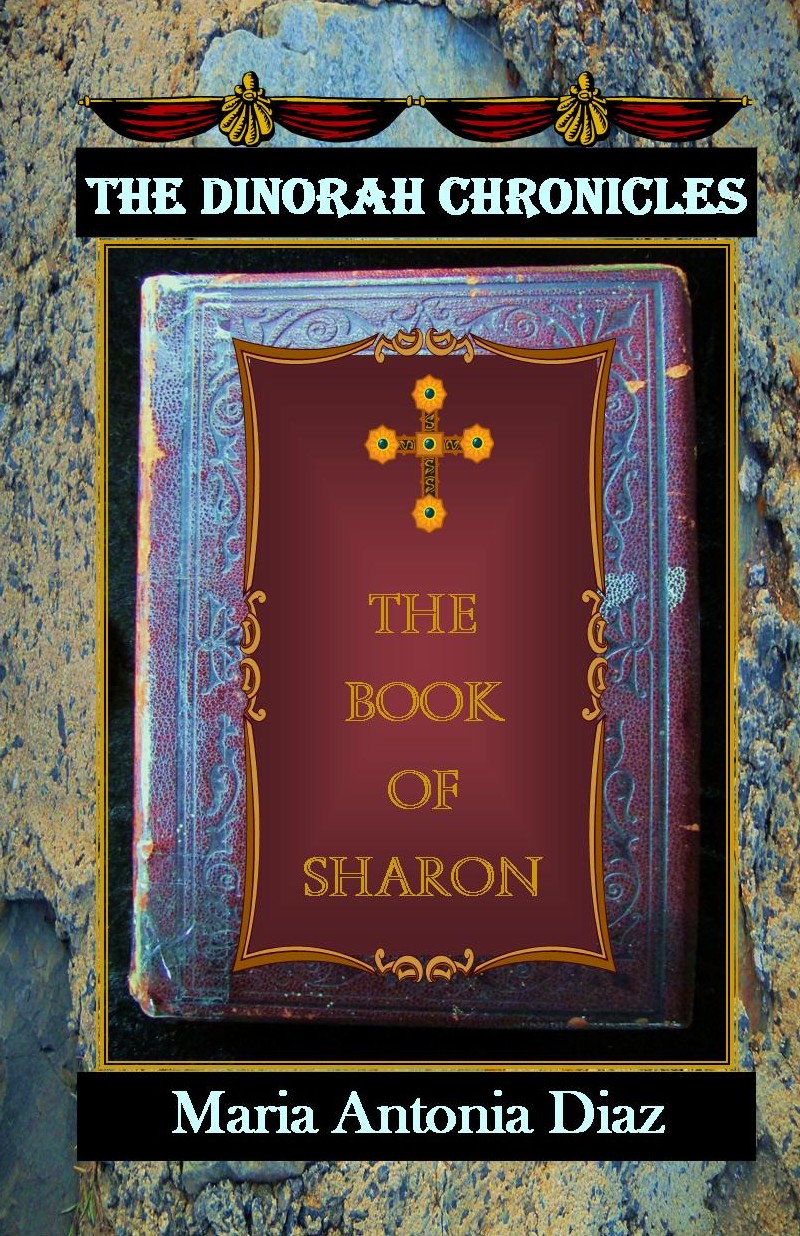
After I sorted all this out and emptied my scattered brain, I realized that I had to make a decision about The Book of Sharon, and that is to publish it as a novella, which suited best the story, and not follow the earlier pattern of my other books, which are novels. I listened to my gut, and decided to make it a novella. It will be available through Amazon and Createspace in a few days. In the meantime, I will give you a peak at the cover.


THE BOOK OF SHARON

THE BOOK OF SHARON

Dinorah Sandbeck, half-Human/half-Anarth, has been chosen to deliver a message, one entrusted to her by birthright. However, she must not reveal her Anarth ancestry. The pages contained in the ancient tome may alter the path of the human race.


The Book of Sharon follows a different style from the other two novels, and it was a bit of a challenge to write because it included Dinorah Sandbeck’s (main character and a writer/librarian) book, as well as pages from her old tome – an ancient book that guides her and that she must protect, but those had to be weaved in the story – the story I wrote. So there are three main components to this book, as well as three voices throughout – Dinorah’s, the ancient tome, and me. Think of it as a book inside a book inside a book. To help the flow of it, as well as the tone, I felt that making it a novella suited best the style. I am happy with the decision.

Food for thought – As an independent author, how do you cope with all the advice offered and the new trends developing? 


Discovering Themes in Your Novels – A Healing Process

I remember watching best-selling author Kate DiCamillo on an interview on YouTube, and something she said stuck with me. I don’t remember the exact words but it was about how sometimes in a more personal level, a novel is a healing process for the writer. At first glance, it may seem as a regular story but later, there might be symbolism in it that only the author will understand and recognize as personal issues that in a way, are healing/addressed through the story, whether past or present issues.

I thought about my novels and went in search of a deeper understanding. At first glance, the stories appear as pure creativity, and unrelated – just an inspired story. However, once I got beyond the written lines, a whole world of symbolism appeared in front of me. I understood what DiCamillo meant. I discovered healing through those pages, and much more. There was a part of me inside the story that only I could understand, and totally oblivious/secret to a reader. I am not saying that every novel I (or you) write will have encrypted meaning and be a healing vessel, but it is possible that somewhere along the line, it may happen. The mind is amazing and it finds a way.

If you are a writer, go back to one of your early stories and look at it beyond the written lines, go on a discovery mission, and pay attention at what comes to mind. It may surprise you and delight you as well. We write for ourselves as much as we write for the readers.

Time Lapse in Writing

Time is one of the trickiest subjects when writing a story. Not only does your world has to be convincing enough when writing fiction, the pass of time is something to keep in mind throughout the story. Depending on your story, you will have to keep track of the days that had gone by naturally, as the characters go about their lives – days, years, age, technology changes … It doesn’t matter if you are writing historical fiction or a modern romance, the pass of time is something to be aware of and keep track. If the protagonist went to work on Monday, and went to sleep that same day, but was meeting with someone on Wednesday, it would be unnatural to wake her up and take her to meet that person – where did Tuesday go? Another example is aging characters appropriately if the story demands it, as well as characters dealing with issues that are age related. In a series, time becomes tricky, and something to watch out for, as in the case of many years going by in the story, from the first book to the second book. You will have to age characters, but also technology in many cases. In addition, some people might not be able to come back because naturally they would be dead. I will use one of my novels as an example, and something I caught “on time” when writing it. It had to do with the pass of time – more than 20 years – and the mention of an aged character in the second book. In the first book, the character retained the title of Mayor, and referred to as Mayor Degan many times. In the second book, I caught myself referring to him as Mayor Degan, when he was at least 20 years older (no problem there, he was aged appropriately), however impossible to be retaining the title for that long. In my mind, the writer’s mind, he was still Mayor Degan, however I had to call him now by his name – Blake Degan. He was not even a character that interacted much throughout the story, but was a necessary one. Time affected even this character.

Supernatural characters might be able to play with time, but it still has to be mentioned in some way, as part of their condition, otherwise it might confuse the reader. Maybe they don’t age, or they can make themselves age according to time … somehow, the writer has to make this known to the reader.

Technology is another issue, not only in the topic of time, but on location as well. As an example, if internet connection is being used as part of the story, it is obvious that the internet speed is different in New York City than in a remote country location. These small details might not seem important, but they are.

The phrase “Time will tell” comes to mind.

Photo by M.A.D.

Photo by M.A.D.


After the Series – What Now?

What now? or What’s next? These are questions that I will answer after I write the last book of The Dinorah Chronicles series. At the moment, I’m ready to start the third re-write of The Book of Sharon, book 2 of the trilogy. If I’m lucky, I’ll have the first draft of Sunrise Souls ready by the end of the year (9 months left). What have I learned?

Moonlit Valley inspired the writing of The Dinorah Chronicles. I never intended to write a series, but it developed as a natural process, so I let it be. I have found that writing a series gives me a bit of comfort in the sense that I am navigating known territory, as opposed to writing a new story. However, I have to admit that I enjoy the process of writing a single story more than writing a series. I never say never, but I think that in the future, I will focus on single stories rather than writing a series (unless I’m inspired otherwise). This took me to ask, What’s next? The answer is not as simple as I thought.

As an indie author, I have the flexibility to do pretty much what I desire. I don’t have contracts to fulfill, or lined up books/deadlines, or commitments abroad. The deadlines are the ones I imposed on myself. My commitment is to the story and to the reader. When I asked myself – What’s next? – I understood that many roads were right in front of me, and the one I take is not so clear yet. Why?

The writing industry changed so much in the last few years, and as an independent author, I need to balance my energy and efforts. It means that I do all the work, and any assistance hired is tied to funds available (if any). Also, it means that it does not make sense to follow trends if I don’t love the process. So naturally, my attention will hover around those projects that I am ready for and will enjoy. These days, the speed of publishing and everything else that surrounds it has multiplied, and indie authors are bombarded with many choices and possible projects that they might feel obligated to undertake to follow the developing industry and current trends – podcasts, audio book, channels, speaking/teaching engagements, the translation of their books, and many other endeavors. I admire indie authors who have the energy and focus to have many of those endeavors developing at once; I called them the Super Indies. They are an inspiration.

All the above considered, I sat down with pen and paper at hand, and thought hard about where I am on my journey, and tried to answer the question (now). I felt that my next natural step (after finishing the series)  would be to write a new single story, and focus on the Spanish translation of my first book, and possibly the series. Any other components of marketing books, gaining exposure, or other writing-related projects will be assigned secondary status (as far as focus and effort). This is a prelude, a peek, an early answer to my question, but of course, it all may change. What’s important is that I challenged myself to think about it and took a glance at the possibilities. It also helped me measure my level of readiness according to where I am on my journey. It was worth considering.

As an indie author, how do you feel about balancing current trends and your own journey?

photo by Maria Antonia Diaz

photo by Maria Antonia Diaz


On Faith and Writing

When I read poetry I notice one thing, the poem is sad/dark, almost as if it bleeds through the page, or on the other hand, it celebrates life, is an exaltation of nature or love, or whatever the subject seems to be, therefore transmitting a peaceful or joyful vibe through the page. It seems as if a tormented soul or a happy one wrote the lines, although that is not necessarily true.

Ernest Hemingway once said,”There is nothing to writing. All you do is sit down at a typewriter and bleed.” Maybe he was right, but what comes out of your veins? What do you bleed? I have found that for me, inspiration may come from nowhere, unexpected, and sometimes, it is directly influenced by my mood. I’ve noticed that when my faith dwindles, so does my writing. It is when my faith is up that I do my best writing, whether I may be going through a difficult situation or not. By faith I don’t mean religion, but my disposition to believe and trust. That said, I can predict when my motivation will suffer, and when my writing will lack. How to prevent this?

The answer is not so much to prevent, because life is full of ups and downs – it is human life’s nature. Instead, maintaining a conscious positive and high disposition (with effort and despite the circumstances) is what seems to help. I must keep up a high level of trust and frequency to support the flow of my writing, otherwise, it becomes forced, superficial, and dense. So my writing seems to be tied to my faith.

“I learned never to empty the well of my writing, but always to stop when there was still something there in the deep part of the well, and let it refill at night from the springs that fed it.” Ernest Hemingway

Heartless Dissection Ready

I hope I didn’t scare you with the title of this post. Almost a month has gone by since I put aside the first draft of The Book of Sharon. The time away is necessary for what comes next – a heartless dissection of it, and I’m ready.

As writers, we pour our heart and soul into our work, then the time comes to forget about it, followed by a cold stare before we are ready to slash it into pieces – heartless and purposely, not an easy thing to do but necessary. From this dismemberment a second draft is assembled. The process goes on until the story is as ready as it can be.

During this time, emotions run wild – from doubt, insecurity, uncertainty, and not wanting to let go, to perfectionism, pride, fear, doubt again, restlessness, exhilaration, incessant questioning … all of it culminating in exhaustion, and all of it necessary. Sounds painful and not too enticing, but it is what writers subject themselves to repeteadly, and beyond scrupulous consideration, and all for the love of the story.

A love affair with words, a crime of passion?


My next victim.

First draft of The Book of Sharon

First draft of The Book of Sharon

A Happy Coincidence

Sometimes, writing takes life on its own. With my first novel, Moonlit Valley, I felt as if the story wrote itself. The characters presented themselves, and I dare to say, named themselves. The writing process is different for everyone, and I have to say that I enjoyed the writing of that first novel; it was an adventure. After a while, I went back and looked at it with different eyes. I found symbolism in it, and a happy coincidence with some of the character’s names. When I looked at the common meaning of their names, what I found intrigued me and excited me. The meaning match the character in an almost eerie coincidence; it is how I imagined them. Here are a few of the names. If you read Moonlit Valley, you will understand what I mean.

  • Jeremy = God will uplift
  • Rose = Flower
  • Cole Angelou = Victorious + Angel
  • Lara = Cheerful
  • Hael = Immense/living in hall
  • Dinorah = Judgement
  • Leah = Weary
  • Olga = Holy
  • Anne = Gracious
  • Maurice = Dark skinned (I imagined this character tall and dark)
  • Jake = Pale/supplanter
  • Robert (town’s mayor) = Famous (of importance)

I found very amusing the coincidence of the meaning matching the characters and my idea of them. After all, writing is a very profound and spiritual endeavor, an act of letting go, of listening, and of invention and communion between writer and characters/story.

moonlit-valley-coverfrontnew.jpg


The Book of Sharon – Update

First draft of The Book of Sharon

First draft of The Book of Sharon

There it is, the first draft of The Book of Sharon. I met my goal. Now, I will put it to sleep for a few weeks, so I can revisit it with fresh eyes to start the editing process. It will get fatter, smaller, skinnier, fat again, until it feels just right, and hopefully, see the light by the end of the first quarter of this year.  After this one, I need a mental vacation. It feels good to have written it, and now the fun begins.

When Inspiration is Not Enough

Cloud

Cloud (Photo credit: Wikipedia)

Many times, I have heard that inspiration is all around us, and may show up unexpected, can come from anywhere because it is everywhere; I’ ve even written about it on this blog. However, I have found that sometimes, inspiration is not enough. How come?

For me, it happens when despite being inspired, the writing presents a challenge. I know what I have to write, or I had written it, but deep inside I have trouble dealing with it – more of a spiritual denial, I think. It is on these instances that I have to step it up a bit, and connect spiritually with my work. It helps me understand my human limitations. It helps me view the overall picture and understand why I have written it, and at the same time understand my perception of it/my conflict. This is happening now when I am writing The Book of Sharon, and another reason why it has been a challenging novel. Sometimes, I’ve had to take a few days between chapters to reconnect with the book (on purpose) and stop fighting my own limitations. I am thinking that because of this, editing will be as challenging or more when time comes.

As individuals, we have our own ways to reconnect spiritually, recharge our batteries, and try to gain a deeper understanding of our work and of the world that surrounds us. For me, prayer/meditation, contemplating nature, awareness of the moment, among other things, help with this. One thing I know for sure is not to ignore when inspiration is not enough. By taking the necessary time to do this, I think that we help and authenticate the process.